
Navigation
Install the app
How to install the app on iOS
Follow along with the video below to see how to install our site as a web app on your home screen.
Note: This feature may not be available in some browsers.
More options
-
⚠️ Price Increase Alert: Lock in Current Pricing before 5/1
Due to rising costs, Supporting Membership prices for new subscriptions increase on May 1st. Join now and your rate will never go up as long as your subscription remains active.
Supporting Members gain instant access to:See Exactly Where You Stand with the NEW Interactive Scattergram
Visualize your realistic chances in real time. Plot your GPA + Film Experience against 5,000+ real applications and instantly see how you compare. Hover for full application details. This data-driven visual tool is something no other public film school site offers.Full Access to 5,000+ Logged Applications + 45 Exclusive Charts
Browse every logged application to see what actually worked for others. Plus deep program statistics including acceptance rates by demographics, experience level, portfolio strength, waitlist movement, scholarship data, reapplication success, and much more...Exclusive Bonus Interviews & Insider Advice
In-depth conversations and insights from admissions teams at top programs including AFI, Chapman, FSU, NFTS, USC, and others...Instant Keyword Alerts
Create a list of keywords like "AFI", "USC", or "Screenwriting" and get real-time updates when new content is posted.Visible Supporter Badge & Highlighted Profile
Show your support with a Supporter banner and bold username across the site.Shared Subscription
Share your membership benefits with one family member or close friend.
Read more about this pricing change.
You are using an out of date browser. It may not display this or other websites correctly.
You should upgrade or use an alternative browser.
You should upgrade or use an alternative browser.
Latest Film School Reviews

Reviewed by:
Alumni
Degree: Other
Degree: Other
Took an online 10-week course for Feature Film 1. In this class, you learn the basics of story structure, analyze scripts, and start working on a draft of your own screenplay. Very much like a writer's group with weekly assignments and reviewing each other's work.
Great instructor, she was very knowledgable and works in the industry, but obviously the class is filled with people of all skill levels so the feedback from peers wasn't always super useful. It was a lot of "this is really good! I enjoyed reading it!" but not a ton of actionable feedback. Though there were also more advanced writers in there too that did provide better feedback.
Great instructor, she was very knowledgable and works in the industry, but obviously the class is filled with people of all skill levels so the feedback from peers wasn't always super useful. It was a lot of "this is really good! I enjoyed reading it!" but not a ton of actionable feedback. Though there were also more advanced writers in there too that did provide better feedback.
- Affordability
- 4.00 star(s)
- Coursework
- 4.00 star(s)
- Professors
- 4.00 star(s)
Anonymous recommends this film school
One member found this helpful.


Reviewed by:
Alumni
Degree: Other
Degree: Other
Pros
- Only MBA in Australia focussing on media business
- Usual group contacts (minor network as AFTRS is poor at alumni)
- High level guest speakers / mentors as the Aus national film school
- Flexible fulltime attendance in blocks around holidays for working folks
- Good if you have a strong media startup idea already. Doubtful otherwise.
- AFTRS has high reputation mostly undeserved since the early first generations Campion, Noyce, Beresford etc excelled but mediocre results since.
Cons
- Chaotic organization. Course changed structure three times in two years with no consultation or warning.
- Organization more interested in social justice issues than filmmaking
- Few instructors (mostly technical) were excellent most were failed filmmakers or professional government media bureaucrats
- MSAB almost unknown as relatively new and AFTRS just graduates and frogets.
- AFTRS Alumni efforts are sites where they post propaganda and kick alumini off if you actually start using the tools they provide . No joke.
MSAB is the Schools only 'adult' course as the Head admitted to us.
It also runs intermittently and seems to be an experimental exercise by those in charge. First meeting half the class quit as they were told the promised mixed attendance (evening / weekends / holidays) had been changed without warning to fulltime blocks around school holidays. As several people had come interstate and changed work situations etc no one was impressed.
They also changed the structure again in the next semester and at the start of the next year (2 year program) without consulting or any warning again. Each time seemed astonished that students lives were impacted - every permanent staff member seemed to be a career arts bureaucrat and have zero empathy with working folks.
Structure was a standard MBA with coursework around Business planning , finances and management. Strategy and marketing. Entrepreneurship and design thinking. Some useful options on Public Policy and Growth and Change management for a growing startup.
Strengths were a stream of visiting heads of studios, tv networks, production houses and senior media public servants who provided real world pragmatism cold water to the startup magic vibe. Also some inspiring innovators in the space (and an equal amount of less inspiring friends of staff members who spouted theory as their practical experience was obviously thin).
Also a class trip to Singapore to study a large animation studio and visit their film board etc for a week or so was valuable and fun.
The small class size (as half never came back after the first encounter) made for a tight group. Several have moved on to senior roles in the national film bodies and broadcaster and several of the other startups seem to be growing but no breakouts I've heard of.
There was much talk of alumni networks and follow up but it equalled less than nothing as when some of us started using the vaunted alumni network to communicate about media projects we got kicked off for overposting. As far as I can work out it merely exists for the school to post marketing to alumni and recruit them for events.
If you want to a business qualification in film particularly with the aim of senior management in a government film body this is the course for you. Helps if you are a diverse minority - AFTRS ran around in circles for this group.
Also if you have a business idea in the media space this gives you a couple of years to develop and document it.
Otherwise I'm not sure what point it would be.
This is a fully funded government course and a fraction of the cost of other MBAs for some reason. In Australia you can pay back student loans as your income grows so its not every onerous and frankly if you don't want to you dont have to unless you're that successful you cant hide your obligation.
Unlike the US its just not a large issue.
It also runs intermittently and seems to be an experimental exercise by those in charge. First meeting half the class quit as they were told the promised mixed attendance (evening / weekends / holidays) had been changed without warning to fulltime blocks around school holidays. As several people had come interstate and changed work situations etc no one was impressed.
They also changed the structure again in the next semester and at the start of the next year (2 year program) without consulting or any warning again. Each time seemed astonished that students lives were impacted - every permanent staff member seemed to be a career arts bureaucrat and have zero empathy with working folks.
Structure was a standard MBA with coursework around Business planning , finances and management. Strategy and marketing. Entrepreneurship and design thinking. Some useful options on Public Policy and Growth and Change management for a growing startup.
Strengths were a stream of visiting heads of studios, tv networks, production houses and senior media public servants who provided real world pragmatism cold water to the startup magic vibe. Also some inspiring innovators in the space (and an equal amount of less inspiring friends of staff members who spouted theory as their practical experience was obviously thin).
Also a class trip to Singapore to study a large animation studio and visit their film board etc for a week or so was valuable and fun.
The small class size (as half never came back after the first encounter) made for a tight group. Several have moved on to senior roles in the national film bodies and broadcaster and several of the other startups seem to be growing but no breakouts I've heard of.
There was much talk of alumni networks and follow up but it equalled less than nothing as when some of us started using the vaunted alumni network to communicate about media projects we got kicked off for overposting. As far as I can work out it merely exists for the school to post marketing to alumni and recruit them for events.
If you want to a business qualification in film particularly with the aim of senior management in a government film body this is the course for you. Helps if you are a diverse minority - AFTRS ran around in circles for this group.
Also if you have a business idea in the media space this gives you a couple of years to develop and document it.
Otherwise I'm not sure what point it would be.
This is a fully funded government course and a fraction of the cost of other MBAs for some reason. In Australia you can pay back student loans as your income grows so its not every onerous and frankly if you don't want to you dont have to unless you're that successful you cant hide your obligation.
Unlike the US its just not a large issue.
- Affordability
- 5.00 star(s)
- Alumni Network
- 3.00 star(s)
- Campus
- 5.00 star(s)
- Career Assistance
- 1.00 star(s)
- Coursework
- 4.00 star(s)
- Facilities & Equipment
- 5.00 star(s)
- Professors
- 3.00 star(s)
- Scholarships
- 4.00 star(s)
Anonymous is undecided about recommending this film school

Reviewed by:
Alumni
Degree: BA/BS/BFA
Concentration: Digital Filmmaking
Degree: BA/BS/BFA
Concentration: Digital Filmmaking
Pros
- Dedicated and knowledgeable Instructors
- Hands on experience with television/short film production
- Excellent instruction on fundamentals
- No formal "Film School" application process
Cons
- Inconsistencies regarding Pre-requisites
- Limited equipment
- Inconsistent with curriculum
Some good and some not-so-good with this program.
The Good: The Digital Filmmaking and Media studies track offers students the opportunity to gain real hands-on experience. There are several classes for the production of "The Bluffs", which is a serialized program created as a television show. There is a writing workshop for the new "Season" each Spring, a Production class the following Fall, and then and Editing and Post-production course the following Spring semester, with the final finished season presented at the conclusion of the Spring semester. UCCS also has some really amazing and talented professors who are really passionate about the craft of filmmaking. The Film Production capstone course allows EVERY student the opportunity to create a short film. The course is designed in such a way that each student is responsible for the entirety of the Pre-Production (creating a script, posting casting calls, holding auditions), Production (including shot lists, securing talent releases/waivers, crewing their productions with DP, 1stAD, 1stAc, 2ndAC, Gaffer, Sound Recordist etc.) and Post-Production (editing, color correction, etc.) for their short film projects.
The Not-So-Good: There are definitely instances where the curriculum isn't consistent from one instructor to another. The most glaring instance is the Screenwriting course. I had a wonderful (but tough) professor who emphasized the fundamentals but I know plenty of other students whose professor treated it like a high school creative writing course with no focus on structure or formatting. The department didn't really do a lot to enforce pre-requisites and as a result, we had a number of students in upper-division courses (Directing for Film and Television, for example) who had never even learned the basics. I even know of a student that was in the capstone film production course who was also taking their Intro to Film class at the same time. This led to a great disparity in terms of the knowledge and experience levels between the students in upper division courses.
Something to note... the Digital Filmmaking track falls under the Communication major. There is no formal "Film School" that you need to apply to. If you are admitted to UCCS as a Communication major, you can choose the Digital Filmmaking track.
The Good: The Digital Filmmaking and Media studies track offers students the opportunity to gain real hands-on experience. There are several classes for the production of "The Bluffs", which is a serialized program created as a television show. There is a writing workshop for the new "Season" each Spring, a Production class the following Fall, and then and Editing and Post-production course the following Spring semester, with the final finished season presented at the conclusion of the Spring semester. UCCS also has some really amazing and talented professors who are really passionate about the craft of filmmaking. The Film Production capstone course allows EVERY student the opportunity to create a short film. The course is designed in such a way that each student is responsible for the entirety of the Pre-Production (creating a script, posting casting calls, holding auditions), Production (including shot lists, securing talent releases/waivers, crewing their productions with DP, 1stAD, 1stAc, 2ndAC, Gaffer, Sound Recordist etc.) and Post-Production (editing, color correction, etc.) for their short film projects.
The Not-So-Good: There are definitely instances where the curriculum isn't consistent from one instructor to another. The most glaring instance is the Screenwriting course. I had a wonderful (but tough) professor who emphasized the fundamentals but I know plenty of other students whose professor treated it like a high school creative writing course with no focus on structure or formatting. The department didn't really do a lot to enforce pre-requisites and as a result, we had a number of students in upper-division courses (Directing for Film and Television, for example) who had never even learned the basics. I even know of a student that was in the capstone film production course who was also taking their Intro to Film class at the same time. This led to a great disparity in terms of the knowledge and experience levels between the students in upper division courses.
Something to note... the Digital Filmmaking track falls under the Communication major. There is no formal "Film School" that you need to apply to. If you are admitted to UCCS as a Communication major, you can choose the Digital Filmmaking track.
- Affordability
- 4.00 star(s)
- Alumni Network
- 2.00 star(s)
- Campus
- 5.00 star(s)
- Career Assistance
- 2.00 star(s)
- Coursework
- 4.00 star(s)
- Facilities & Equipment
- 3.00 star(s)
- Professors
- 4.00 star(s)
- Scholarships
- 3.00 star(s)
Anonymous recommends this film school
One member found this helpful.
Last edited:

Reviewed by:
Alumni
Degree: BA/BS/BFA
Concentration: Animation
Degree: BA/BS/BFA
Concentration: Animation
Pros
- Some good faculty
- Nice location
- Opportunities for certain students
Cons
- Cliquey students and faculty
- Unnecessary Limitations on space and equipment
- High adjunct faculty usage
I went to DePaul for animation, but was heavily involved in the cinema production crowd due to my partner attending the Direction MFA. I would say generally the animation program is good, but you only get what you give. Certain faculty are extremely good and caring while some of the more hyped up faculty who’ve worked in the industry while talented may not be the best at educating students.
In terms of what they market with cinespace and cameras it is relatively fraudulent. You may have some classes there and with the advanced equipment, but if you try to use it for productions for classes you will face roadblocks. The faculty in charge of the studios are extremely clique-y with students and will actively shut you out of facilities if they don’t like you. I’ve experienced reservations for thesis projects being changed to accommodate undergrad regular class projects at camera pickup with no warning and had sound stages cancelled without reason given. You can only make PD changes to the stages if you are tight with the head of the cinespace facilities. Faculty will not give you recommendations for VFX or Production Design students if you ask and are not personal friends with them.
Overall many members of the cinema faculty feel like they joined DePaul to exploit student resources for their own gain. They will tell you if you want recommendations for students that you have to name a price to pay while simultaneously trying to get you to work on their projects for free.
While there I witnessed them shuttle in female and BIPOC students and faculty (even those not in SCA) for photo ops and videos to increase the appearance of diversity in the program marketing materials.
I hope that progress has been made here, but to a certain degree I doubt it since many of the best faculty have moved to other universities while the worst offenders still work there.
Many of the courses in animation were taught by adjuncts who did their undergrad at DePaul. Typically these classes would then just be you teaching yourself a new program or using Lynda.com courses while the adjunct would either do outside work or not show up.
The best thing about the university is the peers you will meet. Some may be standoffish and form cliques with faculty but most are very cool and down to earth. While there I had the pleasure of working with and knowing students who’ve gone on to win Jury Prizes at Slamdance and Sundance.
Lastly, there is virtually no assistance placing students in internships. While there is an internship/experiential learning requirement it is up to you to fulfill this. If you cannot they will try to place you in a week long study abroad trip to fulfill the requirement.
Overall, I would say that this is an okay program especially the animation major. You will learn but only get what you give in terms of portfolio development. I would be more leery to recommend the cinema program given the extreme faculty dysfunction. However, you will learn the basics if you buckle in and grit your teeth at the less than savory dealings.
Scholarships if you receive one can be quite generous though living costs are high.
In terms of what they market with cinespace and cameras it is relatively fraudulent. You may have some classes there and with the advanced equipment, but if you try to use it for productions for classes you will face roadblocks. The faculty in charge of the studios are extremely clique-y with students and will actively shut you out of facilities if they don’t like you. I’ve experienced reservations for thesis projects being changed to accommodate undergrad regular class projects at camera pickup with no warning and had sound stages cancelled without reason given. You can only make PD changes to the stages if you are tight with the head of the cinespace facilities. Faculty will not give you recommendations for VFX or Production Design students if you ask and are not personal friends with them.
Overall many members of the cinema faculty feel like they joined DePaul to exploit student resources for their own gain. They will tell you if you want recommendations for students that you have to name a price to pay while simultaneously trying to get you to work on their projects for free.
While there I witnessed them shuttle in female and BIPOC students and faculty (even those not in SCA) for photo ops and videos to increase the appearance of diversity in the program marketing materials.
I hope that progress has been made here, but to a certain degree I doubt it since many of the best faculty have moved to other universities while the worst offenders still work there.
Many of the courses in animation were taught by adjuncts who did their undergrad at DePaul. Typically these classes would then just be you teaching yourself a new program or using Lynda.com courses while the adjunct would either do outside work or not show up.
The best thing about the university is the peers you will meet. Some may be standoffish and form cliques with faculty but most are very cool and down to earth. While there I had the pleasure of working with and knowing students who’ve gone on to win Jury Prizes at Slamdance and Sundance.
Lastly, there is virtually no assistance placing students in internships. While there is an internship/experiential learning requirement it is up to you to fulfill this. If you cannot they will try to place you in a week long study abroad trip to fulfill the requirement.
Overall, I would say that this is an okay program especially the animation major. You will learn but only get what you give in terms of portfolio development. I would be more leery to recommend the cinema program given the extreme faculty dysfunction. However, you will learn the basics if you buckle in and grit your teeth at the less than savory dealings.
Scholarships if you receive one can be quite generous though living costs are high.
- Affordability
- 3.00 star(s)
- Alumni Network
- 1.00 star(s)
- Campus
- 3.00 star(s)
- Career Assistance
- 1.00 star(s)
- Coursework
- 3.00 star(s)
- Facilities & Equipment
- 2.00 star(s)
- Professors
- 2.00 star(s)
- Scholarships
- 4.00 star(s)
Anonymous is undecided about recommending this film school


- jkosmacki
- 5.00 star(s)
- Reaction score: 1
Reviewed by:
Current Student
Degree: MA/MFA
Concentration: Directing
Degree: MA/MFA
Concentration: Directing
Pros
- Supportive and diverse community
- Fantastic equipment and facilities
- Well-connected networks
- Variety of disciplines
Cons
- CUNY provides inadequate administrative/financial help
The Feirstein School is a huge up-and-comer, a nascent program that will come to rival the top schools in coming years. Their equipment inventory, soundstages, and range of production and post-production facilities, including construction shop, FOLEY studios, many editing bays, motion capture, professional sound studios, not only give filmmakers a wealth of tools to make professional films, there is also the necessary staff, faculty, courses, and students to make full use of the facilities. Many of the professors also teach at other top film schools, mainly NYU and Columbia, as well as Pratt and others, so you're getting the same professor for a fraction of the cost. Another super important thing is the culture at the school, which is very much built around community, collaboration, and support. The refreshing lack of ego and competitiveness makes it a particularly good environment to learn and practice the craft of filmmaking. They also offer screenings, Q&As, workshops, and other such events that bring in members of industry on a regular basis. In addition, the school has a solid advisory council with mentors for students' thesis projects, including such names as Stephen Soderbergh, Ethan Hawke, John Turturro, and Darren Aronofsky. Far and away, Feirstein is the best film school you might never have heard of. But in ten to fifteen years, they'll be talked about in the same breath as Columbia, Emerson, UT Austin, and UCLA.
- Affordability
- 5.00 star(s)
- Alumni Network
- 4.00 star(s)
- Campus
- 5.00 star(s)
- Career Assistance
- 4.00 star(s)
- Coursework
- 4.00 star(s)
- Facilities & Equipment
- 5.00 star(s)
- Professors
- 5.00 star(s)
- Scholarships
- 3.00 star(s)
jkosmacki recommends this film school
2 members found this helpful.

Reviewed by:
Current Student
Degree: Certificate
Concentration: Foundation in Visual Art and Design - Film Production Stream
Degree: Certificate
Concentration: Foundation in Visual Art and Design - Film Production Stream
Pros
- Community
- Some of the equipment and facilities
- Central location in Vancouver
Cons
- Lack of resources
- Price
I've heard Vancouver Film School (VFS) be referred to as a "puppy mill" and I think that's an apt analogy. They have a new intake of students every two months and it does, at times, feel like they're just trying to get as much money as possible. The resources at our disposal were not amazing; computers didn't always work, art supplies were old, camera equipment and lights we had access to were outdated.
I was in the Foundation in Visual Art and Design program which is probably the program the school cares least about. The actual Film Production program receives more attention, funding, and resources.
I think VFS gives you a good basic understanding of film production. Is it worth the tuition? I'm not sure. It also really depends on who your classmates are since these are the people you will be working with. People who had good experiences also had good cohorts, whereas others did not like their classmates had subpar experiences.
Foundation in Visual Art and Design is a unique program. I tried finding similar ones in North America and Europe and couldn't find much. It gives you a taste of the lens-based and digital art world. If you're not sure what you want to do, this is a good program to figure it out. The teachers were, on the whole, pretty good. There were some which weren't that great. They can offer connections in the industry and good advice. I got work on set through some teachers.
The program helped me a lot in figuring out what I wanted and I was able to fund it myself without taking out loans.
Overall, kind of a mixed bag.
If you're between VFS and another film school, I would probably go with the other film school.
I was in the Foundation in Visual Art and Design program which is probably the program the school cares least about. The actual Film Production program receives more attention, funding, and resources.
I think VFS gives you a good basic understanding of film production. Is it worth the tuition? I'm not sure. It also really depends on who your classmates are since these are the people you will be working with. People who had good experiences also had good cohorts, whereas others did not like their classmates had subpar experiences.
Foundation in Visual Art and Design is a unique program. I tried finding similar ones in North America and Europe and couldn't find much. It gives you a taste of the lens-based and digital art world. If you're not sure what you want to do, this is a good program to figure it out. The teachers were, on the whole, pretty good. There were some which weren't that great. They can offer connections in the industry and good advice. I got work on set through some teachers.
The program helped me a lot in figuring out what I wanted and I was able to fund it myself without taking out loans.
Overall, kind of a mixed bag.
If you're between VFS and another film school, I would probably go with the other film school.
- Affordability
- 2.00 star(s)
- Alumni Network
- 4.00 star(s)
- Campus
- 3.00 star(s)
- Career Assistance
- 2.00 star(s)
- Coursework
- 4.00 star(s)
- Facilities & Equipment
- 3.00 star(s)
- Professors
- 3.00 star(s)
- Scholarships
- 2.00 star(s)
Anonymous is undecided about recommending this film school
One member found this helpful.

- finnmanjohn
- 5.00 star(s)
Reviewed by:
Alumni
Degree: Certificate
Concentration: Film Production
Degree: Certificate
Concentration: Film Production
Rome International Film School was life-changing for me. I not only learned every aspect of the film making process, but I created strong bonds with classmates and faculty from all over the world. Exposure to these other perspectives on film, art, and culture has enriched my storytelling abilities and deepened my understanding of humanity. Furthermore, we students had round the clock access to top-tier camera and sound equipment, which created the atmosphere of a professional production house. Teachers were attentive and gave expert feedback based on their years of filmmaking experience. I can’t recommend RIFS more highly.

- fin_cinema
- 2.00 star(s)
Reviewed by:
Current Student
Degree: MA/MFA
Concentration: Film & TV Directing
Degree: MA/MFA
Concentration: Film & TV Directing
Pros
- Affordable tuition (with scholarship)
Cons
- False advertising re: length of program, coursework, expenses
- Consistent miscommunication re: school policy
- Severely limited resources for grad students
- Demotivating/confrontational faculty & staff
- Zero financial support for film productions
The general attitude towards MFA film students at Columbia is antagonistic and confrontational. A lot of incoming students have no prior filmmaking knowledge, but some like myself have at least a couple years of professional experience. Yet all of us are treated as completely inept, naive, or even dangerous. In our first semester, the (now-ex) department chair sat us all down in an auditorium and told us we're not even here to make films. "You're making exercises, I don't know why you keep calling them films." What an incredibly demotivating atmosphere at 1104 S Wabash. I didn't realize I was spending thousands of dollars a semester for exercise school.
I was part of the first cohort to resume in-person learning for Columbia's MFA Directing program. This made us "guinea pigs" (the same ex-dept chair's words) in a supposedly restructured curriculum that aimed to create a sweeping blanket of introductory film knowledge. 1 sound class. 1 lighting class. Film theory 101. This strict curriculum also prevents grad students from being "qualified" to use any of the school's facilities in sound, lighting, cinematography etc. A former peer hoping to become a cinematographer was told directly "You came to the wrong place." They dropped out after the first semester. Instead of being equipped with hands-on knowledge and skills for our films, you are forced to seek out undergraduates who are trained in specific programs to use equipment/facilities, and MAYBE they'll work with you if they're not already swamped with their own work.
Undergraduates are given priority over everything, including equipment, facilities, even time/attention from the faculty. There's one networking mixer each semester and that's it. You're on your own. It makes total sense that the school doesn't want inexperienced students damaging expensive equipment or something, but at least give eager students the opportunity to learn about these things, or better yet, why not INCLUDE specified electives in the grad curriculum so we aren't discouraged from achieving our goals? Seriously. I am a 30 year old man who has been gaslit and talked down to like a child for the last 2.5 years for WANTING TO LEARN MORE.
If I could do it all over again, I certainly would not come to Columbia College Chicago and would absolutely re-think putting personal savings into graduate school for an MFA film degree at all. It is simply not necessary to find work in the film industry. If you're considering grad film schools, you should know exactly why you are entering a particular MFA program (location, facilities, networking) or you will likely end your time here frustrated and unfulfilled. I've left this school feeling far less inclined to even participate in the film industry than when I began, with only a couple "exercises" to show for it
I was part of the first cohort to resume in-person learning for Columbia's MFA Directing program. This made us "guinea pigs" (the same ex-dept chair's words) in a supposedly restructured curriculum that aimed to create a sweeping blanket of introductory film knowledge. 1 sound class. 1 lighting class. Film theory 101. This strict curriculum also prevents grad students from being "qualified" to use any of the school's facilities in sound, lighting, cinematography etc. A former peer hoping to become a cinematographer was told directly "You came to the wrong place." They dropped out after the first semester. Instead of being equipped with hands-on knowledge and skills for our films, you are forced to seek out undergraduates who are trained in specific programs to use equipment/facilities, and MAYBE they'll work with you if they're not already swamped with their own work.
Undergraduates are given priority over everything, including equipment, facilities, even time/attention from the faculty. There's one networking mixer each semester and that's it. You're on your own. It makes total sense that the school doesn't want inexperienced students damaging expensive equipment or something, but at least give eager students the opportunity to learn about these things, or better yet, why not INCLUDE specified electives in the grad curriculum so we aren't discouraged from achieving our goals? Seriously. I am a 30 year old man who has been gaslit and talked down to like a child for the last 2.5 years for WANTING TO LEARN MORE.
If I could do it all over again, I certainly would not come to Columbia College Chicago and would absolutely re-think putting personal savings into graduate school for an MFA film degree at all. It is simply not necessary to find work in the film industry. If you're considering grad film schools, you should know exactly why you are entering a particular MFA program (location, facilities, networking) or you will likely end your time here frustrated and unfulfilled. I've left this school feeling far less inclined to even participate in the film industry than when I began, with only a couple "exercises" to show for it
- Affordability
- 4.00 star(s)
- Alumni Network
- 3.00 star(s)
- Campus
- 2.00 star(s)
- Career Assistance
- 2.00 star(s)
- Coursework
- 2.00 star(s)
- Facilities & Equipment
- 1.00 star(s)
- Professors
- 3.00 star(s)
- Scholarships
- 4.00 star(s)
fin_cinema does not recommend this film school!
One member found this helpful.
Last edited:
- dingoatemybaby
- 1.00 star(s)
- Reaction score: 1
Reviewed by:
Alumni
Degree: MA/MFA
Concentration: Cinematography
Degree: MA/MFA
Concentration: Cinematography
Pros
- Cheap-ish, sort of convenient location, sort of new equipment
Cons
- Cheap, poor leadership, no career prep, haphazard and unorganized, unhappy staff
If you're a director you will be treated like a brilliant golden child whose story must be told, and have to do very little actual work/labor. You'll watch criterion movies and wax poetic about meaning and probably get into heated arguments about race/class.
All the other tracks (Cinematography, writing, etc) are set up to serve the directors. Essentially you are paying to work for free on student films. If you're lucky, maybe it will be a good one. And you get some glorious demo reel footage.
When I was there, we had no actual head of the cinematography department, teachers would show up late, with no plan for the class session, and basically wing it. They'd ask us "well, what do you wanna do? Wanna play with some lights?" Other teachers were arrogant and worked on one movie like 30 years ago. A handful were actively working in the industry, and therefore, their time at feirstein is a side-gig. Not so important to them. Understandable.
Also, getting gear and using the studios are a massive hassle.
Some of the admins are fine, but most are, in a classic hollywood/film world fashion experts at talking but not doing. Evasive and not accountable.
For a film school it's cheap, but considering you leave with basically nothing, it's very expensive. If you have money and time to burn, or a supportive partner/family that funds your life, it can be a fine way to spend 3 years playing around.
If you don't have have money or support, as in, you are a real person who works and pays to live in NYC, it's much much more difficult to make this work. And you will go into a lot of debt for this dream. So it's not really a place for poor people, to put it bluntly. Despite what their marketing may lead you to think.
If you really want to work on film sets, you're better off just doing that, starting as a PA or camera assistant, etc. If you want to make movies, shoot them on your phone. Because that's what you will do after spending 3 years here anyway.
All the other tracks (Cinematography, writing, etc) are set up to serve the directors. Essentially you are paying to work for free on student films. If you're lucky, maybe it will be a good one. And you get some glorious demo reel footage.
When I was there, we had no actual head of the cinematography department, teachers would show up late, with no plan for the class session, and basically wing it. They'd ask us "well, what do you wanna do? Wanna play with some lights?" Other teachers were arrogant and worked on one movie like 30 years ago. A handful were actively working in the industry, and therefore, their time at feirstein is a side-gig. Not so important to them. Understandable.
Also, getting gear and using the studios are a massive hassle.
Some of the admins are fine, but most are, in a classic hollywood/film world fashion experts at talking but not doing. Evasive and not accountable.
For a film school it's cheap, but considering you leave with basically nothing, it's very expensive. If you have money and time to burn, or a supportive partner/family that funds your life, it can be a fine way to spend 3 years playing around.
If you don't have have money or support, as in, you are a real person who works and pays to live in NYC, it's much much more difficult to make this work. And you will go into a lot of debt for this dream. So it's not really a place for poor people, to put it bluntly. Despite what their marketing may lead you to think.
If you really want to work on film sets, you're better off just doing that, starting as a PA or camera assistant, etc. If you want to make movies, shoot them on your phone. Because that's what you will do after spending 3 years here anyway.
- Affordability
- 3.00 star(s)
- Alumni Network
- 3.00 star(s)
- Campus
- 2.00 star(s)
- Career Assistance
- 1.00 star(s)
- Coursework
- 2.00 star(s)
- Facilities & Equipment
- 4.00 star(s)
- Professors
- 2.00 star(s)
- Scholarships
- 2.00 star(s)
Last edited by a moderator:

- praneeth.aitharaju
- 5.00 star(s)
Reviewed by:
Alumni
I recently attended the Rome International Film School (RIFS) for both a year-long course and their summer program. It was a truly remarkable experience. I was in an environment that fostered creativity, collaboration, and personal growth.
One of the standout aspects of RIFS was the opportunity to connect with incredibly talented individuals. From fellow students to faculty members, I was constantly surrounded by a diverse and passionate community. It broadened my perspective on storytelling and technical expertise.
The Faculty at RIFS not only possessed extensive knowledge and experience in the industry but also had a genuine desire to see their students succeed. They were approachable, supportive, and always willing to go the extra mile to ensure we had the resources and guidance we needed to bring our creative visions to life. I made three short films at RIFS that I am genuinely proud of.
I highly recommend it to anyone who is passionate about pursuing a career in Filmmaking.
One of the standout aspects of RIFS was the opportunity to connect with incredibly talented individuals. From fellow students to faculty members, I was constantly surrounded by a diverse and passionate community. It broadened my perspective on storytelling and technical expertise.
The Faculty at RIFS not only possessed extensive knowledge and experience in the industry but also had a genuine desire to see their students succeed. They were approachable, supportive, and always willing to go the extra mile to ensure we had the resources and guidance we needed to bring our creative visions to life. I made three short films at RIFS that I am genuinely proud of.
I highly recommend it to anyone who is passionate about pursuing a career in Filmmaking.
- Affordability
- 5.00 star(s)
- Alumni Network
- 4.00 star(s)
- Campus
- 5.00 star(s)
- Career Assistance
- 5.00 star(s)
- Coursework
- 5.00 star(s)
- Facilities & Equipment
- 5.00 star(s)
- Professors
- 5.00 star(s)
- Scholarships
- 4.00 star(s)
Reviewed by:
Alumni
Degree: MA/MFA
Concentration: Film and Video Production
Degree: MA/MFA
Concentration: Film and Video Production
The main thing to understand is who this program can serve. It is for artist-filmmakers, especially those who work more independently in experimental nonfiction or analytical veins, interested in challenging conventions of filmmaking. Having a strong practice of working this way before will help. The program will help you develop your work conceptually more than practically. You will also come out with strong teaching experience, and  no debt. Perfect for those who match this profile and want to think of grad school as a residency.
I don't think it was a good fit for me personally. I came in with a fair amount of industry experience and a newer personal practice, and I went to grad school hoping to explore my voice and different process-based approaches. I think I would have benefitted from more active mentorship and a more robust community. I felt a bit isolated and unsure how to make work in this environment and shaken by some aggressive critiques. You have to bring your own energy and really be prepared to work by yourself.
A few caveats about my experience. COVID-19 really affected the program in many ways. Sense of community was down, morale across the department was down (it's worth noting that Iowa has become an increasingly red state, and this is a state school directly affected by state politics), mental health issues were on the rise, and enrollment was down. The program had also recently lost a key faculty member to Milwaukee, and really the program was down to 2 faculty and 7 MFAs across 3 years. By the second year of my MFA, we were down to 4 MFAs (2 graduated, 1 left, no new admits in the year following mine). I left before finishing my second year.
Here are my critiques:
The head of the program (for my time) is an incredible artist, not an incredible educator. There's a lot of personality to manage here. Some people manage better than others, depending on your own resiliency. He's a complex person with some real brilliance and exciting moments of insight and clarity, but he's very uneven. You will know if he supports you or not. It was always apparent that he was unhappy in his role, and that affected his students.
One of the things that drew me to this program is that it was far more diverse than others. However, the program completely failed to support the students it accepted. Faculty seem excited by international students and students of less conventional backgrounds, but don't take into consideration the challenges these demographics will have navigating grad school, especially the labyrinthine bureaucracy of an enormous state school, or even the structure of a critique. I think every student in my cohort felt confused about why we were accepted, we felt such a lack of interest and support once admitted.
I was attracted to the fact that Iowa has a more academic component—but you should consider what this means fully. Two film studies courses (which will require 10+ page papers), a comprehensive exam (a whole rigamarole with another 10-page paper) in your second year, and then a thesis paper to accompany your thesis work in your final year. I loved my film studies courses, but consider whether you want this degree of academics. These courses are also often challenging for international students in their first fully US context. I didn't get a lot of advising about the comprehensive exam process—for example, it would have helped to start collecting references in the first year. If you come from a more academic background this may be more obvious, but none of us really knew what a comprehensive exam even was—and it still doesn't make sense to me that this is what is required for thesis clearance, and no review of your film/creative work.
The program requires a certain number of film production courses, but for my time, these offerings were meager. The courses are primarily for undergraduates, with no different criteria or expectations for graduate students. This is especially weird when, as I said, I think the program best serves students with a degree of experience. Screenwriting classes will not count. Photo classes (which you may want to take for darkroom access since the department does not have its own) will not count, even though they will have a larger number of graduate students than your required film production classes. The cinematic arts department is very separate from the art school—even geographically separated by a river—which is a missed opportunity.
The program (or the graduate college?) is obsessed with your income. You are really not allowed to work outside of your fellowship/TA-ship, and the program will NOT turn a blind eye. Many of us found this to be a hardship, since this is real working experience we are not allowed to take. I will also say not paying for grad school is great, I wouldn't do it another way, but you are working for your pay, and you are not paid enough. MFAs are paid less than film studies students, and the wages are just above poverty levels. Iowa City is more expensive than you would think.
Here are some positives:
I made the most incredible community OUTSIDE of the program. This will probably be true for any small program, but I didn't realize how cool this would be. There is a beautiful group of artists drawn to Iowa, I met some of the most amazing people here, and got to collaborate with them in ways I never would have predicted. (Unfortunately, much of this work was "extra" to my requirements.)
Because it is a small community of filmmakers, there can be many more opportunities for those interested in working with other artists. PS One, a community arts space, is incredible.
All of the faculty are incredible filmmakers that I admire deeply. If you are independently proactive, you can get some decent face time with them.
The Writers Workshop, the most prestigious writing MFA in the country, is its own separate heaven, but you CAN take seminar classes, and these will count as electives. You might take these because there are brilliant writers and teachers leading them and you have the pleasure of enjoying them, and you might take them because they have absolutely zero requirements. One of the reasons I decided to go to Iowa was for this opportunity. It's another thing you will have to figure out how to navigate on your own, but I'd seriously recommend it.
There are Bolexes and Steenbecks and an Oxberry and a shitty Telecine and a couple of OK film studios and if you are the kind to figure things out for yourself, you can use these as much as you want, hardly anyone else is.
I understand that people in years prior to mine (or the two above me) had a better experience—I think the lost faculty made a big difference, but also just the particular make-up of the student body then. Some really great artists have come out of Iowa. My takeaway is the program matters less than the people (faculty and students). Research who is currently at the program. Ask current students to connect you with recent alumni who may give you a more honest picture. Realize that current MFAs of any program are partially trying to recruit people they think will improve their own experience.
--
I really hope the program turns around. They hired a new faculty who shows a great deal more interest in students. The last few years seem a little traumatic for the program, and I hope they reckon with it. Ultimately, I think my situation is just one of bad timing, but I couldn't stick it out.
no debt. Perfect for those who match this profile and want to think of grad school as a residency.I don't think it was a good fit for me personally. I came in with a fair amount of industry experience and a newer personal practice, and I went to grad school hoping to explore my voice and different process-based approaches. I think I would have benefitted from more active mentorship and a more robust community. I felt a bit isolated and unsure how to make work in this environment and shaken by some aggressive critiques. You have to bring your own energy and really be prepared to work by yourself.
A few caveats about my experience. COVID-19 really affected the program in many ways. Sense of community was down, morale across the department was down (it's worth noting that Iowa has become an increasingly red state, and this is a state school directly affected by state politics), mental health issues were on the rise, and enrollment was down. The program had also recently lost a key faculty member to Milwaukee, and really the program was down to 2 faculty and 7 MFAs across 3 years. By the second year of my MFA, we were down to 4 MFAs (2 graduated, 1 left, no new admits in the year following mine). I left before finishing my second year.
Here are my critiques:
The head of the program (for my time) is an incredible artist, not an incredible educator. There's a lot of personality to manage here. Some people manage better than others, depending on your own resiliency. He's a complex person with some real brilliance and exciting moments of insight and clarity, but he's very uneven. You will know if he supports you or not. It was always apparent that he was unhappy in his role, and that affected his students.
One of the things that drew me to this program is that it was far more diverse than others. However, the program completely failed to support the students it accepted. Faculty seem excited by international students and students of less conventional backgrounds, but don't take into consideration the challenges these demographics will have navigating grad school, especially the labyrinthine bureaucracy of an enormous state school, or even the structure of a critique. I think every student in my cohort felt confused about why we were accepted, we felt such a lack of interest and support once admitted.
I was attracted to the fact that Iowa has a more academic component—but you should consider what this means fully. Two film studies courses (which will require 10+ page papers), a comprehensive exam (a whole rigamarole with another 10-page paper) in your second year, and then a thesis paper to accompany your thesis work in your final year. I loved my film studies courses, but consider whether you want this degree of academics. These courses are also often challenging for international students in their first fully US context. I didn't get a lot of advising about the comprehensive exam process—for example, it would have helped to start collecting references in the first year. If you come from a more academic background this may be more obvious, but none of us really knew what a comprehensive exam even was—and it still doesn't make sense to me that this is what is required for thesis clearance, and no review of your film/creative work.
The program requires a certain number of film production courses, but for my time, these offerings were meager. The courses are primarily for undergraduates, with no different criteria or expectations for graduate students. This is especially weird when, as I said, I think the program best serves students with a degree of experience. Screenwriting classes will not count. Photo classes (which you may want to take for darkroom access since the department does not have its own) will not count, even though they will have a larger number of graduate students than your required film production classes. The cinematic arts department is very separate from the art school—even geographically separated by a river—which is a missed opportunity.
The program (or the graduate college?) is obsessed with your income. You are really not allowed to work outside of your fellowship/TA-ship, and the program will NOT turn a blind eye. Many of us found this to be a hardship, since this is real working experience we are not allowed to take. I will also say not paying for grad school is great, I wouldn't do it another way, but you are working for your pay, and you are not paid enough. MFAs are paid less than film studies students, and the wages are just above poverty levels. Iowa City is more expensive than you would think.
Here are some positives:
I made the most incredible community OUTSIDE of the program. This will probably be true for any small program, but I didn't realize how cool this would be. There is a beautiful group of artists drawn to Iowa, I met some of the most amazing people here, and got to collaborate with them in ways I never would have predicted. (Unfortunately, much of this work was "extra" to my requirements.)
Because it is a small community of filmmakers, there can be many more opportunities for those interested in working with other artists. PS One, a community arts space, is incredible.
All of the faculty are incredible filmmakers that I admire deeply. If you are independently proactive, you can get some decent face time with them.
The Writers Workshop, the most prestigious writing MFA in the country, is its own separate heaven, but you CAN take seminar classes, and these will count as electives. You might take these because there are brilliant writers and teachers leading them and you have the pleasure of enjoying them, and you might take them because they have absolutely zero requirements. One of the reasons I decided to go to Iowa was for this opportunity. It's another thing you will have to figure out how to navigate on your own, but I'd seriously recommend it.
There are Bolexes and Steenbecks and an Oxberry and a shitty Telecine and a couple of OK film studios and if you are the kind to figure things out for yourself, you can use these as much as you want, hardly anyone else is.
I understand that people in years prior to mine (or the two above me) had a better experience—I think the lost faculty made a big difference, but also just the particular make-up of the student body then. Some really great artists have come out of Iowa. My takeaway is the program matters less than the people (faculty and students). Research who is currently at the program. Ask current students to connect you with recent alumni who may give you a more honest picture. Realize that current MFAs of any program are partially trying to recruit people they think will improve their own experience.
--
I really hope the program turns around. They hired a new faculty who shows a great deal more interest in students. The last few years seem a little traumatic for the program, and I hope they reckon with it. Ultimately, I think my situation is just one of bad timing, but I couldn't stick it out.
- Affordability
- 5.00 star(s)
- Alumni Network
- 4.00 star(s)
- Campus
- 2.00 star(s)
- Coursework
- 2.00 star(s)
- Facilities & Equipment
- 3.00 star(s)
- Professors
- 2.00 star(s)
- Scholarships
- 5.00 star(s)
Anonymous is undecided about recommending this film school
Last edited by a moderator:

- Jlasch
- 5.00 star(s)
Reviewed by:
Alumni
Pros
- Professors, Student Support, High level of 1-1 Interaction, Strong Curriculum
I am the father of a senior in high school who attended last summer's five week program. From start to finish, it was an amazing experience for my son. Over that period, he learned all of the disciplines, and in the first week came up with an idea and wrote a draft for his short film. At the end of the program, he had written, produced, and directed his own 7 minute film, and because he had learned all areas of filmmaking, he was a key contributor on the other students' films. And besides learning how to make a movie, it helped him acquire other skills, including how to be a great team player as well as honing his leadership skills. He had a lot of fun, but make no mistake, there was a lot of hard work and challenges along the way. Misael, the head of the program, is an amazing leader, coach, and mentor, and provided enormous support and guidance to all the students, and his team is exceptional as well. As much as I loved my son's film, it was the passion he showed and the confidence he gained that made the experience so special. I give this program my highest recommendation!
- Affordability
- 4.00 star(s)
- Alumni Network
- 5.00 star(s)
- Campus
- 5.00 star(s)
- Coursework
- 5.00 star(s)
- Facilities & Equipment
- 5.00 star(s)
- Professors
- 5.00 star(s)
Jlasch recommends this film school

- hcoles
- 5.00 star(s)
- Reaction score: 1
Reviewed by:
Alumni
Degree: BA/BS/BFA
Degree: BA/BS/BFA
Pros
- faculty
- community
- location
- NYU facilities
Cons
- film school facilities
I had a great time. Like anywhere, you have to make the most of it, making films outside of class, crewing on other people's films, going to events in the school and in the city (there is always so much to do around the city given the location.)
Some professors are not great, but on the whole they are very good and a range of positions, from young filmmakers starting out to working pros who come and go, to retired with a track record. Some are even inspirational (for me, Alrick Brown, John Warren, Mo Ogrodnik.) If you form close relationships professors are very kind and willing to help read scripts/watch cuts of films outside of class.
The facilities in terms of studio space and lighting and cameras are incredible compared to high school and enough for what you need to make, but having seen USC, they do not come close. NYU argue that that is not a bad thing because limitation causes inspiration, and I can see that argument. The school are pretty relaxed about the equipment that they give you (in a group) for the semester and they allow you to film a lot outside of class projects as well if you want to (you should).
The focus is on artistry and finding a voice and less so on setting you up to get a job on graduating. I don't think it is necessarily a bad thing, but worth knowing. But individual professors are more than happy to help you if you get along, as mentioned.
Some professors are not great, but on the whole they are very good and a range of positions, from young filmmakers starting out to working pros who come and go, to retired with a track record. Some are even inspirational (for me, Alrick Brown, John Warren, Mo Ogrodnik.) If you form close relationships professors are very kind and willing to help read scripts/watch cuts of films outside of class.
The facilities in terms of studio space and lighting and cameras are incredible compared to high school and enough for what you need to make, but having seen USC, they do not come close. NYU argue that that is not a bad thing because limitation causes inspiration, and I can see that argument. The school are pretty relaxed about the equipment that they give you (in a group) for the semester and they allow you to film a lot outside of class projects as well if you want to (you should).
The focus is on artistry and finding a voice and less so on setting you up to get a job on graduating. I don't think it is necessarily a bad thing, but worth knowing. But individual professors are more than happy to help you if you get along, as mentioned.
- Affordability
- 2.00 star(s)
- Alumni Network
- 3.00 star(s)
- Campus
- 5.00 star(s)
- Career Assistance
- 3.00 star(s)
- Coursework
- 5.00 star(s)
- Facilities & Equipment
- 4.00 star(s)
- Professors
- 5.00 star(s)
hcoles recommends this film school
One member found this helpful.
Last edited by a moderator:

Reviewed by:
Alumni
Degree: Certificate
Concentration: Writing for Television
Degree: Certificate
Concentration: Writing for Television
Pros
- Informative lectures & professors
- Interesting and diverse (i.e experience, perspective) classmates and workshop members
Cons
- Not eligible for loans or scholarships, since you aren't reaaaallly a student.
- Your mileage may vary when it comes to instructors
I took this virtually due to the Virus That Shall Not Be Named, so your experience might be a bit different if you're in person. I like to ramble, so feel free to skip to whatever title seems interesting.
Course Structure:
Overall, I enjoyed the program. You have a 3hr workshop once a week and a 1.5hr Q&A session with a professor. The Q&A session is for questions regarding the pre-recorded lecture of the week. Sometimes there are guests in both courses. The guests will depend somewhat on what instructor you have; one professor had guests every week or so, others not at all.
Your courses are as follows: Autumn Quarter - Writing the TV Spec, Winter Quarter - Writing the Original Pilot, Spring Quarter - Writing the Original Pilot. You'll leave with three pilots that should have gone through multiple rounds of feedback and revisions.
There's a variety of experience levels in each class -- some people have never written anything before applying, others write prose or poetry, and others have agents or managers and have been in rooms before.
The Experience:
Not to hammer too much on this, but it being a good experience primarily depends on the professor you have each quarter. I don't think there's a set curriculum for each course. What ends up happening is one instructor might want you to jump right into writing, and you'll need to turn in 5ish pages a week. Another may want to focus on outlining, beat sheets, character write-ups, and so on for a while before writing an act and a half a week. When the entire program met up for those Q&A sessions, it was clear some groups were learning things others didn't learn about until the second or final quarter.
Being a workshop-based program means that if your cohort isn't talkative, feedback may not be as easy to come by. You're in class with the same 5-10 students for the entire program. It was a helpful program for me because it fits with how I typically learn.
Virtual or In Person:
If you're attending virtually, it's super important you keep up with the recorded lectures. If not, finding a free online writer's workshop would be more cost-efficient. Most of the most helpful knowledge I gained all year was from those lectures and one professor who went out of their way to ensure we all got our money's worth.
If you're already in the area or have the funds to be in the area for the length of the course, I'd suggest you take it in person. I know they more frequently had industry guests among other things. In general, workshopping (especially for comedic pieces) is more cohesive when you're all together in one room.
If you're looking for something that would go on a college transcript for academic credit or something that may grade a bit more than simply "Did you turn in a full script at the end of the quarter? Pass," maybe look into the UCLA Extension courses.
Cost:
Since the program isn't for academic credit, you're ineligible for private and federal educational loans, scholarships, and grants. I think the course is just under 7000 dollars now.
Job Outcomes:
They don't offer any career or internship placement during or after the program. There's a big program-wide contest at the end of the year. For this program, you can submit a drama or comedy script, and they will pick one of each to award. I believe the winner got about 1000 dollars, and their name and script logline was published on Deadline. Personally, I think that having it on my resume helped me get a nice coverage position that I might not have been offered otherwise. Outside of that, the primary value was in learning. I'm sure there are more opportunities for networking and the like if you go in person.
Course Structure:
Overall, I enjoyed the program. You have a 3hr workshop once a week and a 1.5hr Q&A session with a professor. The Q&A session is for questions regarding the pre-recorded lecture of the week. Sometimes there are guests in both courses. The guests will depend somewhat on what instructor you have; one professor had guests every week or so, others not at all.
Your courses are as follows: Autumn Quarter - Writing the TV Spec, Winter Quarter - Writing the Original Pilot, Spring Quarter - Writing the Original Pilot. You'll leave with three pilots that should have gone through multiple rounds of feedback and revisions.
There's a variety of experience levels in each class -- some people have never written anything before applying, others write prose or poetry, and others have agents or managers and have been in rooms before.
The Experience:
Not to hammer too much on this, but it being a good experience primarily depends on the professor you have each quarter. I don't think there's a set curriculum for each course. What ends up happening is one instructor might want you to jump right into writing, and you'll need to turn in 5ish pages a week. Another may want to focus on outlining, beat sheets, character write-ups, and so on for a while before writing an act and a half a week. When the entire program met up for those Q&A sessions, it was clear some groups were learning things others didn't learn about until the second or final quarter.
Being a workshop-based program means that if your cohort isn't talkative, feedback may not be as easy to come by. You're in class with the same 5-10 students for the entire program. It was a helpful program for me because it fits with how I typically learn.
Virtual or In Person:
If you're attending virtually, it's super important you keep up with the recorded lectures. If not, finding a free online writer's workshop would be more cost-efficient. Most of the most helpful knowledge I gained all year was from those lectures and one professor who went out of their way to ensure we all got our money's worth.
If you're already in the area or have the funds to be in the area for the length of the course, I'd suggest you take it in person. I know they more frequently had industry guests among other things. In general, workshopping (especially for comedic pieces) is more cohesive when you're all together in one room.
If you're looking for something that would go on a college transcript for academic credit or something that may grade a bit more than simply "Did you turn in a full script at the end of the quarter? Pass," maybe look into the UCLA Extension courses.
Cost:
Since the program isn't for academic credit, you're ineligible for private and federal educational loans, scholarships, and grants. I think the course is just under 7000 dollars now.
Job Outcomes:
They don't offer any career or internship placement during or after the program. There's a big program-wide contest at the end of the year. For this program, you can submit a drama or comedy script, and they will pick one of each to award. I believe the winner got about 1000 dollars, and their name and script logline was published on Deadline. Personally, I think that having it on my resume helped me get a nice coverage position that I might not have been offered otherwise. Outside of that, the primary value was in learning. I'm sure there are more opportunities for networking and the like if you go in person.
- Affordability
- 3.00 star(s)
- Alumni Network
- 4.00 star(s)
- Career Assistance
- 1.00 star(s)
- Coursework
- 4.00 star(s)
- Professors
- 5.00 star(s)
- Scholarships
- 1.00 star(s)
Anonymous recommends this film school
One member found this helpful.
Last edited by a moderator:

Reviewed by:
Alumni
Degree: BA/BS/BFA
Degree: BA/BS/BFA
Pros
- Connections, Opportunities, Industry Events, Fun Classes, The esteem, campus
- Opportunity
Cons
- Elitism, Expensive, Nepotism, You must put the degree to work
I am a Black girl from the South. It was a big adjustment for me, but my total dream. The one takeaway I have from the school is you must make your mark. Everyone in the school is good at what they do and connected. So you must make yourself differeny. DON’T wait to do internships. Make friends everywhere!!! I loved my classes and professors. But put your best foot forward and the 4 years can be a vacation. Also, I am not rich. With Cal grants, I never had to pay tuition. Only housing (which is still a freaking lot) but the university wasn’t so bad financially for ME. Nevertheless it IS expensive so make your time there worth it.
- Affordability
- 3.00 star(s)
- Alumni Network
- 4.00 star(s)
- Campus
- 5.00 star(s)
- Career Assistance
- 4.00 star(s)
- Coursework
- 5.00 star(s)
- Facilities & Equipment
- 5.00 star(s)
- Professors
- 4.00 star(s)
- Scholarships
- 4.00 star(s)
Anonymous recommends this film school
One member found this helpful.
Last edited by a moderator:

- shalley
- 3.00 star(s)
- Reaction score: 1
Reviewed by:
Alumni
Degree: MA/MFA
Concentration: Acting
Degree: MA/MFA
Concentration: Acting
Pros
- Location
Cons
- Price
Honestly, the best thing about NYFA when I was there in 2011 was the location. I attended the New York location and it was a dream for a small-town girl from North Carolina. It was also expensive, of course.
The courses were fun and we actually got the chance to take filmmaking courses along with our acting courses. So you get a little experience with everything (mainly editing, wardrobe and make-up, script supervising, boom operating, gaffer, etc.)
Acting courses included, Acting for Film, Improv, Meisner, Scene Study, and a few others I can't remember right now.
The campuses were spread out when I was there, but that was just good exercise. Classes were every other day and then for your second semester, we switched days(1st-semester m,w,f; 2nd-semester t,t,s ).
The faculty was great. Very supportive. I made life-long friends. Network connections, not so much, but if you know where to go in the city then maybe you can find something or someone.
A few agents and managers will come to the graduation to see your final films (I was asked to submit a headshot to an agency. Nothing came of it, but it was still nice to be noticed.)
Financial aid helps a lot if you can get it. I was lucky enough to be able to live with my cousin for free, so I didn't have to pay rent and could live a little with my extra fin aid money.
The courses were fun and we actually got the chance to take filmmaking courses along with our acting courses. So you get a little experience with everything (mainly editing, wardrobe and make-up, script supervising, boom operating, gaffer, etc.)
Acting courses included, Acting for Film, Improv, Meisner, Scene Study, and a few others I can't remember right now.
The campuses were spread out when I was there, but that was just good exercise. Classes were every other day and then for your second semester, we switched days(1st-semester m,w,f; 2nd-semester t,t,s ).
The faculty was great. Very supportive. I made life-long friends. Network connections, not so much, but if you know where to go in the city then maybe you can find something or someone.
A few agents and managers will come to the graduation to see your final films (I was asked to submit a headshot to an agency. Nothing came of it, but it was still nice to be noticed.)
Financial aid helps a lot if you can get it. I was lucky enough to be able to live with my cousin for free, so I didn't have to pay rent and could live a little with my extra fin aid money.
- Affordability
- 2.00 star(s)
- Alumni Network
- 2.00 star(s)
- Campus
- 5.00 star(s)
- Career Assistance
- 2.00 star(s)
- Coursework
- 4.00 star(s)
- Facilities & Equipment
- 4.00 star(s)
- Professors
- 4.00 star(s)
- Scholarships
- 2.00 star(s)
shalley is undecided about recommending this film school
One member found this helpful.
Last edited by a moderator:

Reviewed by:
Alumni
Degree: BA/BS/BFA
Degree: BA/BS/BFA
Pros
- community - finding the good people is possible and makes it worth it
- networking - the "emerson mafia" is real and great for career help
- experience - I felt prepared for the industry after classes
- location - boston can be <3
Cons
- cost! would not have gone if I didn't have a scholarship
- cringe vibes but that comes from most liberal arts programs
- lots of pretentious rich white students.... but not all of them!
- it has the main cons that all major private institutions have
I loved my time at Emerson. I was a Screenwriting concentration, and once I got to the level where I could really take writing classes, I sunk my teeth in. The key to Emerson is drive - you get out what you put in. It's expensive (luckily I was in the Honors College and had a great scholarship through them) so you have to make it count. Emerson can have the toxic hustle-culture mentality of Who Is Working The Hardest, but it doesn't have to be that way. Attach yourself to extra circulars and projects that you care about and go for quality over quantity. The friends and networking opportunities are huge. Since Emerson I have had two internships and a job, all of which I got through the school. I also loved living in Boston for college, especially since I knew I'd likely end up in LA anyway. Students definitely come out prepared for the real world.
- Affordability
- 2.00 star(s)
- Alumni Network
- 5.00 star(s)
- Campus
- 4.00 star(s)
- Career Assistance
- 4.00 star(s)
- Coursework
- 4.00 star(s)
- Facilities & Equipment
- 4.00 star(s)
- Professors
- 4.00 star(s)
- Scholarships
- 4.00 star(s)
Anonymous recommends this film school
One member found this helpful.
Last edited by a moderator:


- jordanrosephotos
- 5.00 star(s)
- Reaction score: 2
Reviewed by:
Alumni
Degree: BA/BS/BFA
Concentration: Film Production
Degree: BA/BS/BFA
Concentration: Film Production
Pros
- Collaborative, small, hands-on, lots of room to learn, great professors, great networking, beautiful campus & facilities
Cons
- Wished they taught us more about crowdfunding/funding in general, and distribution
I had an amazing time at LMU- it is truly a special school. The film program is competitive partially because it is so small- but since it is small everyone knows each other, you have opportunity to build a great network, and the classes are very hands-on. The program is very collaborative and encourages you to all work together, which is different than a lot of the other film programs in LA. The professors are knowledgable and encourage free and creative expression. Beautiful campus and wonderful facilities- I don't have a lot to complain about, but if I had to, I would say I wished we had more lessons/lectures about crowdfunding, funding films in general, and then distribution. Those were real life situations I faced after I graduated where I had little to no knowledge.
- Affordability
- 2.00 star(s)
- Alumni Network
- 4.00 star(s)
- Campus
- 5.00 star(s)
- Career Assistance
- 4.00 star(s)
- Coursework
- 5.00 star(s)
- Facilities & Equipment
- 5.00 star(s)
- Professors
- 5.00 star(s)
- Scholarships
- 5.00 star(s)
jordanrosephotos recommends this film school
3 members found this helpful.
Last edited by a moderator:

Reviewed by:
Current Student
Degree: MA/MFA
Concentration: Screenwriting
Degree: MA/MFA
Concentration: Screenwriting
Pros
- Good teachers
- Good cost
Cons
- UCLA bureaucracy
I wanted to correct the record a bit:
I'm a first year in the Screenwriting program and, so far, I'm very happy with the decision I made. The school attracts a lot of thoughtful, friendly and conscientious students and its rigor seems to be underrated.
As opposed to its private peers, UCLA is incredibly democratic. Every student gets a fair shot and there doesn't seem to be a lot of chatter about who is the son/daughter of someone wealthy or famous. I understand that this can come at the expense of certain networking perks but it makes for a peaceable and meritocratic environment.
Everyone in the program is pretty impressed with our professors. Each brings a different outlook and vibe to the table. Their standards are high and, sometimes, they do instill fear in students. But most agree that this is effective: no one feels comfortable slacking and a solid learning curve is going to come with some stress and fear. The commitment and presence these teachers bring, given that they all have careers outside of UCLA, is really surprising and they do care about making you into a better writer.
In this program, you write more than the others. As you probably know, there's no better way to improve your writing than... writing... a lot.
After the curriculum overhaul, the school seems to be a lot better about having students interact with students outside their program. This has been a really fun part about the program.
Overall: high praise. I'd make the same decision again.
I'm a first year in the Screenwriting program and, so far, I'm very happy with the decision I made. The school attracts a lot of thoughtful, friendly and conscientious students and its rigor seems to be underrated.
As opposed to its private peers, UCLA is incredibly democratic. Every student gets a fair shot and there doesn't seem to be a lot of chatter about who is the son/daughter of someone wealthy or famous. I understand that this can come at the expense of certain networking perks but it makes for a peaceable and meritocratic environment.
Everyone in the program is pretty impressed with our professors. Each brings a different outlook and vibe to the table. Their standards are high and, sometimes, they do instill fear in students. But most agree that this is effective: no one feels comfortable slacking and a solid learning curve is going to come with some stress and fear. The commitment and presence these teachers bring, given that they all have careers outside of UCLA, is really surprising and they do care about making you into a better writer.
In this program, you write more than the others. As you probably know, there's no better way to improve your writing than... writing... a lot.
After the curriculum overhaul, the school seems to be a lot better about having students interact with students outside their program. This has been a really fun part about the program.
Overall: high praise. I'd make the same decision again.
- Affordability
- 5.00 star(s)
- Alumni Network
- 5.00 star(s)
- Campus
- 5.00 star(s)
- Career Assistance
- 4.00 star(s)
- Coursework
- 5.00 star(s)
- Facilities & Equipment
- 3.00 star(s)
- Professors
- 5.00 star(s)
- Scholarships
- 5.00 star(s)
Anonymous recommends this film school
4 members found this helpful.
Last edited by a moderator:

- HadleyDake01
- 5.00 star(s)
Reviewed by:
Current Student
Degree: BA/BS/BFA
Degree: BA/BS/BFA
Pros
- interesting
- fun
Currently taking a class with Mike White and he's great. He gives students the freedom to add their opinions during class. His lessons are entertaining and keep me on the edge of my seat.
Last edited by a moderator:
Latest Accepted Applications
-
Admitted but Not Attending (After Interview) MFA Film - NYU
Statement was a bit stressful but the...- Film Program & Degree
- NYU Tisch - Graduate Film MFA
- Attempts
- First Time Applying
- Submission Date
- Nov 30, 2025
- Interview Date
- Feb 17, 2026
- Decision Notification Date
- Mar 13, 2026
- Scholarship Notification
- Mar 17, 2026
- RPA
- Updated:
- Views: 847
- Reaction score: 2
- Comments: 7
-
Attending (Admitted w/o Interview) Art Center - MFA - Film
Nothing complicated. The intent word limit was...- Film Program & Degree
- ArtCenter College of Design (MFA)
- Attempts
- First Time Applying
- Submission Date
- Dec 1, 2025
- Decision Notification Date
- Mar 11, 2026
- RPA
- Updated:
- Views: 305
- Reaction score: 2
- Comments: 6
-
Admitted but Not Attending (After Interview) CMU Dramatic Writing Fall 2026
It went okay, I didn't feel great after the...- Film Program & Degree
- Carnegie Mellon Dramatic Writing MFA
- Attempts
- First Time Applying
- Submission Date
- Nov 30, 2025
- Interview Notification Date
- Feb 5, 2026
- Interview Date
- Feb 17, 2026
- Decision Notification Date
- Mar 27, 2026
- Scholarship Notification
- Apr 7, 2026
- goose23
- Views: 94
- Reaction score: 1
- Comments: 1
-
Admitted (After Interview) Columbia College Chicago - Film and Television Directing
The application process has been going very...- Film Program & Degree
- Columbia College Chicago - Cinema and Television Directing (MFA)
- Attempts
- First Time Applying
- Submission Date
- Mar 1, 2026
- Interview Notification Date
- Apr 15, 2026
- Interview Date
- Apr 17, 2026
- Decision Notification Date
- Apr 21, 2026
- Scholarship Notification
- Apr 21, 2026
- Willing to share application materials?
- Yes (DM me privately)
- dbrown40202
- Updated:
- Views: 205
- Reaction score: 1
- Comments: 3
-
Attending (Off Waitlist After Interview) Chapman - Directing MFA
Chapman's application was a lot of fun. I...- Film Program & Degree
- Chapman - Directing MFA
- Attempts
- First Time Applying
- Submission Date
- Oct 20, 2025
- Interview Notification Date
- Feb 23, 2026
- Interview Date
- Feb 26, 2026
- Decision Notification Date
- Mar 16, 2026
- Admitted Off Waitlist Date
- Apr 17, 2026
- Noahm
- Updated:
- Views: 566
- Reaction score: 1
- Comments: 13
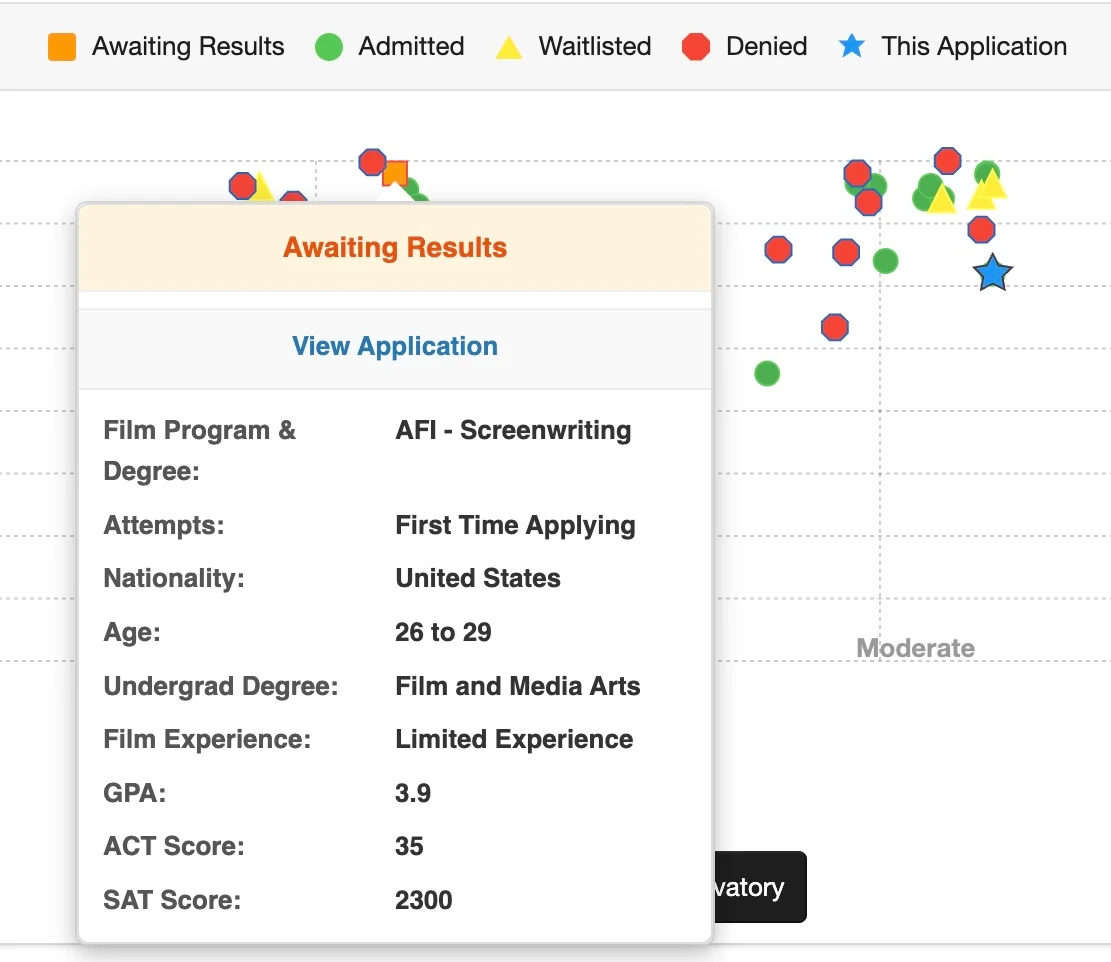
Unlock Film School Admissions Insights
Stop guessing about your chances. See exactly where you stand with real data from 5,000+ applications by becoming a Supporting Member.
This Application in the Scattergram
- See applications plotted by GPA + Film Experience
- View real outcomes: Admitted, Waitlisted, Denied, Awaiting Results
- Hover for full application details
+ 45 Exclusive Admissions Charts
Acceptance rates, reapplication success, interview impact, portfolio breakdowns, and more.
Instant access • Cancel anytime
the good (?) news is that next year they're officially doing away with the cine, screenwriting, post, etc. tracks altogether and just doing one singular "Live Action Filmmaking" track which according to the curriculum just looks like they just took the directing track and slapped a couple of screenwriting, cinematography and film studies courses in there
which I suppose is for the best since in my year, like, there's just 3 post students and 4 cinematographers, and like 20-30 directors, so they're recognizing that that's what most people want to go to film school for