
Navigation
Install the app
How to install the app on iOS
Follow along with the video below to see how to install our site as a web app on your home screen.
Note: This feature may not be available in some browsers.
More options
You are using an out of date browser. It may not display this or other websites correctly.
You should upgrade or use an alternative browser.
You should upgrade or use an alternative browser.
Latest Film School Reviews

Reviewed by:
Current Student
Degree: BA/BS/BFA
Degree: BA/BS/BFA
Came in as both a transfer and commuter, so my experience was really lessened by that fact.
Your time and success here is really up to you. Students, in my experience, are given a good amount of independence to do whatever they want. This lets driven students excel, but on the flip side the ones that are less so are free to drag everyone else in the group down (and all film stuff is group work).
Most professors are eccentrics. That has its ups and downs when it comes to classroom learning; but at the very least they're all good and understanding people who want to see their students succeed.
I highly recommend dorming and it is super important you get to know your classmates (especially those in other Comm Media Majors like acting). Get involved with as many student productions as you can!
The required internship program at the end is okay too. Once again, you need to push and advocate for yourself to get into a good internship.
Don't take the back seat in your education here!
Your time and success here is really up to you. Students, in my experience, are given a good amount of independence to do whatever they want. This lets driven students excel, but on the flip side the ones that are less so are free to drag everyone else in the group down (and all film stuff is group work).
Most professors are eccentrics. That has its ups and downs when it comes to classroom learning; but at the very least they're all good and understanding people who want to see their students succeed.
I highly recommend dorming and it is super important you get to know your classmates (especially those in other Comm Media Majors like acting). Get involved with as many student productions as you can!
The required internship program at the end is okay too. Once again, you need to push and advocate for yourself to get into a good internship.
Don't take the back seat in your education here!
- Affordability
- 5.00 star(s)
- Campus
- 3.00 star(s)
- Career Assistance
- 3.00 star(s)
- Coursework
- 3.00 star(s)
- Facilities & Equipment
- 3.00 star(s)
- Professors
- 4.00 star(s)
- Scholarships
- 3.00 star(s)
Anonymous is undecided about recommending this film school
One member found this helpful.
Last edited by a moderator:


- catmom
- 5.00 star(s)
- Reaction score: 1
Reviewed by:
Alumni
Degree: BA/BS/BFA
Concentration: Playwriting & Screenwriting
Degree: BA/BS/BFA
Concentration: Playwriting & Screenwriting
Pros
- Knowledgeable Instructors (Work/worked in the Industry. Some also teach at NYU Tisch)
- Non-Competitive
Cons
- Poor On-Campus Amenities/Campus Is Aging Poorly
I want to start off by mentioning that I came to Purchase as a transfer student from another liberal arts college and screenwriting program. This program is very much a "you get what you put in" deal. I was a student who put my all into the program, and in return I felt like I graduated with an excellent amount of knowledge in screenwriting and playwriting.
The professors are really knowledgeable and most still work in the industry. The head of the program, along with all of the professors and instructors, actually care about you as an individual. They gave great feedback and didn't mind staying after class to talk when I had questions, or just wanted advice, on anything from relevant work to your career outside of the school. They offer a variety of electives to choose from outside of the required courses, such as Television Writing, Bookwriting for the Musical, and Documentary Writing. They do work you quite a bit, helping you build from ten page screenplays in Screenwriting I to 30 page in Screenwriting II and 60 page screenplays in Screenwriting III. In your final year, you write a thesis of either a full-length play or a feature length screenplay that has to be approved and graded for you to graduate, but I've never heard of someone not finishing it.
The school itself is kind of falling apart, but they did just put in a new student dorm. I didn't live in it, so I can't review it, but I think it was generally well-liked. They also just put in a new Film & Theatre Building that looks great. I didn't get to have any classes in it because I was in my last semester, but it is brand new! There's a Starbucks on campus that takes meal swipes, three other different places to get food from with meal swipes or cash. They have dorms that accommodate different needs and financial abilities. It's also located right next to the Connecticut/New York border, so sometimes it feels like you're in the middle of nowhere. The school offers free shuttle buses daily, at different times (some days it was once an hour, others it was once every twenty minutes. I forgot the actual schedule.) that takes you to the nearest city of White Plains. There's malls, grocery shopping, a Target, and a train station that gets you to Grand Central in Manhattan.
There's plenty of internship opportunities in Manhattan if you want to do that commute once or twice a week. I did it in my senior year and I think the experience was worth it. I would just recommend that you intern somewhere in Midtown. I interned in Soho and it made my commute longer. Good news is you can work on scripts while riding from GC to White Plains. They also have Purchase Television on campus where you can intern. It's pretty laid back depending on who runs it. I think you have to be a sophomore or junior to receive credit from it.
All in all, the quality of my education was excellent. If you're looking for a cheaper alternative to NYU, or are a NYS resident, you should consider this program. Put your all into it, and think wide open!
The professors are really knowledgeable and most still work in the industry. The head of the program, along with all of the professors and instructors, actually care about you as an individual. They gave great feedback and didn't mind staying after class to talk when I had questions, or just wanted advice, on anything from relevant work to your career outside of the school. They offer a variety of electives to choose from outside of the required courses, such as Television Writing, Bookwriting for the Musical, and Documentary Writing. They do work you quite a bit, helping you build from ten page screenplays in Screenwriting I to 30 page in Screenwriting II and 60 page screenplays in Screenwriting III. In your final year, you write a thesis of either a full-length play or a feature length screenplay that has to be approved and graded for you to graduate, but I've never heard of someone not finishing it.
The school itself is kind of falling apart, but they did just put in a new student dorm. I didn't live in it, so I can't review it, but I think it was generally well-liked. They also just put in a new Film & Theatre Building that looks great. I didn't get to have any classes in it because I was in my last semester, but it is brand new! There's a Starbucks on campus that takes meal swipes, three other different places to get food from with meal swipes or cash. They have dorms that accommodate different needs and financial abilities. It's also located right next to the Connecticut/New York border, so sometimes it feels like you're in the middle of nowhere. The school offers free shuttle buses daily, at different times (some days it was once an hour, others it was once every twenty minutes. I forgot the actual schedule.) that takes you to the nearest city of White Plains. There's malls, grocery shopping, a Target, and a train station that gets you to Grand Central in Manhattan.
There's plenty of internship opportunities in Manhattan if you want to do that commute once or twice a week. I did it in my senior year and I think the experience was worth it. I would just recommend that you intern somewhere in Midtown. I interned in Soho and it made my commute longer. Good news is you can work on scripts while riding from GC to White Plains. They also have Purchase Television on campus where you can intern. It's pretty laid back depending on who runs it. I think you have to be a sophomore or junior to receive credit from it.
All in all, the quality of my education was excellent. If you're looking for a cheaper alternative to NYU, or are a NYS resident, you should consider this program. Put your all into it, and think wide open!
- Affordability
- 5.00 star(s)
- Alumni Network
- 4.00 star(s)
- Campus
- 3.00 star(s)
- Career Assistance
- 4.00 star(s)
- Coursework
- 5.00 star(s)
- Facilities & Equipment
- 3.00 star(s)
- Professors
- 5.00 star(s)
- Scholarships
- 3.00 star(s)
catmom recommends this film school
One member found this helpful.
Last edited by a moderator:

Reviewed by:
Alumni
Degree: BA/BS/BFA
Degree: BA/BS/BFA
I'd like to preface this by saying I graduated a while ago. It's possible that the school has changed significantly since then so take what I say with a grain of salt. Also, I made quite a few mistakes while there. Columbia College is a giant hub that draws in everybody from the Midwest. I feel like I know more people from Michigan than anywhere else in the world. You meet a lot of people in undergrad. Tons of students and they're all pipelined out to Los Angeles. That said, the alumni coordination leaves a little to be desired.
The big reason to go is tons of access to equipment and the ability to wheel around town and shoot whatever you want during independent study. It's an excellent trade school for its combination of hands-on experience and big alumni class. Go for an undergrad education, a solid bedrock to be followed up with an MFA. It is not a great school for writing and directing. That said, Columbia started up its Second City Program as soon as I left which likely would've been a game changer for me if it existed while I was there.
You have the ability to make an undergrad thesis with a lot of freedom. The thesis advisors aren't very hands-on. They have a Practicum Program that when I was there seemed like a great idea, designed in the style of AFI but it wasn't there in execution. Hopefully it's improved since then. It's a great idea. When I was there, it was a chaotic school without much direction and a lot of kids running around with cameras, shooting. Take all of this with a grain of salt.
The big reason to go is tons of access to equipment and the ability to wheel around town and shoot whatever you want during independent study. It's an excellent trade school for its combination of hands-on experience and big alumni class. Go for an undergrad education, a solid bedrock to be followed up with an MFA. It is not a great school for writing and directing. That said, Columbia started up its Second City Program as soon as I left which likely would've been a game changer for me if it existed while I was there.
You have the ability to make an undergrad thesis with a lot of freedom. The thesis advisors aren't very hands-on. They have a Practicum Program that when I was there seemed like a great idea, designed in the style of AFI but it wasn't there in execution. Hopefully it's improved since then. It's a great idea. When I was there, it was a chaotic school without much direction and a lot of kids running around with cameras, shooting. Take all of this with a grain of salt.
- Affordability
- 3.00 star(s)
- Alumni Network
- 3.00 star(s)
- Campus
- 4.00 star(s)
- Career Assistance
- 2.00 star(s)
- Coursework
- 2.00 star(s)
- Facilities & Equipment
- 4.00 star(s)
- Professors
- 3.00 star(s)
Last edited by a moderator:

Reviewed by:
Alumni
Degree: BA/BS/BFA
Degree: BA/BS/BFA
Pros
- Washington, DC location which offers opportunities for internships
- Friendly campus atmosphere
Cons
- No portfolio requirement
- Only one required film production course
- Some important film topics that aren't offered at AU like cinematography courses
- Not enough hands on training on the equipment
- Not enough film facilities or equipment on campus
I apologize for the very long post, but I have a lot of things to say about the Film and Media Arts department at AU.
I am EXTREMELY unhappy with the undergraduate Film and Media Arts program at American University and I mean that in the most respectful way.
I say that I'm unhappy because there simply wasn't enough hands on training in my courses so that when I graduated, I could make short films, documentaries and even know how to do basic video shooting and video editing. I took one required film course, Comm 331, and we didn't even have to use a film slate in our projects when we shot short films in groups.
It could have been that one professor that I had that wasn't a great teacher and maybe relied on theory too much, but I think I should have come away with more knowledge of film production. The fact that there is no film portfolio requirement confuses me. It's like an art major not having to create a portfolio of their paintings and drawings before they graduate. I think there is nothing good about that and how does a university know a student can be successful in their chosen career field if they don't have to do a portfolio or a senior thesis as a requirement in order for them to graduate? I think the curriculum has a lot of holes in it that need to be filled in for the sake of the students.
I also have to acknowledge that AU isn't exactly known for their film program so I shouldn't be too surprised that it's not on par with universities that are higher ranked overall and are touted for their film departments like UCLA, NYU and USC.
Because I have experienced the program at AU, I am just sharing my experience to those who are thinking about applying as a Film and Media Arts major. If you plan to study film at AU, PLEASE choose your professors wisely. I only took one professor so I can't talk about anyone else, but I came away with little knowledge from the professor I took. And I don't think only one production course should be required. I think there needs to be at least two production courses required with a lot of different aspects covered. It's also weird that the professor didn't chaperone us when we did film shoots at least for the first time when we did it for the class. It was very independent learning and theory based, which is not appropriate for something technical like shooting a film in my opinion.
It was embarrassing as a graduate when I moved to NYC and had interviews at film production houses only for them to see right away that I was inexperienced with operating the video camera and do video editing. I didn't even have knowledge of some industry standard equipment names.
I actually learned how to do video shooting and editing when I went to graduate school at another university, which was ranked higher overall than AU and I studied journalism. I didn't even study film in graduate school and I came away with more training in video shooting and editing. It shouldn't be this way. And I mention that the other university was ranked higher because I do think rankings show the value of the courses students will take.
I feel sad that I still don't know how to do narrative films because of my experiences at AU. I feel cheated because I spent a lot of money at AU and I can't even do a basic short film or a professional documentary.
So, I recommend that if you go to AU, be prepared for the lack of hands on training in the film department. I'm sure the other departments at AU are fine. I took gen ed courses in other departments and they were fine. But, I feel like the film department is extremely lacking as far as hands on training and focuses too much on theory.
I don't mean to sound bitter or bash AU, I'm just being very honest and straightforward because I want people to know about my personal experience as a way to provide insight.
If I could do it all over again and planned to study film, I would have chosen a different university that had better film resources and facilities with a hands on learning approach.
Your college decision and major are one of the most important decisions that you will make in your life. Please choose wisely.
On a positive note, I did meet very nice people at AU. I was very happy there. The students in general are extremely welcoming and caring and the faculty do care about the students. But, the film courses I took were not industry standard in my opinion.
AU's SOC Department focuses on famous faculty and alumni as a draw, which is misleading. A school shouldn't advertise these people as a way to persuade people that prospective students will learn so much in film if the teaching process doesn't display this. Some alumni of any university can learn most of their craft on their own without the help of the university.
You just really got to do your research not only in your major because you might change that when you start university, but do research on the entire department that you are interested in so you can have a good perspective on what to expect when you take classes.
I am hoping there is a way for me to learn narrative film production in the future because I yearn to still know how to do this professionally.
Again, I apologize if I sound bitter or severely critical of my review of the program. I know it's hard to read tone when someone is writing a post. It's more of me coming from an honest place instead of an angry place. I am disappointed though and that is obvious in my post.
Thank you for reading this.
I am EXTREMELY unhappy with the undergraduate Film and Media Arts program at American University and I mean that in the most respectful way.
I say that I'm unhappy because there simply wasn't enough hands on training in my courses so that when I graduated, I could make short films, documentaries and even know how to do basic video shooting and video editing. I took one required film course, Comm 331, and we didn't even have to use a film slate in our projects when we shot short films in groups.
It could have been that one professor that I had that wasn't a great teacher and maybe relied on theory too much, but I think I should have come away with more knowledge of film production. The fact that there is no film portfolio requirement confuses me. It's like an art major not having to create a portfolio of their paintings and drawings before they graduate. I think there is nothing good about that and how does a university know a student can be successful in their chosen career field if they don't have to do a portfolio or a senior thesis as a requirement in order for them to graduate? I think the curriculum has a lot of holes in it that need to be filled in for the sake of the students.
I also have to acknowledge that AU isn't exactly known for their film program so I shouldn't be too surprised that it's not on par with universities that are higher ranked overall and are touted for their film departments like UCLA, NYU and USC.
Because I have experienced the program at AU, I am just sharing my experience to those who are thinking about applying as a Film and Media Arts major. If you plan to study film at AU, PLEASE choose your professors wisely. I only took one professor so I can't talk about anyone else, but I came away with little knowledge from the professor I took. And I don't think only one production course should be required. I think there needs to be at least two production courses required with a lot of different aspects covered. It's also weird that the professor didn't chaperone us when we did film shoots at least for the first time when we did it for the class. It was very independent learning and theory based, which is not appropriate for something technical like shooting a film in my opinion.
It was embarrassing as a graduate when I moved to NYC and had interviews at film production houses only for them to see right away that I was inexperienced with operating the video camera and do video editing. I didn't even have knowledge of some industry standard equipment names.
I actually learned how to do video shooting and editing when I went to graduate school at another university, which was ranked higher overall than AU and I studied journalism. I didn't even study film in graduate school and I came away with more training in video shooting and editing. It shouldn't be this way. And I mention that the other university was ranked higher because I do think rankings show the value of the courses students will take.
I feel sad that I still don't know how to do narrative films because of my experiences at AU. I feel cheated because I spent a lot of money at AU and I can't even do a basic short film or a professional documentary.
So, I recommend that if you go to AU, be prepared for the lack of hands on training in the film department. I'm sure the other departments at AU are fine. I took gen ed courses in other departments and they were fine. But, I feel like the film department is extremely lacking as far as hands on training and focuses too much on theory.
I don't mean to sound bitter or bash AU, I'm just being very honest and straightforward because I want people to know about my personal experience as a way to provide insight.
If I could do it all over again and planned to study film, I would have chosen a different university that had better film resources and facilities with a hands on learning approach.
Your college decision and major are one of the most important decisions that you will make in your life. Please choose wisely.
On a positive note, I did meet very nice people at AU. I was very happy there. The students in general are extremely welcoming and caring and the faculty do care about the students. But, the film courses I took were not industry standard in my opinion.
AU's SOC Department focuses on famous faculty and alumni as a draw, which is misleading. A school shouldn't advertise these people as a way to persuade people that prospective students will learn so much in film if the teaching process doesn't display this. Some alumni of any university can learn most of their craft on their own without the help of the university.
You just really got to do your research not only in your major because you might change that when you start university, but do research on the entire department that you are interested in so you can have a good perspective on what to expect when you take classes.
I am hoping there is a way for me to learn narrative film production in the future because I yearn to still know how to do this professionally.
Again, I apologize if I sound bitter or severely critical of my review of the program. I know it's hard to read tone when someone is writing a post. It's more of me coming from an honest place instead of an angry place. I am disappointed though and that is obvious in my post.
Thank you for reading this.
- Affordability
- 3.00 star(s)
- Alumni Network
- 3.00 star(s)
- Campus
- 4.00 star(s)
- Career Assistance
- 3.00 star(s)
- Coursework
- 2.00 star(s)
- Facilities & Equipment
- 2.00 star(s)
- Professors
- 2.00 star(s)
- Scholarships
- 3.00 star(s)
3 members found this helpful.
Last edited by a moderator:

- A248
- 5.00 star(s)
- Reaction score: 2
Reviewed by:
Current Student
Degree: MA/MFA
Concentration: Film and Television Production
Degree: MA/MFA
Concentration: Film and Television Production
Pros
- Knowledgeable Faculty
- Beautiful Location
- Well-Rounded Experience
- On Set Experience
- Access to internships
- Diverse students
Cons
- Expensive
LMU's Film and Television Production MFA program is a great choice for students who want a well-rounded film education. You are able to make both fiction/non-fiction films and can choose electives that suit your interests and goals. There are also quite a few teaching assistantships and campus jobs available to students. The Westchester and Playa Vista campuses are both beautiful and we have access to all Hollywood has to offer as far as talent, locations, props, equipment, internships, gigs, etc. Going to school at LMU and living in LA is expensive and you must be prepared to navigate a city that is nonstop and quite hectic a lot of the time, but I've found that the pros definitely outweigh the cons.
- Affordability
- 4.00 star(s)
- Alumni Network
- 5.00 star(s)
- Campus
- 5.00 star(s)
- Career Assistance
- 5.00 star(s)
- Coursework
- 5.00 star(s)
- Facilities & Equipment
- 5.00 star(s)
- Professors
- 5.00 star(s)
- Scholarships
- 5.00 star(s)
4 members found this helpful.
Last edited by a moderator:

Reviewed by:
Current Student
Degree: MA/MFA
Concentration: Film and Television Production
Degree: MA/MFA
Concentration: Film and Television Production
Pros
- gaining experience (even if it's not under the best circumstances)
- good post-production instruction
- SCA network
- being around people who want to make film their vocation
- ability to try different tracks
Cons
- mediocre faculty who cannot teach, give helpful notes, or make good work
- ineffective administration that doesn't like change
- poorly designed first year curriculum
- bad cinematography program
- conservative, non-progressive school that lacks ability to hold people accountable, especially when it comes to social justice (too white)
- does not set students up to succeed or help them make their best work - quality of work is generally, at best, mediocre
- innovation is not encouraged, what matters more is reputation
- little theoretical or intellectual sophistication in students or faculty (unless you are in the critical studies dept.)
- expensive
I'm writing this review because there wasn't a lot of clear info when I was applying so I hope that this can offer some clarification beyond the fluff of USC marketing (like "the #1 film school in the world" bullshit).
The first year at USC is the worst one and is truly a mess. The film program accepts students based on their perspectives, meaning there is a wide range of skill level when it comes to film. Some people have had done a degree program before or have worked, while others do not know anything. This is not inherently a bad thing but what is dishonest about SCA is that they are not clear about the fact that the first year does not actually serve either groups of people. There is too little teaching that would give beginners a good foundation, but at the same time more experienced people are bored by how basic everything is. The approach of the first year is to have useless lectures during class, assigning students to trios, and having them figure out filmmaking themselves while learning how to "collaborate". What I have seen of even this attempt to teach people to collaborate is that they value students who don't make a fuss, meaning students will put on their best face to teachers so that they can have opportunities to direct higher level productions. They do not offer helpful support for students who struggle with things such as conflict resolution, mental health issues, cultural differences, or disability. I don't consider this good teaching or learning. Also, effective learning is seriously impaired by teachers who largely lack the basic skill of organizing classes and lecturing, in addition to not actually being that good at helping people with their films. If they were skilled enough to be successful most of them would not be teaching there.
After the first year, things get dramatically better because there is more choice in how people can work, who they work with, as well as what they take. This is when people start taking basic intermediate classes (directing, producing, etc.) which would have been far more useful to have learned in the first year before we had to make films. The faculty is improved from the first year but I have found that great professors are still hard to come by. There are certainly some here and there, though. The advanced production classes (esp 546/narrative and 547/doc) are well-regarded and I've generally heard good things about them. In general the coursework becomes more helpful since you can focus on one thing at a time and begin to consider how these will help you in your career. However, even then, I have found classes and instructions to be just okay.
USC is actually best for people who are already quite good at filmmaking and know what they are doing. In addition, this school is more helpful for people who want to be blockbuster directors and make films in a more standard way. However, artists who try to break the mold or make experimental work will not be as well supported, especially by the faculty who often don't understand that type of filmmaking. Stories told by POC exist in plenty but because most of the faculty is white those stories also do not get the best support that they should. When it comes to tracks, directing, cinematography, and PD are the weaker tracks here. Writing, producing, and post-production (editing and sound) are strong. The editing and sound facilities are definitely good and the faculty will train you from the beginning.
I can't say if USC is worth it or not really. I'd have to graduate to see if it is but I think it can be depending on what your goals are, what you want to do, and whether you can afford it. I have learned a lot from doing things in classes but I do wish that the education was structured better. The film program can certainly help you get a job (esp if you do a post-production track), gain familiarity with equipment, and learn technical skills but it won't help you become a better artist. However, I do think that coming to USC will open doors career wise because it is well-connected but so far it has come at the cost of dealing with all of the bullshit of the school. By the time people graduate the anger of going through the first year is gone but many are left with mixed feelings. You should know what to expect before you say yes.
The first year at USC is the worst one and is truly a mess. The film program accepts students based on their perspectives, meaning there is a wide range of skill level when it comes to film. Some people have had done a degree program before or have worked, while others do not know anything. This is not inherently a bad thing but what is dishonest about SCA is that they are not clear about the fact that the first year does not actually serve either groups of people. There is too little teaching that would give beginners a good foundation, but at the same time more experienced people are bored by how basic everything is. The approach of the first year is to have useless lectures during class, assigning students to trios, and having them figure out filmmaking themselves while learning how to "collaborate". What I have seen of even this attempt to teach people to collaborate is that they value students who don't make a fuss, meaning students will put on their best face to teachers so that they can have opportunities to direct higher level productions. They do not offer helpful support for students who struggle with things such as conflict resolution, mental health issues, cultural differences, or disability. I don't consider this good teaching or learning. Also, effective learning is seriously impaired by teachers who largely lack the basic skill of organizing classes and lecturing, in addition to not actually being that good at helping people with their films. If they were skilled enough to be successful most of them would not be teaching there.
After the first year, things get dramatically better because there is more choice in how people can work, who they work with, as well as what they take. This is when people start taking basic intermediate classes (directing, producing, etc.) which would have been far more useful to have learned in the first year before we had to make films. The faculty is improved from the first year but I have found that great professors are still hard to come by. There are certainly some here and there, though. The advanced production classes (esp 546/narrative and 547/doc) are well-regarded and I've generally heard good things about them. In general the coursework becomes more helpful since you can focus on one thing at a time and begin to consider how these will help you in your career. However, even then, I have found classes and instructions to be just okay.
USC is actually best for people who are already quite good at filmmaking and know what they are doing. In addition, this school is more helpful for people who want to be blockbuster directors and make films in a more standard way. However, artists who try to break the mold or make experimental work will not be as well supported, especially by the faculty who often don't understand that type of filmmaking. Stories told by POC exist in plenty but because most of the faculty is white those stories also do not get the best support that they should. When it comes to tracks, directing, cinematography, and PD are the weaker tracks here. Writing, producing, and post-production (editing and sound) are strong. The editing and sound facilities are definitely good and the faculty will train you from the beginning.
I can't say if USC is worth it or not really. I'd have to graduate to see if it is but I think it can be depending on what your goals are, what you want to do, and whether you can afford it. I have learned a lot from doing things in classes but I do wish that the education was structured better. The film program can certainly help you get a job (esp if you do a post-production track), gain familiarity with equipment, and learn technical skills but it won't help you become a better artist. However, I do think that coming to USC will open doors career wise because it is well-connected but so far it has come at the cost of dealing with all of the bullshit of the school. By the time people graduate the anger of going through the first year is gone but many are left with mixed feelings. You should know what to expect before you say yes.
- Affordability
- 1.00 star(s)
- Alumni Network
- 4.00 star(s)
- Campus
- 3.00 star(s)
- Career Assistance
- 4.00 star(s)
- Coursework
- 2.00 star(s)
- Facilities & Equipment
- 3.00 star(s)
- Professors
- 2.00 star(s)
- Scholarships
- 3.00 star(s)
9 members found this helpful.
Last edited by a moderator:
- soybean
- 1.00 star(s)
- Reaction score: 2
Reviewed by:
Current Student
Pros
- Free lunch if you don't pay at Galen Center
Cons
- They pick literally anyone, students who have no idea what filmmaking is (not talking about experience but at least passion and basic understanding of filmmaking)
- Terrible taste (Hollywood trash, as I stated. They would all die for Marvel because- KeviN FeiGe iS aN AlUmNi)
- Expensive (Tuition + living cost in LA for 3 years, plus production cost etc would likely cost you a literal kidney)
- USC owns YOUR film that YOU pay on your own
- Most students can't accept criticism and can't give criticism
- They rely on sappy stories to make film, without actually having merit
- Useless first year
- Useless faculty
- Terrible equipment with low production value
- Not actual industry network as they market, most of the time it's just B-list directors who happen to be friends with the faculty
Overall, this school is what 'quantity over quality' means.
The network they brag about is absolutely not as they market. The filmmakers who come mostly make low-rated films that happen to need a boost of marketing. Occasionally they are good, don't get me wrong, but it's just gonna be once every semester so I wouldn't call that good network.
I would give it 0 star but this website won't let me.
Oh and the SCA building is a horrific building, an insult to any architect in the world. At least $75 million endowment from alumni and organizations are distributed to the construction of this awful building instead of I don't know, scholarship? Emergency fund? Lower tuition?
The network they brag about is absolutely not as they market. The filmmakers who come mostly make low-rated films that happen to need a boost of marketing. Occasionally they are good, don't get me wrong, but it's just gonna be once every semester so I wouldn't call that good network.
I would give it 0 star but this website won't let me.
Oh and the SCA building is a horrific building, an insult to any architect in the world. At least $75 million endowment from alumni and organizations are distributed to the construction of this awful building instead of I don't know, scholarship? Emergency fund? Lower tuition?
- Affordability
- 1.00 star(s)
- Alumni Network
- 2.00 star(s)
- Campus
- 2.00 star(s)
- Career Assistance
- 1.00 star(s)
- Coursework
- 1.00 star(s)
- Facilities & Equipment
- 2.00 star(s)
- Professors
- 1.00 star(s)
- Scholarships
- 1.00 star(s)
4 members found this helpful.
Last edited by a moderator:

HatsOnHatsOnHats
Which program are you in?
Reviewed by:
Current Student
Pros
- Good weather
- Chance of connections
Cons
- Cost
- Lack of diversity
- Favoritism
- Useless first year
- Antagonistic admins
- Scholarships only for certain groups
If you don’t get a scholarship to attend USC I would advise against going. It’s too much money to throw away for a school with so many problems. The first year is remedial film. If you’ve ever taken film before, it’s useless. 6 units are devoted to critical studies, which at the time of writing is 12k. Do yourself a favor and save for a house.
The so called network only helps a certain few. The fact that you’re in college helps more, so I would choose a cheaper school.
If you get a scholarship then by all means go.
The so called network only helps a certain few. The fact that you’re in college helps more, so I would choose a cheaper school.
If you get a scholarship then by all means go.
- Affordability
- 1.00 star(s)
- Alumni Network
- 3.00 star(s)
- Campus
- 3.00 star(s)
- Career Assistance
- 1.00 star(s)
- Coursework
- 1.00 star(s)
- Facilities & Equipment
- 2.00 star(s)
- Professors
- 2.00 star(s)
- Scholarships
- 1.00 star(s)
4 members found this helpful.
Last edited:
HatsOnHatsOnHats
Which program are you in?


- pcasmur
- 5.00 star(s)
Reviewed by:
Current Student
Pros
- class content
- accessibility
- duration
- learning experience
- professor
Thanks to professor Carl Haber I was able to learn the fundamentals of screenwriting and how to implement them. For the first time in my life, I'm able to write an interesting story from beginning to end. Haber is very knowledgeable and guides his students into the interesting world of filmmaking. Great class, school, and professor! I highly recommend it!
- Affordability
- 5.00 star(s)
- Alumni Network
- 5.00 star(s)
- Career Assistance
- 5.00 star(s)
- Coursework
- 5.00 star(s)
- Professors
- 5.00 star(s)
I
I.P. Miller
Are the classes in English? I'm guessing there are no programs for people from the US right now

Carl H
the classes are in English, yes. Currently courses are online, so Americans can of course participate, as they are scheduled in the later afternoon Rome time. The hope and plan is to re-open the school on site for a special one semester term beginning in January, and if the covid19 pandemic eases up, and US residents are allowed back in to the EU and Italy specifically, then surely qualified Americans could join the program in Rome. If you are interested in the online classses taking place now and/or into the fall, please do write ASAP to info@romefilmschool.org - thanks from all of us at RIFS for your interest.

Reviewed by:
Current Student
Degree: MA/MFA
Concentration: Screenwriting
Degree: MA/MFA
Concentration: Screenwriting
Pros
- Networking
- Writers Room experience
- Creating Portfolio with Samples
- Transition to LA
- Internship Possibilities
- TA Positions/Funding
- Two-Year Program
Cons
- Expensive
I have loved this program so far! For me, it was the right move. Coming from out-of-state, I learned a lot about LA and housing, but it could have been worse. With the loans from FA, I was able to move relatively stress-free.
I have met like-minded individuals who are hungry to make a career for themselves in this industry. The professors are incredibly helpful, intelligent, and know what they're talking about. They care about students and their success.
The one thing I wish the program did a better job of was connecting us to industry professionals with the intention of getting our work out there. I feel like they should want their alumni to do well in the industry, so a little bit of a push would be great. But at the same time, they offer real advice about breaking in. It's tough but they are supportive.
I have met like-minded individuals who are hungry to make a career for themselves in this industry. The professors are incredibly helpful, intelligent, and know what they're talking about. They care about students and their success.
The one thing I wish the program did a better job of was connecting us to industry professionals with the intention of getting our work out there. I feel like they should want their alumni to do well in the industry, so a little bit of a push would be great. But at the same time, they offer real advice about breaking in. It's tough but they are supportive.
- Affordability
- 3.00 star(s)
- Alumni Network
- 5.00 star(s)
- Campus
- 5.00 star(s)
- Career Assistance
- 3.00 star(s)
- Coursework
- 4.00 star(s)
- Facilities & Equipment
- 3.00 star(s)
- Professors
- 5.00 star(s)
- Scholarships
- 4.00 star(s)
One member found this helpful.
Last edited by a moderator:


- jn0pe
- 5.00 star(s)
- Reaction score: 1
Reviewed by:
Alumni
Pros
- Excellent faculty
- Small class sizes
- Outstanding special events
- Interdisciplinary
- Doc Films
- Daily screenings
- Film Studies Center & Logan Media Center
- Scholarships
- Study abroad
- Fire Escape Films
Cons
- Few production classes
- Many "core" requirements outside Cinema major
- Expensive without scholarship
In my opinion, the University of Chicago's Cinema & Media Studies program is one of the most outstanding and underrated programs out there. I loved my experience getting a B.A. in CMS! (There's also a PhD program, but I'm speaking about my experience as an undergraduate.) However, it's not for everyone. I'll run through a list of important points that anyone considering the program should be aware of.
1. Core Classes. Every student in the College at UChicago must complete a large number of rigorous Core Classes ranging from physical and biological sciences, mathematics, and social sciences to arts and humanities. In fact, these Core Classes will take up about a third of your studies as an undergraduate. If you want to go to a school where you'll just be studying your major, UChicago is not for you. However, if you are open to it, I think having the opportunity to take classes in such a variety of disciplines actually ends up benefitting you.
2. Major requirements. There are a few prerequisite courses for the major including Intro to Film Analysis (basically a crash course in critical viewership and film language), plus a two-quarter sequence called History of International Cinema. I was lucky enough to be taking the History sequence when two very well-known professors were teaching it, and it's actually one of my favorite classes I took. I believe more recently the course has been expanded to a three-quarter sequence (when I was a student, it covered silent through 1960, but now it covers film up to present day.)
3. Thesis. Majors are required to complete either a written or intensive-track production thesis. The majority of students opt to do a written thesis, and all students must enroll in an additional seminar to prepare for their research, find a faculty advisor, and work with a graduate preceptor. You are also expected to provide periodic peer feedback to your classmates on their work and progress during this seminar. Writing a thesis was simultaneously one of the most terrifying and rewarding undertakings during my time as an undergraduate, but I'd say it's well worth the pain. Not only do you get to develop a relationship with and receive personal feedback from a professor, but also the research skills and knowledge you gain from the process are a big plus. My thesis was called From Canvas to Camera: F.W. Murnau's Intertextual Filmmaking Practice (I wrote a joint thesis with the Art History department, and both departments were very accommodating about allowing me to choose an interdisciplinary topic because of my second major.) For my few classmates who did production theses, their films were screened at the end of the year for everyone to see.
4. Facilities. I was very impressed with the facilities available. The majority of my classes were held in theaters either at Cobb Hall where the Film Studies Center is, or at the new Logan Center for the Arts which houses several state-of-the-art theaters as well. Logan also includes the Logan Media Center, which offers free training courses (I took a free training course in video editing in my spare time), a darkroom, printing facilities, equipment available for students to check out and work on projects, and a brand new computer lab with editing software. The majority of the film screenings for my cinema classes took place at Logan, which was really exciting because the facilities truly are top-notch. (You're also welcome to attend other courses' screenings!) Logan Center website: Reva and David Logan Center for the Arts
5. Events. There is something happening literally every single day. Special guests are constantly being brought in (one of my classes got to meet Agnes Varda as she personally guided us through her exhibition at the Logan Center), and there is always an abundance of lectures to attend. I remember at Halloween, Rockefeller Chapel did a screening of Faust with live organ accompaniment!
6. Doc Films. This is one of the most incredible student film societies ever. Located at Max Palevsky Cinema on campus, students create the programming of films to be shown each night of the week, every single night. For instance, Monday nights might be devoted to a particular director, Tuesdays for a specific genre, Wednesdays for films about a relevant theme, and so on. Saturdays are dedicated to new releases, and Thursdays are double features. Let this sink in: not only are there multiple showtimes each night, but every night of the week you could go see a film ($5 per film, or $30 for a season pass)! Students in Doc Films take turns introducing the films before they begin, students serve as the projectionists, students create the programming, students bring in special guests (once they brought in Woody Allen for a Q&A, but it was before I was a student there)... students do it all! Furthermore, Doc Films is committed to screening films in their original formats (I remember once they had someone come out and apologize for having to project a Blu-Ray instead of film stock.) Do Films is an incredible resource not only for those interested in running a cinema, but also for any cinema fans. I had such an amazing time diving into all kinds of films screened at Doc, and I regret not joining as a volunteer. Check out their website: Doc Films
7. Fire Escape Films. FEF is a student-run film production organization at UChicago, so if you want to get some hands-on production experience to go with all the theory you study in class, this is a great opportunity. Student directors choose from student-written scripts, and members of FEF team up into crews to produce the films and screen them in their own film fest at Max Palevsky Cinema. Equipment and resources come from the Logan Media Center, so students don't need to worry about paying for tech. FEF also runs a cool 48-hour film festival where you camp out in Logan and create an entire short film within the time limit. Here's FEF's Vimeo: Fire Escape Films
8. Film Studies Center. This serves as a supplemental resource for the Cinema & Media Studies program. They have an impressive library of films to check out as well as screenings rooms you can reserve. (In addition, the University's library system also has an enormous library of media available to you. If there's something they don't have, put in a request and they'll buy it!) FSC website: Film Studies Center
9. Study abroad. UChicago has tons of study abroad programs, and the funding to back it up (I studied abroad 4 times). The wide variety of programs allows students from diverse majors to participate. One program I did was a Spring Quarter in Paris with four courses; one on 19th Century Art in Paris Museums, one on Godard, one on Hegel, and one in French. It was an incredible opportunity to study Godard's work while being able to inhabit the spaces of his films and take field trips to places like the Cinémathèque Française and Fondation Jérôme Seydoux-Pathé, among others. Plus, it counted toward my major requirements!
10. Classes. Prerequisites aside, the majority of the classes are small and seminar-style. This usually means doing a lot of reading for homework, followed by intense class discussions and debates. You're encouraged to think critically about the texts you've read, and exams are usually in the form of final papers where you draw on analyses of the films you watched, texts you've studied, and themes from class discussions. (Note: you're trained for this kind of class from day one, since all the Core humanities courses are conducted in this style.)
To sum up, this is an outstanding program if you are looking for a solid grounding in film analysis and theory. This is not necessarily what every film student is looking for, but I think it helped prepare me for pursuing an MFA in film production in ways that perhaps students who focused on production in undergrad might have missed out on. If you are keen on getting production experience at UChicago, it's absolutely possible if you put in the work and join some of the student organizations. Even if you're starting with zero experience, you can get the training you need outside class time with the Logan Media Center and by learning from your classmates on extracurricular projects. Meanwhile, you will learn a ton and hone in on your interests while writing your thesis and completing research. Feel free to contact me with any questions about the program! Hopefully I didn't forget anything!!
1. Core Classes. Every student in the College at UChicago must complete a large number of rigorous Core Classes ranging from physical and biological sciences, mathematics, and social sciences to arts and humanities. In fact, these Core Classes will take up about a third of your studies as an undergraduate. If you want to go to a school where you'll just be studying your major, UChicago is not for you. However, if you are open to it, I think having the opportunity to take classes in such a variety of disciplines actually ends up benefitting you.
2. Major requirements. There are a few prerequisite courses for the major including Intro to Film Analysis (basically a crash course in critical viewership and film language), plus a two-quarter sequence called History of International Cinema. I was lucky enough to be taking the History sequence when two very well-known professors were teaching it, and it's actually one of my favorite classes I took. I believe more recently the course has been expanded to a three-quarter sequence (when I was a student, it covered silent through 1960, but now it covers film up to present day.)
3. Thesis. Majors are required to complete either a written or intensive-track production thesis. The majority of students opt to do a written thesis, and all students must enroll in an additional seminar to prepare for their research, find a faculty advisor, and work with a graduate preceptor. You are also expected to provide periodic peer feedback to your classmates on their work and progress during this seminar. Writing a thesis was simultaneously one of the most terrifying and rewarding undertakings during my time as an undergraduate, but I'd say it's well worth the pain. Not only do you get to develop a relationship with and receive personal feedback from a professor, but also the research skills and knowledge you gain from the process are a big plus. My thesis was called From Canvas to Camera: F.W. Murnau's Intertextual Filmmaking Practice (I wrote a joint thesis with the Art History department, and both departments were very accommodating about allowing me to choose an interdisciplinary topic because of my second major.) For my few classmates who did production theses, their films were screened at the end of the year for everyone to see.
4. Facilities. I was very impressed with the facilities available. The majority of my classes were held in theaters either at Cobb Hall where the Film Studies Center is, or at the new Logan Center for the Arts which houses several state-of-the-art theaters as well. Logan also includes the Logan Media Center, which offers free training courses (I took a free training course in video editing in my spare time), a darkroom, printing facilities, equipment available for students to check out and work on projects, and a brand new computer lab with editing software. The majority of the film screenings for my cinema classes took place at Logan, which was really exciting because the facilities truly are top-notch. (You're also welcome to attend other courses' screenings!) Logan Center website: Reva and David Logan Center for the Arts
5. Events. There is something happening literally every single day. Special guests are constantly being brought in (one of my classes got to meet Agnes Varda as she personally guided us through her exhibition at the Logan Center), and there is always an abundance of lectures to attend. I remember at Halloween, Rockefeller Chapel did a screening of Faust with live organ accompaniment!
6. Doc Films. This is one of the most incredible student film societies ever. Located at Max Palevsky Cinema on campus, students create the programming of films to be shown each night of the week, every single night. For instance, Monday nights might be devoted to a particular director, Tuesdays for a specific genre, Wednesdays for films about a relevant theme, and so on. Saturdays are dedicated to new releases, and Thursdays are double features. Let this sink in: not only are there multiple showtimes each night, but every night of the week you could go see a film ($5 per film, or $30 for a season pass)! Students in Doc Films take turns introducing the films before they begin, students serve as the projectionists, students create the programming, students bring in special guests (once they brought in Woody Allen for a Q&A, but it was before I was a student there)... students do it all! Furthermore, Doc Films is committed to screening films in their original formats (I remember once they had someone come out and apologize for having to project a Blu-Ray instead of film stock.) Do Films is an incredible resource not only for those interested in running a cinema, but also for any cinema fans. I had such an amazing time diving into all kinds of films screened at Doc, and I regret not joining as a volunteer. Check out their website: Doc Films
7. Fire Escape Films. FEF is a student-run film production organization at UChicago, so if you want to get some hands-on production experience to go with all the theory you study in class, this is a great opportunity. Student directors choose from student-written scripts, and members of FEF team up into crews to produce the films and screen them in their own film fest at Max Palevsky Cinema. Equipment and resources come from the Logan Media Center, so students don't need to worry about paying for tech. FEF also runs a cool 48-hour film festival where you camp out in Logan and create an entire short film within the time limit. Here's FEF's Vimeo: Fire Escape Films
8. Film Studies Center. This serves as a supplemental resource for the Cinema & Media Studies program. They have an impressive library of films to check out as well as screenings rooms you can reserve. (In addition, the University's library system also has an enormous library of media available to you. If there's something they don't have, put in a request and they'll buy it!) FSC website: Film Studies Center
9. Study abroad. UChicago has tons of study abroad programs, and the funding to back it up (I studied abroad 4 times). The wide variety of programs allows students from diverse majors to participate. One program I did was a Spring Quarter in Paris with four courses; one on 19th Century Art in Paris Museums, one on Godard, one on Hegel, and one in French. It was an incredible opportunity to study Godard's work while being able to inhabit the spaces of his films and take field trips to places like the Cinémathèque Française and Fondation Jérôme Seydoux-Pathé, among others. Plus, it counted toward my major requirements!
10. Classes. Prerequisites aside, the majority of the classes are small and seminar-style. This usually means doing a lot of reading for homework, followed by intense class discussions and debates. You're encouraged to think critically about the texts you've read, and exams are usually in the form of final papers where you draw on analyses of the films you watched, texts you've studied, and themes from class discussions. (Note: you're trained for this kind of class from day one, since all the Core humanities courses are conducted in this style.)
To sum up, this is an outstanding program if you are looking for a solid grounding in film analysis and theory. This is not necessarily what every film student is looking for, but I think it helped prepare me for pursuing an MFA in film production in ways that perhaps students who focused on production in undergrad might have missed out on. If you are keen on getting production experience at UChicago, it's absolutely possible if you put in the work and join some of the student organizations. Even if you're starting with zero experience, you can get the training you need outside class time with the Logan Media Center and by learning from your classmates on extracurricular projects. Meanwhile, you will learn a ton and hone in on your interests while writing your thesis and completing research. Feel free to contact me with any questions about the program! Hopefully I didn't forget anything!!
- Affordability
- 5.00 star(s)
- Alumni Network
- 3.00 star(s)
- Campus
- 5.00 star(s)
- Career Assistance
- 5.00 star(s)
- Coursework
- 5.00 star(s)
- Facilities & Equipment
- 4.00 star(s)
- Professors
- 5.00 star(s)
- Scholarships
- 5.00 star(s)
Last edited:


Chris W
Awesome and informative review! Made me want to go there.  Sounds like a blast. I also studied abroad in France for a year in Grenoble. Didn't count towards my major but I also ate up Cinema while I was there.
Sounds like a blast. I also studied abroad in France for a year in Grenoble. Didn't count towards my major but I also ate up Cinema while I was there.

- julia1
- 3.00 star(s)
- Reaction score: 2
Reviewed by:
Alumni
Pros
- Boston is a great college town
- Have built an okay network there, a foundation for the network I have now
- Awesome study abroad programs -- the Castle, Prague, Greece, etc
- Employment office does try to help you prepare for job hunting, they can look over your resumes & host mock interviews
- You have access to Emerson's film equipment (but you're often not really taught how to use them because you can only check the EQ out if you're shooting a class project)
Cons
- Campus isn't super accessible for students w disabilities
- Not a lot of great professors, just a lot of average ones (have definitely had a professor advertise his book to us in a lecture before)
- My whole experience felt half-baked
- ELA is useless, internships aren't guaranteed and the classes they have there are awful + the campus is GAUDY
- You really need to join clubs/extracurriculars to build your network/get experience but you end up having to be interviewed by your peers to get in; weird environment
- Can only take 4 classes per semester -- rip off?
- Dorms are disgusting
- Transfers are treated lesser than 4 year students
- You have to take a lot of useless classes that Emerson requires to make you a "more well rounded student" but you can only take 4 classes per semester so there's less time for more concentrated classes
- Some professors are just salty that they're teaching film students rather than making films themselves
I went to Emerson for my undergrad for VMA (Visual media arts, just generally the film program) and...it was a lot of fun, I certainly learned some things, but it's truly what you make of it. There are plenty of really good professors that care and want to share their knowledge with you, but a lot of classes felt useless to me. You're also only able to take 4 classes per semester which felt like a rip off. You do have smaller class sizes and Boston is an awesome college town, but I'd be lying if I said that Emerson doesn't have it's flaws. Take advantage of all the extracurriculars and clubs, sometimes you learn more from those than actual classes. Like they have comedy shows you can write/act in and be able to work in a studio, they also have the EVVYs award show you can work on (I didn't but I wish I can been a part of a big production like that). I didn't have a concentration when I was there because I didn't know what I really wanted to do yet, so I feel like I lost time while I was there (I also transferred in as a sophomore and they don't treat transfers the same as freshmen, plus you cannot attend the Castle study abroad program). The Boston classes feel like a lot of film history and not a lot of practical stuff unless you find that diamond in the rough production class (only had about 2 production classes where I actually learned things, otherwise you just kinda have to volunteer to be on student film sets).
Luckily, I was able to go to the Prague summer study abroad program and study at FAMU (the world's oldest film school) and produce my own short film, that alone made the entire Emerson experience worth it; great people and great professors there. I also did the ELA program on their Los Angeles campus my final semester and got an internship (you really have to get your own internship, not a lot of help from their network), the classes at ELA were ABSOLUTELY HORRIBLE and USELESS to me, but I did end up getting a job out of my internship -- only a handful of people actually get work out of their internships so don't bank on this. The job was AWFUL (I was an assistant in a small production house and they treated me like shit, plus I felt like I was wasting my time there because I wasn't learning about preproduction, I was just an admin) and I left after a few months. I left LA altogether bc it's a terrible environment and moved in NYC, which has a much better film industry in my opinion because there's less competition than LA. However, the "Emerson Mafia" didn't help me land ANY jobs in NYC, I got all of those on my own and was successful there (before Covid rip).
This was just MY experience with Emerson, luckily I was only there 2 and a half years since I was a transfer so I got what I wanted out of it (kinda, it felt half-baked at times), but people that went there all 4 years absolutely hated it. It's a very small community but it's realistic to predict your future career in film in the way that everything relies on your reputation, if you work well with others, and if you have talent. But there's definitely a popularity hierarchy at a school this small, you really do have to find your niche. There were a lot of people who truly utilized all of Emerson's resources and came out with a lot of great student films but plenty of people just scraped by with nothing to show for it.
*note: I came in as a transfer so I wasn't able to get into the dorms, I had to move into a shitty and expensive apt near campus at the last minute bc Emerson didn't help me AT ALL.
Not the best faculty, looking back, just some diamonds in the rough. I'm sure the same things can be said for any small arts school. But they do have an employment office that helps you with resume building and interviewing, they still helped me after I graduated which was nice.
Luckily, I was able to go to the Prague summer study abroad program and study at FAMU (the world's oldest film school) and produce my own short film, that alone made the entire Emerson experience worth it; great people and great professors there. I also did the ELA program on their Los Angeles campus my final semester and got an internship (you really have to get your own internship, not a lot of help from their network), the classes at ELA were ABSOLUTELY HORRIBLE and USELESS to me, but I did end up getting a job out of my internship -- only a handful of people actually get work out of their internships so don't bank on this. The job was AWFUL (I was an assistant in a small production house and they treated me like shit, plus I felt like I was wasting my time there because I wasn't learning about preproduction, I was just an admin) and I left after a few months. I left LA altogether bc it's a terrible environment and moved in NYC, which has a much better film industry in my opinion because there's less competition than LA. However, the "Emerson Mafia" didn't help me land ANY jobs in NYC, I got all of those on my own and was successful there (before Covid rip).
This was just MY experience with Emerson, luckily I was only there 2 and a half years since I was a transfer so I got what I wanted out of it (kinda, it felt half-baked at times), but people that went there all 4 years absolutely hated it. It's a very small community but it's realistic to predict your future career in film in the way that everything relies on your reputation, if you work well with others, and if you have talent. But there's definitely a popularity hierarchy at a school this small, you really do have to find your niche. There were a lot of people who truly utilized all of Emerson's resources and came out with a lot of great student films but plenty of people just scraped by with nothing to show for it.
*note: I came in as a transfer so I wasn't able to get into the dorms, I had to move into a shitty and expensive apt near campus at the last minute bc Emerson didn't help me AT ALL.
Not the best faculty, looking back, just some diamonds in the rough. I'm sure the same things can be said for any small arts school. But they do have an employment office that helps you with resume building and interviewing, they still helped me after I graduated which was nice.
- Affordability
- 2.00 star(s)
- Alumni Network
- 3.00 star(s)
- Campus
- 4.00 star(s)
- Career Assistance
- 4.00 star(s)
- Coursework
- 3.00 star(s)
- Facilities & Equipment
- 3.00 star(s)
- Professors
- 3.00 star(s)
- Scholarships
- 1.00 star(s)
Last edited:

Reviewed by:
Alumni
Pros
- Relatively affordable
- Decent gear
- Philly is a great city
Cons
- Lack of focus
- No real stages
- Somewhat out of touch with the "industry"
I graduated in 2013 and know several recent graduates ( 2017-2019 classes) as well. My personal and their related experiences are the basis for the sum of this review. I currently work as a DP & AC in Los Angeles. I was out of state and found it quite affordable. With some small scholarships & grants, I was only left with around $16K in student loan debt, which ain't bad at all. The film school isn't any more expensive than any other degree on campus to my knowledge. For PA residents it's a very affordable school and that is where a significant amount of the students are from for sure. Many others like myself were from surrounding mid-Atlantic states, and then you had a peppering of people from everywhere else. Philadelphia is fairly popular film making city, with lots of trickle down from NYC and good amount of local industry as well.
Temple's film program is interesting. It is relatively small and doesn't make a ton of "lists" but you'll find a surprising amount of Temple alumni with substantial careers in the industry. Temple ultimately gives you what you put into it. Among my peers, by the end of Junior year, it was clear which students would likely go on to have active careers within the film industry based on how they "moved" through the film program. When I was in the program, their where no "concentrations" and you had to forge your own from what courses were offered. It was easy to get lost as a student there. The best students recognized what they wanted to do in the industry and used whatever the school might offer to achieve it. I see now they do offer concentration tracks in cinematography, screenwriting etc. and I'm glad they made that change. I think it will help many students feel less lost. For what it's worth, the list of required and suggested elective courses for the Cinematography track very closely mirror the courses I chose to take in my time there. They don't look to be offering more than there were in 2009-2013, but they are definitely presenting it better.
The school offers modest gear and facilities, with tools that in 2020 are plenty enough to make a film with. Access was tiered and tied to classes, you aren't going to be shooting on RED or Amira until your maybe 3rd, probably 4th year. You also wont be renting out any of the "good lights" if you aren't enrolled in a lighting, cinematography or thesis course. They boasted a fairly large collection of 16mm & Super 16mm cameras and shooting film is an active part of the curriculum. Professors were generally knowledgeable and encouraging. Many of them had respectable bodies of work, especially in documentary and independent film circles. Temple is actually known to produce great documentary filmmakers. However, I found that to really learn how a set worked, what roles there were in play, what practices and techniques were considered standard and professional...I needed to not only work on any and every student project I could, but also find local sets to crew on and do my own research. Speaking particularity to cinematography and camera department, I found that the gear & practical "on set" education I got solely from courses at Temple where CRAP compared to the USC/Chapman/LMU alums I met in LA. And that is honestly to be expected...those schools have tons of money, resources, connections and of course the price tags to go with them.
Community is probably the most important thing you get from film school and this is where Temple shines to me. We stick together. The "indie" offerings from the school often force the students who really want to succeed to push each other to do so. All film schools breed tight knit relationships among students, but I felt that Temple with the backdrop of Philadelphia as your formative environment, really make for some tight bonds with the peers you knew wanted to "make it" in larger markets like LA or NYC. More formally, Temple does have a very strong Los Angeles internship program that is probably the single most crucial part of the program to consider. It definitely gave me and countless other students the legs to make it to LA after school, obviously with career connections, but also adjusting to LA living, housing, etc. There is a house LA that has served as a place for new graduates to room in (its like a 5 bedroom house) and find their footing in the city. Somewhat legendary, as the landlord is a Temple alum and its been exclusively rented (for cheap) to Temple alums for over a decade. There is also a good amount of alumni in the NYC market given its proximity to Philadelphia, and the school will support intern programs there as well. That Temple bond actually makes for a great alumni network in LA and NYC.
All in all it's a good program that will give back what you put into it. Like any film school, you should always be looking for work outside of academics...crewing on local sets, shooting beyond classes, etc. But when your school is somewhat obviously not up to snuff with the industry's latest and greatest, the drive to go the extra mile kicks in even harder. Success in this industry means you have to hustle and, even if unintentionally, Temple pushes it students to do just that. Despite Temple's lack of "hollywood training" I had just as much (and sometimes more) practical experience than those big ticket school alums, because the program inadvertently made me seek out professional opportunities pretty much from Freshman year. It's a program & environment that show you a path to success, but it's up to you to work hard and go down it.
Temple's film program is interesting. It is relatively small and doesn't make a ton of "lists" but you'll find a surprising amount of Temple alumni with substantial careers in the industry. Temple ultimately gives you what you put into it. Among my peers, by the end of Junior year, it was clear which students would likely go on to have active careers within the film industry based on how they "moved" through the film program. When I was in the program, their where no "concentrations" and you had to forge your own from what courses were offered. It was easy to get lost as a student there. The best students recognized what they wanted to do in the industry and used whatever the school might offer to achieve it. I see now they do offer concentration tracks in cinematography, screenwriting etc. and I'm glad they made that change. I think it will help many students feel less lost. For what it's worth, the list of required and suggested elective courses for the Cinematography track very closely mirror the courses I chose to take in my time there. They don't look to be offering more than there were in 2009-2013, but they are definitely presenting it better.
The school offers modest gear and facilities, with tools that in 2020 are plenty enough to make a film with. Access was tiered and tied to classes, you aren't going to be shooting on RED or Amira until your maybe 3rd, probably 4th year. You also wont be renting out any of the "good lights" if you aren't enrolled in a lighting, cinematography or thesis course. They boasted a fairly large collection of 16mm & Super 16mm cameras and shooting film is an active part of the curriculum. Professors were generally knowledgeable and encouraging. Many of them had respectable bodies of work, especially in documentary and independent film circles. Temple is actually known to produce great documentary filmmakers. However, I found that to really learn how a set worked, what roles there were in play, what practices and techniques were considered standard and professional...I needed to not only work on any and every student project I could, but also find local sets to crew on and do my own research. Speaking particularity to cinematography and camera department, I found that the gear & practical "on set" education I got solely from courses at Temple where CRAP compared to the USC/Chapman/LMU alums I met in LA. And that is honestly to be expected...those schools have tons of money, resources, connections and of course the price tags to go with them.
Community is probably the most important thing you get from film school and this is where Temple shines to me. We stick together. The "indie" offerings from the school often force the students who really want to succeed to push each other to do so. All film schools breed tight knit relationships among students, but I felt that Temple with the backdrop of Philadelphia as your formative environment, really make for some tight bonds with the peers you knew wanted to "make it" in larger markets like LA or NYC. More formally, Temple does have a very strong Los Angeles internship program that is probably the single most crucial part of the program to consider. It definitely gave me and countless other students the legs to make it to LA after school, obviously with career connections, but also adjusting to LA living, housing, etc. There is a house LA that has served as a place for new graduates to room in (its like a 5 bedroom house) and find their footing in the city. Somewhat legendary, as the landlord is a Temple alum and its been exclusively rented (for cheap) to Temple alums for over a decade. There is also a good amount of alumni in the NYC market given its proximity to Philadelphia, and the school will support intern programs there as well. That Temple bond actually makes for a great alumni network in LA and NYC.
All in all it's a good program that will give back what you put into it. Like any film school, you should always be looking for work outside of academics...crewing on local sets, shooting beyond classes, etc. But when your school is somewhat obviously not up to snuff with the industry's latest and greatest, the drive to go the extra mile kicks in even harder. Success in this industry means you have to hustle and, even if unintentionally, Temple pushes it students to do just that. Despite Temple's lack of "hollywood training" I had just as much (and sometimes more) practical experience than those big ticket school alums, because the program inadvertently made me seek out professional opportunities pretty much from Freshman year. It's a program & environment that show you a path to success, but it's up to you to work hard and go down it.
- Affordability
- 4.00 star(s)
- Alumni Network
- 4.00 star(s)
- Campus
- 4.00 star(s)
- Career Assistance
- 3.00 star(s)
- Coursework
- 3.00 star(s)
- Facilities & Equipment
- 3.00 star(s)
- Professors
- 3.00 star(s)
- Scholarships
- 3.00 star(s)
Last edited:


- dkimg21
- 5.00 star(s)
- Reaction score: 1
Reviewed by:
Alumni
Pros
- Curriculum Flexibility
- Small Student Body
- Interaction with people from MANY fields
- George Eastman House and Little Theater
Cons
- Lack of Equipment
- Limited offerings in some fields
I graduated from UofR with a double major in Film and Media Studies and Economics. My experiences at Rochester really shaped my filmmaking career, and it definitely helped me get into UCLA's Production/Directing program, which I will attend this fall.
First off, if you're looking for a technical/hands-on type of film program, this is NOT for you. I gave the UofR Film and Media Studies Program (FMS) because of the OVERALL experience and value. As a program at the university, there is no dedicated film school within the university.
Curriculum: As a program, much of the curriculum focuses on theory and narrative. There are two tracks, one for FMS Studies (theory and history) and one for FMS Production (editing, production), but the only difference is 1-2 additional production courses. Overall, you are at least taking 12 classes over four years. With how the "Rochester Curriculum" is set up, you have a LOT of flexibility in terms of what you want to study. For the curious mind, this is perfect! I have taken classes in philosophy, history, economics, and astronomy, some of which crosses into film. However, one con I do have with the curriculum is the limited number of courses in certain areas of film. Production classes here leans on editing instead of on-set production. Screenwriting is only offered every other year. Sometimes, you will need to supplement credit with different areas, like photography or sound. Again, most courses are focused on theory and history.
(If you want to make a short film using high-end equipment, there is absolutely NOTHING from stopping you. I decided to sign up for an "Independent Study" class, which allowed me to make a short film, from pre-production to post, over the course of a semester. I HIGHLY recommend this because it helped me see how much progress I have made as a filmmaker)
Class size: My graduating class was 8 people if I remember correctly, and many of the classes themselves are around 10-15 people. If you want small classes, this is it! I was able to constantly interact with professors and other students, which offered a lot of useful perspectives and insights into different techniques, cultures, and movie recommendations.
Affordability: The price tag almost scared me away from UofR, but out of my choices (UC Berkeley, University of Denver) it was the cheapest after financial aid. The school is incredibly generous with its scholarships and grants, and I came out of school with only $30k over four years! Might be a lot to some, but as an out-of-state student from Colorado, it's a bargain for a top-notch education (ironically the University of Denver would have left me closer to $60k after graduation).
Resources: This is a complete toss-up. On the one hand, most of the equipment is poor, relying on DSLR's. There is almost no stabilization equipment, and lighting isn't the best. HOWEVER, these resources are readily available, with places like Rettner Lab, Sage Art Center, and the FMS Department. Also, I think it is important to highlight the ease of access to 16 mm film cameras and projectors, which brings me to my next pro. Rochester, NY is an incredibly underrated film city, and it makes sense with its connections to Kodak. The George Eastman Museum (a mansion owned by the guy who found Kodak) hosts an incredible collection of film prints and events. One of my favorites is the annual Nitrate Film Festival, where you can watch a lot of movies that many people believed to be lost. The Little Theater is also a great place to watch indie releases. Overall, the resources at UofR really depend on what you want to do.
**Forgot to mention Todd Union, but it's an on-campus theater that has an incredible number of talented actors/actresses. There is also a strong Audio Engineering program at the school, which is helpful for catching sound.
Extracurriculars: I am definitely a little biased here since I held executive board positions in URCG and UFC, but there are 3 film-related organizations on campus. URCG hosts weekly screenings of major releases for free. URTV focuses on TV-production and has episodes aired through WRUR, the school's radio station. UFC hosts a bunch of workshops, and it is a great way to meet other film nerds all over campus! Beyond clubs, if you're looking to get your hands on-set, the FMS department will send occasionally send emails about local productions. There is also a program called "Art NY," where you hold an internship in New York City while receiving class credit. I was able to do this program, and it definitely helped with my last point:
Career Preparedness: As a program that focuses on theory, you probably won't get on set immediately after graduation. However, it helped me a LOT with networking. There is a lot of UofR alumn working in the film industry, as well as marketing. In my opinion, if you want to work in the film industry, networking is the most important skill. The Art NY program will be a great way to start off, and it helped me get another internship during my undergrad. Overall, it really depends on which field you're looking into, as well as how productive you have been.
(SIdenote: I would probably be interning/working at a film company right now, but I wanted to save some money before moving to NYC or LA. Currently, I'm in CO)
Ending Thoughts: If you're looking to learn RED cameras and on-set production, UofR might not be for you. However, if you're looking more towards writing/directing, consider UofR! While my main complaint has been the lack of resources and certain courses, I really had a blast while going here! At one point, I did transfer to Colorado Film School because I wanted to make movies, not study them. However, within a week, I dropped out of CFS because I didn't enjoy the environment. I went back to the UofR, and it was the best decision I have ever made. As someone who takes a lot of initiative, UofR fosters a great environment for creatives to start learning about filmmaking, and collaboration is key if you want to experience any success!
(PS: Apologies if this review seems all over the place. If you have any questions, drop them below!)
First off, if you're looking for a technical/hands-on type of film program, this is NOT for you. I gave the UofR Film and Media Studies Program (FMS) because of the OVERALL experience and value. As a program at the university, there is no dedicated film school within the university.
Curriculum: As a program, much of the curriculum focuses on theory and narrative. There are two tracks, one for FMS Studies (theory and history) and one for FMS Production (editing, production), but the only difference is 1-2 additional production courses. Overall, you are at least taking 12 classes over four years. With how the "Rochester Curriculum" is set up, you have a LOT of flexibility in terms of what you want to study. For the curious mind, this is perfect! I have taken classes in philosophy, history, economics, and astronomy, some of which crosses into film. However, one con I do have with the curriculum is the limited number of courses in certain areas of film. Production classes here leans on editing instead of on-set production. Screenwriting is only offered every other year. Sometimes, you will need to supplement credit with different areas, like photography or sound. Again, most courses are focused on theory and history.
(If you want to make a short film using high-end equipment, there is absolutely NOTHING from stopping you. I decided to sign up for an "Independent Study" class, which allowed me to make a short film, from pre-production to post, over the course of a semester. I HIGHLY recommend this because it helped me see how much progress I have made as a filmmaker)
Class size: My graduating class was 8 people if I remember correctly, and many of the classes themselves are around 10-15 people. If you want small classes, this is it! I was able to constantly interact with professors and other students, which offered a lot of useful perspectives and insights into different techniques, cultures, and movie recommendations.
Affordability: The price tag almost scared me away from UofR, but out of my choices (UC Berkeley, University of Denver) it was the cheapest after financial aid. The school is incredibly generous with its scholarships and grants, and I came out of school with only $30k over four years! Might be a lot to some, but as an out-of-state student from Colorado, it's a bargain for a top-notch education (ironically the University of Denver would have left me closer to $60k after graduation).
Resources: This is a complete toss-up. On the one hand, most of the equipment is poor, relying on DSLR's. There is almost no stabilization equipment, and lighting isn't the best. HOWEVER, these resources are readily available, with places like Rettner Lab, Sage Art Center, and the FMS Department. Also, I think it is important to highlight the ease of access to 16 mm film cameras and projectors, which brings me to my next pro. Rochester, NY is an incredibly underrated film city, and it makes sense with its connections to Kodak. The George Eastman Museum (a mansion owned by the guy who found Kodak) hosts an incredible collection of film prints and events. One of my favorites is the annual Nitrate Film Festival, where you can watch a lot of movies that many people believed to be lost. The Little Theater is also a great place to watch indie releases. Overall, the resources at UofR really depend on what you want to do.
**Forgot to mention Todd Union, but it's an on-campus theater that has an incredible number of talented actors/actresses. There is also a strong Audio Engineering program at the school, which is helpful for catching sound.
Extracurriculars: I am definitely a little biased here since I held executive board positions in URCG and UFC, but there are 3 film-related organizations on campus. URCG hosts weekly screenings of major releases for free. URTV focuses on TV-production and has episodes aired through WRUR, the school's radio station. UFC hosts a bunch of workshops, and it is a great way to meet other film nerds all over campus! Beyond clubs, if you're looking to get your hands on-set, the FMS department will send occasionally send emails about local productions. There is also a program called "Art NY," where you hold an internship in New York City while receiving class credit. I was able to do this program, and it definitely helped with my last point:
Career Preparedness: As a program that focuses on theory, you probably won't get on set immediately after graduation. However, it helped me a LOT with networking. There is a lot of UofR alumn working in the film industry, as well as marketing. In my opinion, if you want to work in the film industry, networking is the most important skill. The Art NY program will be a great way to start off, and it helped me get another internship during my undergrad. Overall, it really depends on which field you're looking into, as well as how productive you have been.
(SIdenote: I would probably be interning/working at a film company right now, but I wanted to save some money before moving to NYC or LA. Currently, I'm in CO)
Ending Thoughts: If you're looking to learn RED cameras and on-set production, UofR might not be for you. However, if you're looking more towards writing/directing, consider UofR! While my main complaint has been the lack of resources and certain courses, I really had a blast while going here! At one point, I did transfer to Colorado Film School because I wanted to make movies, not study them. However, within a week, I dropped out of CFS because I didn't enjoy the environment. I went back to the UofR, and it was the best decision I have ever made. As someone who takes a lot of initiative, UofR fosters a great environment for creatives to start learning about filmmaking, and collaboration is key if you want to experience any success!
(PS: Apologies if this review seems all over the place. If you have any questions, drop them below!)
- Affordability
- 4.00 star(s)
- Alumni Network
- 5.00 star(s)
- Campus
- 5.00 star(s)
- Career Assistance
- 5.00 star(s)
- Coursework
- 4.00 star(s)
- Facilities & Equipment
- 4.00 star(s)
- Professors
- 5.00 star(s)
- Scholarships
- 5.00 star(s)
2 members found this helpful.


- mac_53156
- 4.00 star(s)
- Reaction score: 1
Reviewed by:
Current Student
Pros
- Facilities
- Access to Equipment
- Film Studies
- Incredibly Supportive of Students
Cons
- Needs more production professors (overworked)
- Expensive
- Update Lighting and Grip Equipment
Funnily, I am even featured in the photo for this department (the young man with the afro). So I have had quite an interesting relationship with Hofstra. I've come to the conclusion that I was satisfied with what I received from the program; I entered Lawrence Herbert with no prior experience editing, filming, or even watching much film at all. I left with a great appreciation for all the dimensions of filmmaking. Two elements of the school are of notable appreciation/importance: the access the equipment and their facilities. The equipment is rather interesting (Digital Bolex/Film Bolexes/Black Magic Pocket), and you gain exposure to them quite early on. The lighting gear is older, but it is sufficient to begin learning the craft. And again, the early access to said gear was by far the most valuable thing when it came to the production side of things.
The other half of the major, Film Studies, was the portion of the school that formed me the most. With a proper screening room dedicated to film study lecture and exemplary film studies professors, horizons were effectively broadened. Personally, I believe their Film Studies program is not fully appreciated or talked about; but I believe it to be the most important part of the school, barring some good mentors.
My film placed 1st in the 2019 Film Festival, so you can take this review as coming from someone who really ran the gamut of this program: for an undergraduate program, it is a very good starting point for yourself. And you will have staff that know and care about you. There are improvements to be made (not enough quality film production professors to handle all students), but it is amongst the least encumbered by bureaucratic red tape when it comes to supporting the students. The film program has a real heart.
In summary: if you are looking for a program that will aid in shaping you into a thoughtful filmmaker, this is where one should enroll. Pricey, but the facilities, alumni, and key film professors make it worth it. I appreciate the role Hofstra served in my career, and I assure anyone who considers the school that it can greatly benefit you if you aim to learn filmmaking; take this from someone who was very much a complete blank slate at the beginning of my matriculation. Definitely warrants at least a tour.
The other half of the major, Film Studies, was the portion of the school that formed me the most. With a proper screening room dedicated to film study lecture and exemplary film studies professors, horizons were effectively broadened. Personally, I believe their Film Studies program is not fully appreciated or talked about; but I believe it to be the most important part of the school, barring some good mentors.
My film placed 1st in the 2019 Film Festival, so you can take this review as coming from someone who really ran the gamut of this program: for an undergraduate program, it is a very good starting point for yourself. And you will have staff that know and care about you. There are improvements to be made (not enough quality film production professors to handle all students), but it is amongst the least encumbered by bureaucratic red tape when it comes to supporting the students. The film program has a real heart.
In summary: if you are looking for a program that will aid in shaping you into a thoughtful filmmaker, this is where one should enroll. Pricey, but the facilities, alumni, and key film professors make it worth it. I appreciate the role Hofstra served in my career, and I assure anyone who considers the school that it can greatly benefit you if you aim to learn filmmaking; take this from someone who was very much a complete blank slate at the beginning of my matriculation. Definitely warrants at least a tour.
- Affordability
- 3.00 star(s)
- Alumni Network
- 4.00 star(s)
- Campus
- 4.00 star(s)
- Career Assistance
- 4.00 star(s)
- Coursework
- 3.00 star(s)
- Facilities & Equipment
- 4.00 star(s)
- Professors
- 4.00 star(s)
- Scholarships
- 4.00 star(s)

- Comedynerd
- 5.00 star(s)
- Reaction score: 3
Reviewed by:
Alumni
Pros
- Experienced Professors
- Industry Contacts
- High Achieving Peers
- Supportive Environment
- Scholarship Opportunities (Mostly Second Year)
Cons
- Cost
I couldn't ask for anything more from a writing program. During my time at USC I interned on two TV shows run by my idols. After I graduated I got an entertainment lawyer and management through a USC professor. Then I was hired by a different USC professor to write and develop IP. Ten months later I was staffed by a yet another USC professor on a TV show. Now I also have a book deal and a
pilot in development with my dream company.
This is obviously not everyone's experience. My results were a combination of extreme hard work and lots of luck. I also came into the program with a lot of experience, TONS of failures under my belt, and very thick skin. I'm not saying the program is perfect, but it can definitely help start your career. In my opinion, that's worth the crazy price tag.
pilot in development with my dream company.
This is obviously not everyone's experience. My results were a combination of extreme hard work and lots of luck. I also came into the program with a lot of experience, TONS of failures under my belt, and very thick skin. I'm not saying the program is perfect, but it can definitely help start your career. In my opinion, that's worth the crazy price tag.
- Affordability
- 3.00 star(s)
- Alumni Network
- 5.00 star(s)
- Campus
- 5.00 star(s)
- Career Assistance
- 5.00 star(s)
- Coursework
- 5.00 star(s)
- Facilities & Equipment
- 5.00 star(s)
- Professors
- 5.00 star(s)
- Scholarships
- 4.00 star(s)
2 members found this helpful.


- JoanCrawford
- 4.00 star(s)
- Reaction score: 4
Reviewed by:
Interviewed with School
Pros
- Intimate program
- Financial assistance - Grants & Scholarships
- Diversity of writing mediums
- Emphasis on the auteur
- Chicago is at your disposal and Evanston is gorgeous
- Affordable off-campus housing
- Required Internship
- Public transit is readily available to you!
- Decent alumni connections
- Encouragement to self-produce
Cons
- Not as many connections to TV and Film in Chicago
- Facilities probably pale in comparison to other schools
- Not much access to others who are specialized in production
- Not much direct career assistance
- You have to figure out production yourself
It's so unfortunate that this program hasn't gotten as much attention compared to other MFA writing programs--which is why I felt so compelled to write this review.
Let's talk location. Chicago is a fantastic city and is completely underrated in the face of NYC and LA. Might I add that I lived here for four years of undergrad, and now live back in my hometown of LA (so a girl knows what she's talking about). It's incredibly affordable, since finding a neighborhood that suits your price point is so easy. Northwestern is along the subway line so your commute is just a hop and skip away. Chicago, in general, is incredibly accessible, so kiss your car and insurance goodbye, because she ain't necessary.
Northwestern's campus is beautiful and pristine and sits in cozy little Evanston. The campus sits lakefront so if you get landlocked, you'll find it a-okay. It's nice, the end.
So the program itself, is strong, considering it's about 10 years old. Considering that timeframe, there aren't a ton of notable alumni from this program, although, many are quoted to be working for theaters, TV, and film companies across the nation. However, the general alumni network is substantial especially in terms of comedy and playwriting. Something that makes me hesitate is the lack of TV and film presence in Chicago. As someone who wants to be a feature writer, it's concerning. However, there is a lot of weight in knowing how to write plays, tv, and film as a writer. A lot of the faculty themselves exercise their various writing abilities. A look at the core faculty shows that all are playwrights, but one also writes for TV and the other writes for/works on films. And this is just the core faculty. Because Northwestern, like NYU, utilizes a multi-medium approach; it gives you more power and breadth as the auteur. I think this is a serious consideration when making decisions about film schools: Do you want to be an exceptionally specialized writer in the Hollywood assembly line or do you want the freedom of being a multifaceted independent artist? Both have their pros and cons, so feel out what draws you as a writer.
They expect volition on your part when it comes to producing your own work which I find valuable. Everyone is required to take a production course, sure, that's standard for writers. However, they offer you a $5,000 grant to produce one of your pieces, but it's optional and not required to graduate. It's on YOU to get that together, too, because there aren't other MFA programs in film and/or production at Northwestern. Finding actors shouldn't be an issue though, but editors, producers, directors (if not yourself) requires a bit of networking on your end.
Speaking of money that Northwestern throws at you, they offer every accepted student some nice grants and scholarships. Having an intimate program with only 12 people allows you more opportunities to get funding! All students will receive a $6,000 scholarship their first year (spread over 3 quarters). Your second year, everyone is assigned as a TA for a quarter, receiving a full tuition subsidy for that quarter and a $5,000 spending stipend. I'm sure with a bit more digging, there are plenty more opportunities for scholarships, but these are the ones they quote as a surefire aspect of your acceptance. Everyone is also required to do an internship at some point, and they make sure of that with there being only 12 students. So, if you're sad that you're not in NYC or LA, that's your chance to experience more of the world while gaining experience in whatever area you choose!
I think that Northwestern's Writing for Screen and Stage MFA program has so much to offer! I hope that this helps any potential candidates in the future. I'd love to answer any questions anyone has about Chicago life and so forth.
Let's talk location. Chicago is a fantastic city and is completely underrated in the face of NYC and LA. Might I add that I lived here for four years of undergrad, and now live back in my hometown of LA (so a girl knows what she's talking about). It's incredibly affordable, since finding a neighborhood that suits your price point is so easy. Northwestern is along the subway line so your commute is just a hop and skip away. Chicago, in general, is incredibly accessible, so kiss your car and insurance goodbye, because she ain't necessary.
Northwestern's campus is beautiful and pristine and sits in cozy little Evanston. The campus sits lakefront so if you get landlocked, you'll find it a-okay. It's nice, the end.
So the program itself, is strong, considering it's about 10 years old. Considering that timeframe, there aren't a ton of notable alumni from this program, although, many are quoted to be working for theaters, TV, and film companies across the nation. However, the general alumni network is substantial especially in terms of comedy and playwriting. Something that makes me hesitate is the lack of TV and film presence in Chicago. As someone who wants to be a feature writer, it's concerning. However, there is a lot of weight in knowing how to write plays, tv, and film as a writer. A lot of the faculty themselves exercise their various writing abilities. A look at the core faculty shows that all are playwrights, but one also writes for TV and the other writes for/works on films. And this is just the core faculty. Because Northwestern, like NYU, utilizes a multi-medium approach; it gives you more power and breadth as the auteur. I think this is a serious consideration when making decisions about film schools: Do you want to be an exceptionally specialized writer in the Hollywood assembly line or do you want the freedom of being a multifaceted independent artist? Both have their pros and cons, so feel out what draws you as a writer.
They expect volition on your part when it comes to producing your own work which I find valuable. Everyone is required to take a production course, sure, that's standard for writers. However, they offer you a $5,000 grant to produce one of your pieces, but it's optional and not required to graduate. It's on YOU to get that together, too, because there aren't other MFA programs in film and/or production at Northwestern. Finding actors shouldn't be an issue though, but editors, producers, directors (if not yourself) requires a bit of networking on your end.
Speaking of money that Northwestern throws at you, they offer every accepted student some nice grants and scholarships. Having an intimate program with only 12 people allows you more opportunities to get funding! All students will receive a $6,000 scholarship their first year (spread over 3 quarters). Your second year, everyone is assigned as a TA for a quarter, receiving a full tuition subsidy for that quarter and a $5,000 spending stipend. I'm sure with a bit more digging, there are plenty more opportunities for scholarships, but these are the ones they quote as a surefire aspect of your acceptance. Everyone is also required to do an internship at some point, and they make sure of that with there being only 12 students. So, if you're sad that you're not in NYC or LA, that's your chance to experience more of the world while gaining experience in whatever area you choose!
I think that Northwestern's Writing for Screen and Stage MFA program has so much to offer! I hope that this helps any potential candidates in the future. I'd love to answer any questions anyone has about Chicago life and so forth.
- Affordability
- 5.00 star(s)
- Alumni Network
- 4.00 star(s)
- Campus
- 5.00 star(s)
- Career Assistance
- 3.00 star(s)
- Coursework
- 5.00 star(s)
- Facilities & Equipment
- 3.00 star(s)
- Professors
- 5.00 star(s)
- Scholarships
- 5.00 star(s)
5 members found this helpful.

DarynRobinson
Thanks for posting this! I recently interviewed at Northwestern, and I also went to undergrad in Chicago, so this is good insight in case they accept me!
I am concerned about the lack of film opportunities compared to LA, and that their faculty consists mostly of playwrights, because I want to be a TV writer. I do like the flexibility of mastering different mediums but I wonder if this inhibits students' ability to specialize, like you said. Lots to think about!
I am concerned about the lack of film opportunities compared to LA, and that their faculty consists mostly of playwrights, because I want to be a TV writer. I do like the flexibility of mastering different mediums but I wonder if this inhibits students' ability to specialize, like you said. Lots to think about!
B
Browncapital
I’m thinking about applying here.

Reviewed by:
Alumni
Pros
- - Campuses in all major South African cities
- - A lot of practical experience during the undergrad
- - Extensive Alumni network in South Africa
Cons
- - Dated curriculum
- - Certain aspects of the industry despises the arrogance of alumni (understandably)
- - Out of touch faculty
This is specifically reviewing the Cape Town campus - I can not speak for the other.
AFDA is great at marketing and they are in the business of selling dreams. I spent three years there for my undergraduate (but heard similar issues within MFA students), and although I don't regret it (as I made amazing friends) part of me do wish I attended an institution that would have challenged me more with pushing the medium of film rather than conforming into a supposed structure that will be the yellow brick road to a successful film (yes, this school says f** it to all the established screenwriting structures, made up their own and force their students to use 10 beats in 2 minute films).
I've always thought that education should be a place where one is taught how to challenge the world and the thing that is being studied. This is not AFDA. You are taught to think in a box, and if you at all attempt to step out of it you get penalized.
The positive, however, has been the amount of team work that is required. Filmmaking is teamwork, and AFDA is about 3 years of just teamwork and a lot of practical experience.You can a lot of technical training and experience - and it undoubtedly has some of the best equipment in South Africa (for film schools). One or two of the faculty members are extremely passionate and do what they can within the constricted system to make your studies worth it.
If you want technical experience and build work friends and can afford it, it's not terrible. However, if you want to learn to think go to Wits or UCT and do what you can to intern and work in the industry on the side.
Affordability: For South Africans it is quite expensive
Alumni: It's extensive because they have a million campuses and are the oldest filmschool in the country.
Campus: Could be better.
Career Assistance: Cute.
Facilities: It's decent.
Professors: One or two gems.
Scholarships: Uncertain - but heard it's not very good.
AFDA is great at marketing and they are in the business of selling dreams. I spent three years there for my undergraduate (but heard similar issues within MFA students), and although I don't regret it (as I made amazing friends) part of me do wish I attended an institution that would have challenged me more with pushing the medium of film rather than conforming into a supposed structure that will be the yellow brick road to a successful film (yes, this school says f** it to all the established screenwriting structures, made up their own and force their students to use 10 beats in 2 minute films).
I've always thought that education should be a place where one is taught how to challenge the world and the thing that is being studied. This is not AFDA. You are taught to think in a box, and if you at all attempt to step out of it you get penalized.
The positive, however, has been the amount of team work that is required. Filmmaking is teamwork, and AFDA is about 3 years of just teamwork and a lot of practical experience.You can a lot of technical training and experience - and it undoubtedly has some of the best equipment in South Africa (for film schools). One or two of the faculty members are extremely passionate and do what they can within the constricted system to make your studies worth it.
If you want technical experience and build work friends and can afford it, it's not terrible. However, if you want to learn to think go to Wits or UCT and do what you can to intern and work in the industry on the side.
Affordability: For South Africans it is quite expensive
Alumni: It's extensive because they have a million campuses and are the oldest filmschool in the country.
Campus: Could be better.
Career Assistance: Cute.
Facilities: It's decent.
Professors: One or two gems.
Scholarships: Uncertain - but heard it's not very good.
- Affordability
- 2.00 star(s)
- Alumni Network
- 4.00 star(s)
- Campus
- 3.00 star(s)
- Career Assistance
- 1.00 star(s)
- Coursework
- 1.00 star(s)
- Facilities & Equipment
- 3.00 star(s)
- Professors
- 2.00 star(s)
- Scholarships
- 2.00 star(s)
One member found this helpful.

Reviewed by:
Current Applicant
Pros
- The City - The bustling energy of the city and the vibrant and diverse arts and foods and cultures all slammed together into this relatively small area, all accessible by just hopping on the subway.
- The Talent - This may be a controversial statement to some, but I also feel the talent pool of serious actors and performers in NYC is superior to that of LA. The level of talent (stage and musical actors, dancers, musicians) even among those who are still trying to make it, and their willingness to act for student films, is a serious blessing.
- The Resources - The facilities are wonderful and up to date, and just walking around the building you can tell plenty of funds are flowing through that place. It seems like you'll feel well-supported in terms of equipment, sound, editing, ADR, foley, etc.
- The Alumni - The proof is in the pudding. A stellar track record of producing great writer/directors who are making meaningful contributions to cinema and television, whether it be commercial or independent.
- The Learnin' - It seems that while you do learn a bit about everything, you get to focus on a certain aspect of filmmaking in your second year, and you will be able to direct a significant project your second year if you so desire.
- The Intimacy - Since NYU only takes 36 students per year, you'd get to know everyone pretty well and that points to stronger bonds forming for post-graduation relationships.
Cons
- The Cost - Not just the expensive tuition (60k-70k) but the cost of living in NYC is pretty atrocious.
- Local Opportunities vs. LA - While it's not a total con, the opportunities for jobs is pretty good from what I hear but pales in comparison to Los Angeles.
Keep in mind, these are simply my thoughts as a current New York City resident who has applied to the NYU MFA Grad Film program. Some of this is my own personal observation of life in New York City, and some of it is based on research, and some just pure speculation. I didn't submit ratings for certain categories that I simply don't know about yet, such as Career Assistance, Coursework, or Scholarships. I have toured their facilities though (beautiful and well-equipped), and I've managed to make it to the interview round so I'll hope to hear back from them sometime in March for the yay or nay.
- Affordability
- 3.00 star(s)
- Alumni Network
- 5.00 star(s)
- Campus
- 5.00 star(s)
- Facilities & Equipment
- 5.00 star(s)
- Professors
- 5.00 star(s)
One member found this helpful.
- Cinematic
- 5.00 star(s)
- Reaction score: 5
Reviewed by:
Current Student
Degree: MA/MFA
Concentration: Production/Directing
Degree: MA/MFA
Concentration: Production/Directing
Pros
- Los Angeles
- Great Campus
- You own the films you make
- The curriculum is well designed and keeps you advancing
- The cohort is small and becomes a close family
- Only 24 people are accepted a year, so it is very selective
- Since it is small, teacher focus on you and become invested in your success
- It is more affordable than a private school
Cons
- The facilities are not as fancy as some other updated schools
I am going to write this review from the rationale of why I chose UCLA, and compare it to the other big film schools that exist in the top four.
UCLA is the best film school out there, but that obviously depends on your goals. They only accept 24 people a year, and even less than that for Narrative Directing. USC MFA selects significantly more twice a year and you are not even guaranteed that you will make one film; at UCLA you are guaranteed to direct 4 films, and unlike AFI and USC you own all the rights to every one of those films and can do with them whatever you please. With UCLA you are also offered a very esteemed network from the number one public university in the country, although AFI is a great network it only provides you the network in the entertainment industry. UCLA TFT also has theater attached to it so it has access to excellent actors, prop and set designers, as well as composers from the music school, and access to a world renown screenwriting program.
The only problem that I have with UCLA is the facilities. We actually have great useful facilities with 6 soundstages, but if you want the most beautiful film school you have ever seen and looks like a palace - go to USC. UCLA is a public school; it has what you need but it is not beautiful. BUT, UCLA is located on a beautiful campus right outside of the gates to Bel Air, and USC is in a not so great neighborhood (take your pick.) AFI is in Hollywood, and if you have ever been there, you either hate Hollywood... or hate Hollywood.
UCLA's program is top notch with wonderful filmmakers and well designed. The curriculum focuses on all aspects of production (Screenwriting, editing, directing, cinematography, producing, etc) which you should know as a good director, but directing is your primary focus. At AFI you only really focus on Directing, or Producing, Screenwriting etc. At USC it is just a degree in production and never really focus on one aspect unless you choose to.
Finally, NYU; Do you want to be in New York or Los Angeles?
I hope this helps. I love every day that I am at UCLA and all the focus that I receive from top notch instructors in order to become a successful filmmaker. I do not feel like I am lost in the machine of a school just trying to pump out students with a graduate degree that will serve me no purpose later on.
UCLA is the best film school out there, but that obviously depends on your goals. They only accept 24 people a year, and even less than that for Narrative Directing. USC MFA selects significantly more twice a year and you are not even guaranteed that you will make one film; at UCLA you are guaranteed to direct 4 films, and unlike AFI and USC you own all the rights to every one of those films and can do with them whatever you please. With UCLA you are also offered a very esteemed network from the number one public university in the country, although AFI is a great network it only provides you the network in the entertainment industry. UCLA TFT also has theater attached to it so it has access to excellent actors, prop and set designers, as well as composers from the music school, and access to a world renown screenwriting program.
The only problem that I have with UCLA is the facilities. We actually have great useful facilities with 6 soundstages, but if you want the most beautiful film school you have ever seen and looks like a palace - go to USC. UCLA is a public school; it has what you need but it is not beautiful. BUT, UCLA is located on a beautiful campus right outside of the gates to Bel Air, and USC is in a not so great neighborhood (take your pick.) AFI is in Hollywood, and if you have ever been there, you either hate Hollywood... or hate Hollywood.
UCLA's program is top notch with wonderful filmmakers and well designed. The curriculum focuses on all aspects of production (Screenwriting, editing, directing, cinematography, producing, etc) which you should know as a good director, but directing is your primary focus. At AFI you only really focus on Directing, or Producing, Screenwriting etc. At USC it is just a degree in production and never really focus on one aspect unless you choose to.
Finally, NYU; Do you want to be in New York or Los Angeles?
I hope this helps. I love every day that I am at UCLA and all the focus that I receive from top notch instructors in order to become a successful filmmaker. I do not feel like I am lost in the machine of a school just trying to pump out students with a graduate degree that will serve me no purpose later on.
- Affordability
- 4.00 star(s)
- Alumni Network
- 4.00 star(s)
- Campus
- 5.00 star(s)
- Career Assistance
- 4.00 star(s)
- Coursework
- 5.00 star(s)
- Facilities & Equipment
- 3.00 star(s)
- Professors
- 4.00 star(s)
- Scholarships
- 5.00 star(s)
5 members found this helpful.
Last edited by a moderator:

charlottehuang
Hi! Thanks for your sharing! I’m wondering since it’s a 3-4year program, what may cause the student spend 4 years finishing the program? Does it happen frequently? Or most of the students finish in 3 years?
Latest Accepted Applications
-
Admitted (Off Waitlist After Interview) NYU Dramatic Writing - 2026
this was a long journey but also my dream...- Film Program & Degree
- NYU Tisch - Dramatic Writing MFA
- Attempts
- First Time Applying
- Submission Date
- Nov 26, 2026
- ladybug
- Views: 144
- Reaction score: 1
- Comments: 1
-
Admitted but Not Attending (After Interview) AFI Cinematography - Fall 2026
Graduated from Northwestern University last...- Film Program & Degree
- AFI - Cinematography
- Attempts
- First Time Applying
- Submission Date
- Dec 1, 2025
- Interview Notification Date
- Jan 14, 2026
- Interview Date
- Jan 20, 2026
- Decision Notification Date
- Mar 16, 2026
- parisiantexan
- Updated:
- Views: 828
- Reaction score: 3
- Comments: 2
-
Attending (Admitted After Interview) NYU Film MFA
Applied to NYU Film MFA with a primary...- Film Program & Degree
- NYU Tisch - Graduate Film MFA
- Attempts
- First Time Applying
- Submission Date
- Dec 1, 2025
- Interview Notification Date
- Feb 4, 2026
- Interview Date
- Feb 23, 2026
- Decision Notification Date
- Mar 13, 2026
- parisiantexan
- Updated:
- Views: 854
- Reaction score: 1
- Comments: 3
-
Attending (Admitted After Interview) Stony Brook MFA FILM - 2026 - Producing track
I haven't been in school for over 10 years, so...- Film Program & Degree
- Stony Brook - MFA in Film Producer Track
- Attempts
- First Time Applying
- Submission Date
- Jan 5, 2026
- Interview Notification Date
- Jan 29, 2026
- Interview Date
- Feb 2, 2026
- Decision Notification Date
- Feb 16, 2026
- Scholarship Notification
- Apr 20, 2026
- Willing to share application materials?
- No / Prefer not to share
- Medeina
- Views: 253
- Reaction score: 1
- Comments: 1
-
Admitted but Not Attending (After Interview) AFI Directing - 2026
Application was pretty straightforward except...- Film Program & Degree
- AFI - Directing
- Attempts
- First Time Applying
- Submission Date
- Dec 1, 2025
- Interview Notification Date
- Jan 15, 2026
- Willing to share application materials?
- Yes (DM me privately)
- rouleau.alexander
- Updated:
- Views: 487
- Reaction score: 1
- Comments: 1
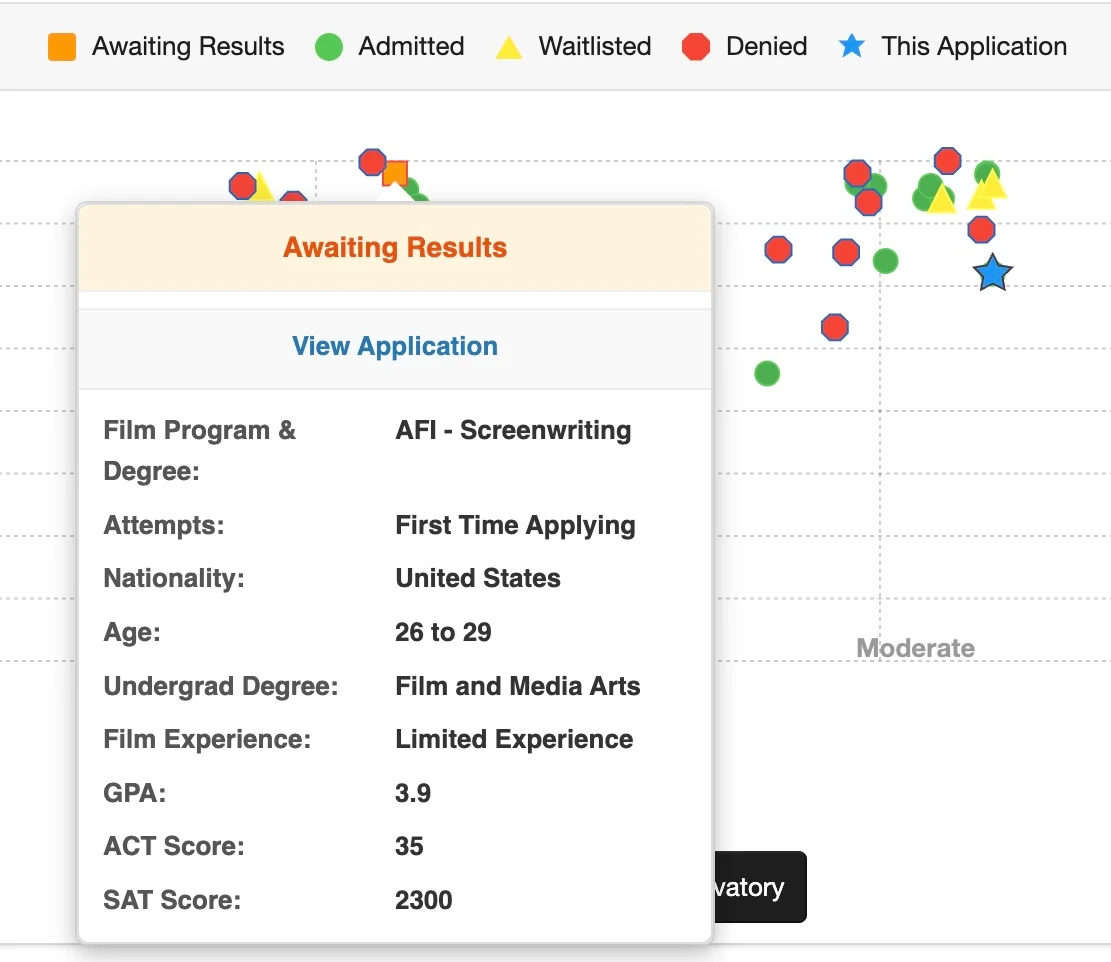
Exclusive Supporting Member Benefits
Peak behind the admissions curtain. Supporting Members unlock full access to insightful data, interviews, and more...
Instant Keyword Alerts
Visible Supporter Badge & Highlighted Profile
Share Subscription with one family member or friend
Instant access • Cancel anytime