San Diego State University - School of Theatre, Television, and Film

Website
https://ttf.sdsu.edu/programs/television-film-media
Location
Open Air Theater, 5500 Campanile Dr, San Diego, CA 92182, USA
Degrees Offered
  1. 4 Year BS
  2. 3 Year MFA
Concentrations
  1. Cinematography
  2. Directing
  3. Documentary Filmmaking
  4. Editing
  5. Film Studies / Critical Studies
  6. Film & Television Production
  7. Production Design
  8. Screenwriting
  9. Set Design

Reviews summary

2
 
50%
1
 
25%
1
 
25%
0
 
0%
0
 
0%
Overall rating
4.25 star(s) 4 reviews
Affordability
4.75 star(s)
Alumni Network
4.25 star(s)
Campus
4.75 star(s)
Career Assistance
2.75 star(s)
Collaborative Culture
4.25 star(s)
Coursework
3.25 star(s)
Facilities & Equipment
3.75 star(s)
Professors
3.75 star(s)
Scholarships
3.25 star(s)
25% are recommending this film school.
Lookback at SDSU TFM
Reviewed by: Alumni
Class Year: 2026
Degree: BA/BS/BFA
Concentration: Television, Film, and New Media: Emphasis in Production
Pros
  • Supportive faculty, students and university
  • Talented and well connected alumni network
  • Gear selection and equipment is good
  • Small Class Sizes (Production)
Cons
  • Funding for projects is limited,
  • Critical Studies focus could be better
  • Some faculty have very some outdated perspective, teaching and mindset
I have a lot to say about this film school since arriving in fall of 2022. Originally entered as critical studies, I was accepted for the Fall of 2024 into the production emphasis. I've taken a lot of the class in both critical studies and on the production emphasis. Keep in mind, the program is constantly changing and the portfolio requirements or classes so something noted might not be accurate whenever you are applying.

This review is all subjective at the end of the day. It's up to you to decide.

Production Emphasis:
Classes and Program Layout:

The production focus of the program is two year program, which had you start with TFM 314 (Introduction Class) followed by 361 (Studio Production) then 362 (Intermediate Filmmaking) alongside 540 (Documentary Production) and ending with 560 (Advanced Film). You can swap 560 with 561 (Advanced Television), which I wasn't able to take because there wasn't a professor to teach it at the time but its a route if you are wanting to focus on more Television than narrative film. You can delay taking 540 to take it alongside 560, which I wouldn't recommend cause it alot work but is an option.

I find my con of this layout is a ton of repetition especially in 362, where it feels like a repeat of 314 and things that we already know have to be re-explained. 560 as a thesis film class suffers from the fact that it should be a two semester class, split between pre-production in first and production and post in the second. I do think that one class that should be require is the internship class as one form of career prep within the film program to help student with working in the field.

Electives:
The program has a ton of elective classes that you are able to take to focus on a subject or emphasis. For me, I focused on Cinematography and Production Design as those caught my eye. The program does need more post-production/vfx as well as more producer focus classes similar to other film programs have. The program elective courses, especially in cinematography and production design do suffer from not having more classes or more professors teaching it.

Production Design emphasis has you taking TFM 350 (Staging for Film and TV Classes), followed by either focusing on Art Direction (TFM 550), Production Design (TFM 551) or Digital Design for Film and Television (TFM 559). If you focus on this route, I highly recommend taking 559 as you design sets using CAD software like Vectorworks or Rhino. Production Design and Art Direction have you focus on scenic design, graphics, set decoration, budgeting, and scheduling. You might even take a tour to Warner Bros or Paramount or Raleigh Studios.

Cinematography emphasis has you take Cinematography for Television and Film (TFM 322) and Advanced Cinematography for Television and Film (TFM 522). Both classes you make a multiple film projects with their own unique story.

Professors:
Many of the professors do teach at other schools, such as UCLA, USC, AFI and more. You sort of get some form of education that they teach there from those school in here which is nice. Many of the classes with the exception of 362, had professors with recent film industry experience or ongoing film work which is a welcome change.

Gear:
We have a good selection of gear that can be further expand, especially with the recent cohorts (including the one I was in) making more films. As of recent we had like 10 560 Films, 10 362 and a ton of documentary which lead to issue of not having enough gear for a lot of programs to use.
We also have a deal with RED Cinema Camera to buy their cinema camera at a cut priced. We also have discount pricing for a ton of the film gear rental houses.

Career Prep, Internships and Outreach:
Beside working on film projects for classes, there are a ton of opportunities in and out of the university that the department sends for students to apply to. You can work the local Emmys and a ton of news station and media companies hire students and college graduates. Similarly to other film schools, it's up to you to decide and choose to apply.

A lot of successful alumni recently have been outreaching to the program and especially graduates.

Critical Studies Emphasis:
Critical Studies focuses on the study and analysis of film, television and media and is very much different. Prior to getting into the major, I was in the Critical Studies Emphasis and it is the emphasis that you would go into if you didn't get into the Production Emphasis. You learn alot of film history and some of the classes are interesting as well semester to semester.

Classes and Program Layout:
The classes for the Critical Studies focus are on critically analyzing film, with the upper division requiring that you have taken at least TFM 310 and 330. The 400-500 level class are not for the faint of heart, as they very much test your ability to write what is essentially graduate thesis level work especially because it taught by only really professor. The interdisciplinary electives within the TFM program are very knowledgeable to have for post-graduation, and I would recommend a ton of people to take 401.

You are able to take certain Production Classes electives, such as Production Design, Sound Design and Screenwriting. So if you didn't get into the program, you have options to give you better chances and have a unique skillset for post graduation. One thing, I recommend is going on-set for some of the production as people are always looking for help.

Professors:
Similarly to the production emphasis, there are both tenure vs non tenure professors. Many of those professors teach at other schools such as UCLA, USC or UCSD.

Career Prep:
I do think one of the downfalls of the Critical Studies emphasis is that there is no help for post-college career work.

Overall:
The program for me was very fun and enjoyable, with a lot of talented people coming out from it. Some production and critical studies classes could be better structured and hiring of new staff could alleviate many of those issues. As a local from San Diego and as a transfer, it is a good film school for the price if you are local.
Affordability
5.00 star(s)
Alumni Network
5.00 star(s)
Campus
5.00 star(s)
Career Assistance
3.00 star(s)
Collaborative Culture
5.00 star(s)
Coursework
4.00 star(s)
Facilities & Equipment
4.00 star(s)
Professors
5.00 star(s)
Scholarships
4.00 star(s)
dontshootphotos recommends this film school

Attachments

  • 000000040013.webp
    000000040013.webp
    1.4 MB · Views: 4
  • 3649-1_37.webp
    3649-1_37.webp
    1.6 MB · Views: 3
  • IMG_2250.webp
    IMG_2250.webp
    830.3 KB · Views: 4
  • IMG_2273.webp
    IMG_2273.webp
    1.2 MB · Views: 2
Last edited:
Passionate professors
Reviewed by: Alumni
Class Year: 2026
Degree: BA/BS/BFA
Concentration: Television, Film, and New Media Production
Pros
  • Teachers also work at USC
  • Growing alumni network
  • Supportive students and faculty
  • Access to equipment
  • Great feedback
Cons
  • Some professors are a bit outdated
  • Lack of funding for projects
The vast majority of my professors have been outstanding, especially the female ones. They truly care about your success and the outcome of your projects. While we don’t have an excessive amount of equipment, it is a great start to make a fantastic piece. I have never felt so supported by a group of students as I have in my classes. Our alumni network is also growing, I’m excited to see where this program goes in the upcoming years!
Affordability
5.00 star(s)
Alumni Network
4.00 star(s)
Campus
5.00 star(s)
Career Assistance
3.00 star(s)
Collaborative Culture
5.00 star(s)
Coursework
5.00 star(s)
Facilities & Equipment
4.00 star(s)
Professors
5.00 star(s)
Scholarships
4.00 star(s)
It's as good as you make it
Reviewed by: Alumni
Class Year: 2024
Degree: BA/BS/BFA
Concentration: Television, Film, and New Media Production
Pros
  • Amazing access to equipment, Great collaboration with your peers, actually get to make films
Cons
  • Most professors have outdated info with little to no real film or television experience
The access to free professional equipment with little resistance is awesome. A lot of film schools do not allow easy access in this way, and the SDSU inventory is on par with the other film schools in socal, for an extremely reasonable price. Additionally, you actually get to make a short film every semester here (one semester is a documentary if you play your cards right and don't double up your schedule), whereas the other public film schools DO NOT do that.

Ultimately, the school is what you make it. You will learn from your peers and your own mistakes 10000% more than from the professors. There are a handful of amazing new professors with more experience, but when I was there it was 70% old men with no recent film industry experience, whose advice I found to be useless and outdated now that I myself work in the film industry. I truly believe this is now changing over time (and may have already), and my hint would be if you see a woman's name listed as professor: TAKE THAT CLASS.

Their career assistance has been unfortunately lackluster for me thus far, I have gotten work and jobs from putting the work in by myself (despite my persistent efforts in asking them for help), but again they are working to change this and believe it will be a lot better moving forward. Their alumni network is vast, they just need to learn how to use it, and to really do the work in having more alumni outreach to the recent successful alums, not only the older ones from a billion years ago, because I've found the recent alums from the last 5-6 years to be far more engaging and helpful.
Affordability
5.00 star(s)
Alumni Network
4.00 star(s)
Campus
5.00 star(s)
Career Assistance
2.00 star(s)
Collaborative Culture
4.00 star(s)
Coursework
3.00 star(s)
Facilities & Equipment
4.00 star(s)
Professors
3.00 star(s)
Scholarships
3.00 star(s)
Nothing special
Reviewed by: Alumni
Degree: BA/BS/BFA
Concentration: Television, Film, and New Media, emphasis in production
Pros
  • Peers
  • Connections
  • Work opportunities
Cons
  • Most professors aren’t very insightful
  • Repetitive coursework, may end up learning “beginning” subjects in “advanced” classes
  • Course subjects can sometimes not be very relevant
You really kind of get what you pay for with this program. It might be one of the cheapest programs out there but it’s also one of the most disorganized and least useful. Most of what will learn will be from your peers, which could be really great or really bad, or from the couple of actually insightful faculty members.

If you absolutely need to join this program to just start getting your feet wet, it can still work as the connections you make can lead to work (even a couple of the professors have offered some work to students), but don’t expect to do much learning while in the classes.
Affordability
4.00 star(s)
Alumni Network
4.00 star(s)
Campus
4.00 star(s)
Career Assistance
3.00 star(s)
Collaborative Culture
3.00 star(s)
Coursework
1.00 star(s)
Facilities & Equipment
3.00 star(s)
Professors
2.00 star(s)
Scholarships
2.00 star(s)

Latest Accepted Applications

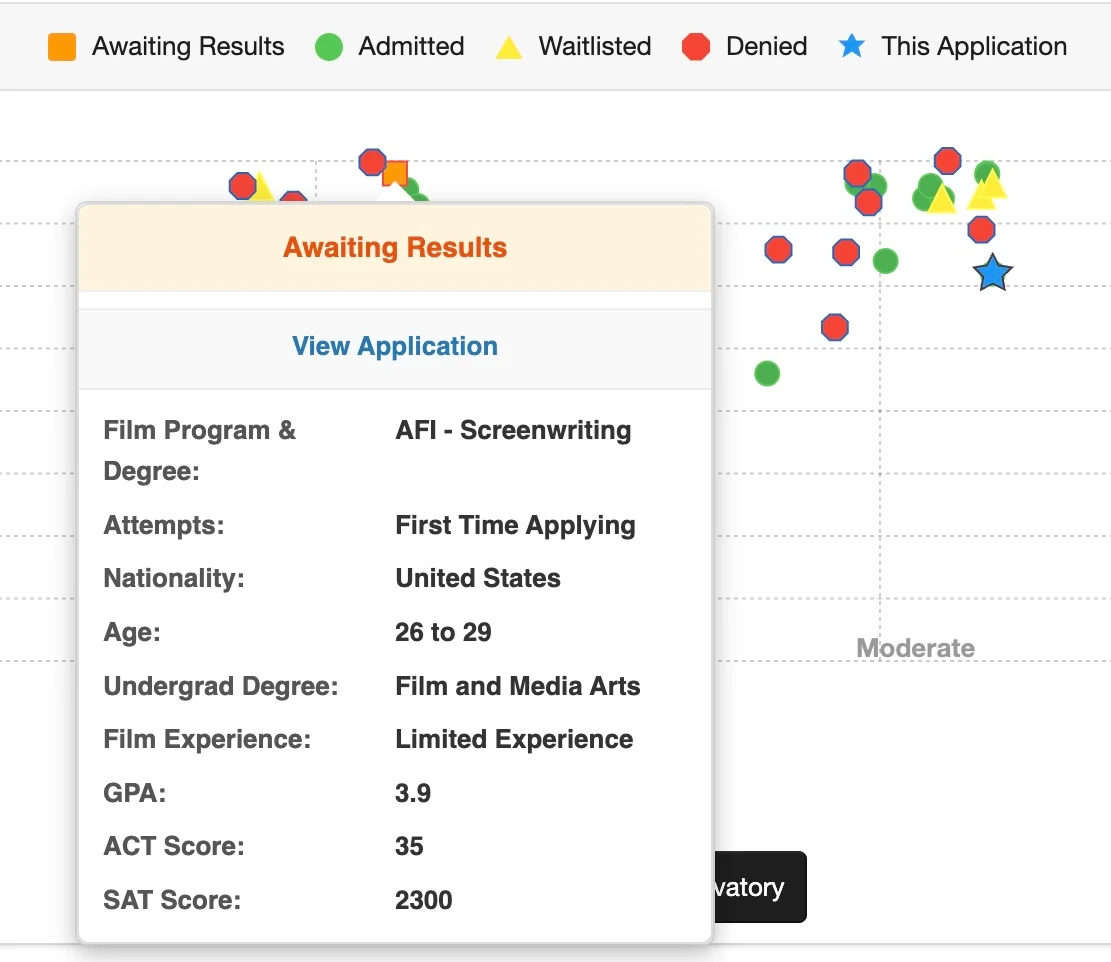
This Application in the Scattergram

Exclusive Supporting Member Benefits

Peak behind the admissions curtain. Supporting Members unlock full access to insightful data, interviews, and more...

Instant Keyword Alerts
Visible Supporter Badge & Highlighted Profile
Share Subscription with one family member or friend

Instant access • Cancel anytime

Applications
Articles
Forums
Film Schools
Scholarships
Back
Top