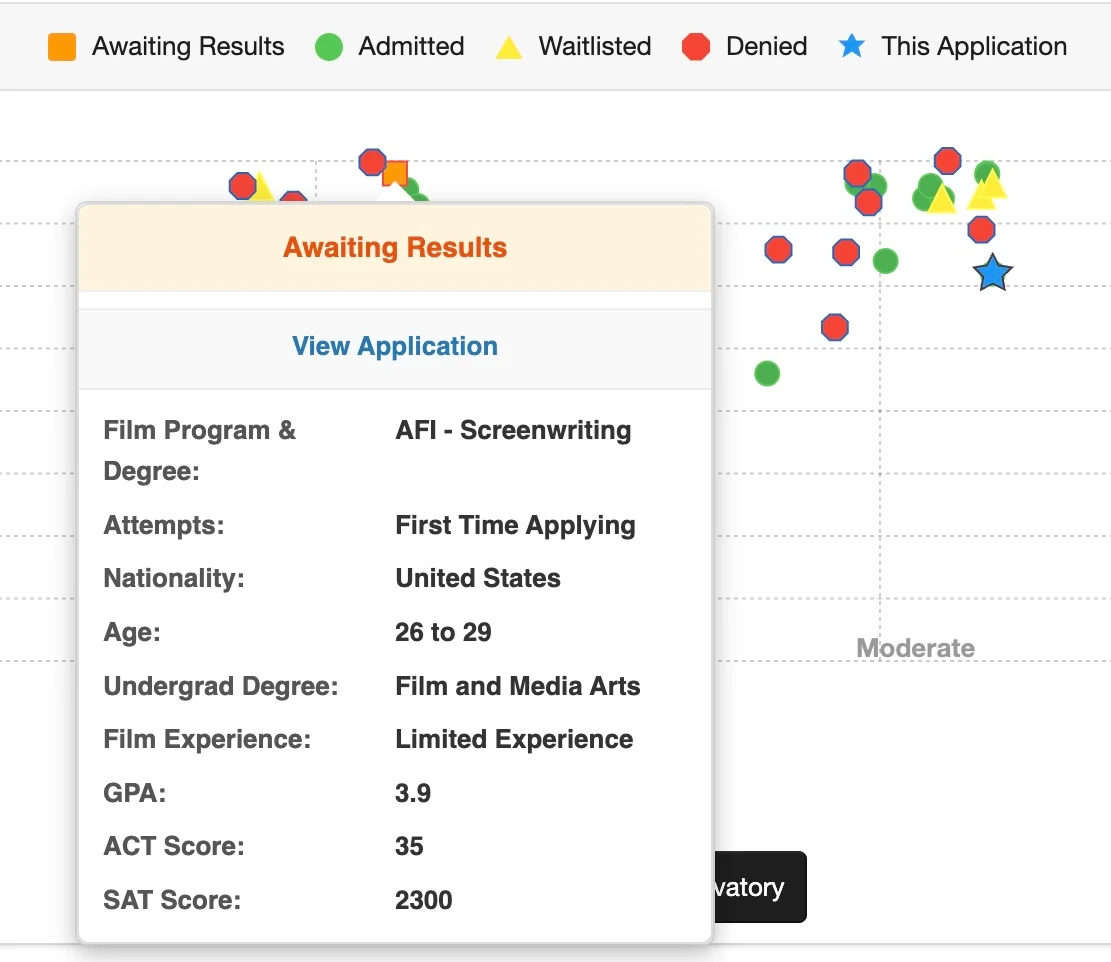
California Institute of the Arts, better known as CalArts, offers an artistic community where filmmakers are encouraged to experiment and explore their creative identities. Walt Disney founded the school in 1961, envisioning an institution where artists of every kind could learn from each other. Disney's vision holds true today: undergraduate and graduate film students have endless opportunities to take courses in music, dance, and other areas of the fine arts. The school is located only 30 miles north of Hollywood, giving students access to networking opportunities, internships, and first jobs that set them up for success.
While CalArts’ live action film program has produced prolific names in the industry, such as Academy Award-winning sound designer Dane A. Davis (“The Matrix” trilogy), director James Mangold (“Walk the Line,” “Logan”) and director Tim Burton (Dir., “Beetlejuice,” “The Nightmare Before Christmas,”), animation is arguably where CalArts has had its greatest success. The school's Character Animation and Experimental Animation programs earned the no. 1 spot in all 15 eligible categories in Animation Career Review's 2026 rankings for the sixth consecutive year. Prestigious animators who graduated from CalArts include Pete Docter (“Inside Out,” “Up”), Andrew Stanton (“Finding Nemo,” “WALL·E”), Chris Buck (“Frozen”), and Daniel Chong (“Hoppers”).
Alexa Pellegrini for FilmSchool.org spoke with Ranu Mukherjee to share deeper insights into getting admitted to CalArts and what the school looks for in applicants.
Ranu Mukherjee is the Dean of the School of Film/Video at CalArts. She has been at CalArts since 2024, and her career has spanned more than thirty years in higher education. Previously, she was a professor and chair at the California College of Arts in San Francisco; prior to that, she was on the faculty at Goldsmiths College in London. Mukherjee is also a practicing artist whose work spans painting and film installation. Her cross-disciplinary practice is central to her approach as an educator and drew her to CalArts' model of integrating the arts. You can view Mukherjee’s work in the permanent collections of the Asian Art Museum, San Francisco; de Young Museum, San Francisco; Escalette Collection at Chapman University, Orange, California; and the Oakland Museum of California, among others. She has served on the boards of directors at the San Jose Museum of Art and Bridge Live Arts, and is currently a board member at Southern Exposure.
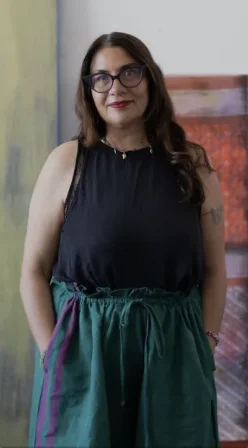
Ranu Mukherjee
Editor's note: This interview is approximately 12 pages. Part 2 (7 pages) offers a closer look into the types of films students create, how students collaborate across disciplines, the CalArts alumni network, and more. It is available exclusively to Supporting Members, without whom in-depth articles and interviews like this one would not be possible as FilmSchool.org is 100% advertisement-free. Supporting Members also enjoy access to our database that tracks upwards of 5,000 film school applications and the full Acceptance Data statistics for each film program that helps demystify common questions about how to construct a winning portfolio, ideal GPAs and GRE scores, and much more.
Ranu Mukherjee: The way we describe [CalArts] is that it’s an art school film program. Training the total filmmaker [...] means that our students will come in and learn the basic skills of their field while developing their vision as an artist. A lot of people find their way into what they want to do through our process, and also what their vision is and what they want to make.
The pipeline taught in a lot of conventional film schools is very much like this: Students are proposing different scripts, and then a few scripts are chosen to be made. They're working in a team and people are assigned roles. So, that model is great if you definitely know you want to be a DP, and you want to go to a film school where you know you're primarily going to do that role. But if you really want to expand your work, and be certain you will be making your own work along with serving others, CalArts is a great fit.
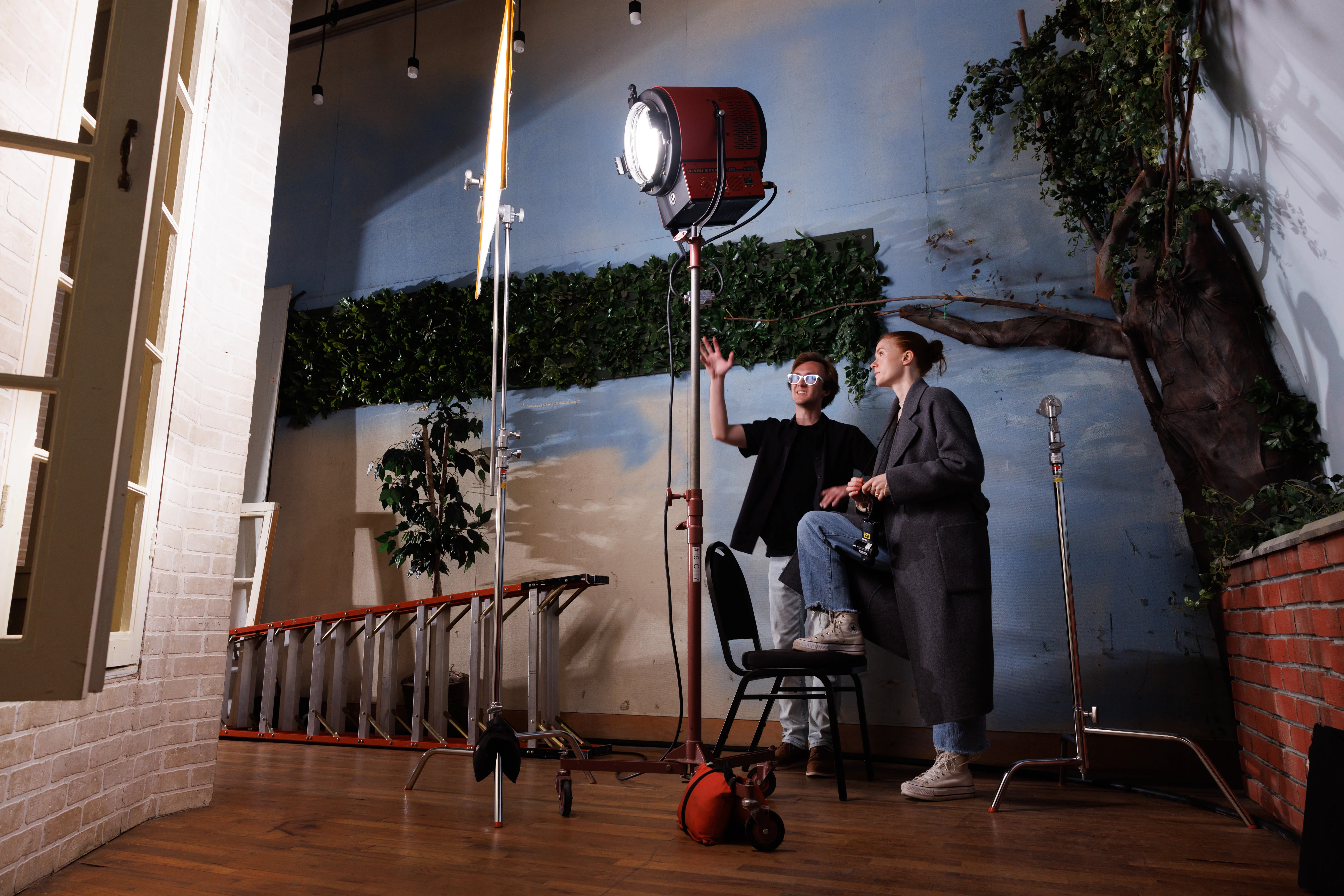
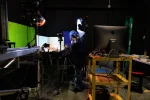
CalArts students collaborate on film lighting. (Courtesy: Ranu Mukherjee)
RM: Film students benefit from sometimes being in courses with students from our Music school, Theater school, Art school, and Dance School. We have students who do a range of different kinds of projects. [...] For example, Character Animation students often work with Acting students to do voice-overs on their animations. We have an advanced acting class that includes theater students who want to work in film, too. So, there is a lot of cross-pollination across different areas.
Music students often come and train to work in the realm of cinema, and our film students have access to musicians for sound for their films. We have a pretty advanced sound area, so there's a possibility of creating full sound mixes on students’ films. We try to take the sound part of filmmaking very seriously. We think of it as at least 50% of making a film.
RM: We have a fully seated mixing theater for sound, where you can mix the sound while watching the projection of the film. We also have a recording booth so people can do ADR, that kind of thing. And then, we have a required sound curriculum for all our film students.
We also have electives like ‘Bad Sound,’ which is sort of an experimental class that thinks about everyday sound in your environment, how to record things, and about the different qualities of microphones that you can use to get different kinds of sounds. Also, right now, we're trying to collaborate more with the Music school so that some film students can get basic music instruction as well.
RM: We are looking for imagination, passion, and interesting ideas. You know, somebody who is motivated by their inner life, or their relationship to the world in some way. I think all of CalArts’ programs are really looking for [...] that artistic authorship. If someone is coming to learn one specific skill or be on only one side of the filmmaking equation, CalArts is not the best film school for them. There are programs where you can just learn to be a sound designer, for example; that's not our school.
We don't expect people who apply to be completely developed, because that's why you go to art school. But we expect to see their imagination in their portfolios. We are a very diverse community, so when we look at [...] the essay, we are looking for the whole person in there — who they are, and how that plays into what they want to make.
RM: Interviews play an important role as stage two of the MFA admissions process. This is a way that faculty can get to know the candidate and vice versa. We want to have a conversation with the graduate students to understand their ambitions, interests and ideas and emergent visions for work not yet made, in addition to what is in the application.
They do not need to come in with a project in hand — this is what they develop while here. We know that this is a big decision for an emerging filmmaker. CalArts is a small school and one of the benefits is to have a close connection to your faculty- this is what can begin in an interview.
RM: Faculty admissions panels focus on the portfolio and statement, as well as prior experience and recommendations, to determine an artistic ranking. They review other factors such as GPA and transcripts to make sure candidates meet the minimum requirements.
So, it is a holistic admissions process with the weight being on artistic merit. This includes vision and experience as well as the portfolio; it is not simply about prior technical skills.
RM: Our most recent numbers, from 2025, are:
RM: We have an Experimental Animation BFA and MFA. Then we have Character Animation, which is only a BFA.
Experimental Animation [...] looks at the industry, the art world, and film festival world at the same time, and students are very interested in making animation in a way that's very hybrid. So, those students will learn, at the very beginning, different techniques. There’s a lot of [drawing by hand], stop motion, clay animation, puppetry, and building sets. So, there's a lot of handmade, physical work going on. Students also do CG, and some of them are starting to work with AI applications. And so, a lot of work in our Experimental Animation program is hybrid in that way, since it combines technology and techniques. Students move into specializations over time; some students are just doing motion capture, for instance. BFAs and MFAs have a few core courses that they have to take, and they have a lot more room to take electives. These students might take more [electives] in art or dance.
The Character Animation BFA is really focused on traditional character animation. It's kind of unconventional but it's definitely industry-facing. Students make a film every year, with a year-long film workshop that ends with a finished film—the same as our Experimental Animation students. But Character Animation, in comparison, is centered around story development and character development, where they move from a lot of hand drawing to digital animation and visual development. This program is very structured all the way through. They do take a couple of electives, but not as many.
RM: The BFA in Film and Video, which is our undergraduate live-action program, begins with core classes Filmmaking Fundamentals I and II in the first semester and second semester. One thing that's really important to note is that all the technical and conceptual are totally melded in these courses. We don't really see the making as different from learning to use these tools. They'll learn about all sorts of different approaches to live-action filmmaking, and look at a lot of work, as well as starting to develop their own projects.
Then they take ‘Cinematography’ and ‘Digital Editing' in the fall. In 'Cinematography,' they learn the basic functions of cinematography and stage setup. They also learn about lighting, thinking about on-set versus outdoor lighting, et cetera. They have a lecture, and then they have a hands-on section.
‘Digital Editing’ is exactly as it sounds: a basic editing class. Then, students take ‘Production Sound’ in the fall and ‘Post-Production Sound’ in the spring. So, that’s sort of self-explanatory. But it's important to point out that, again, we're not thinking of the tools as separate from the conceptual understanding of what sound is in a film. We’re thinking about the dimensions you can open up by working with sound, same as with working with light and image.
Then, students take ‘Film History’ in the spring, which is a deep dive into the history of cinema. It’s a very dense curriculum in the first year, which sets everybody out for the same kind of grounding. We also recommend that they take a class called ‘Aesthetics of Sound and Image,’ which is about the relationship between the visual and the aural elements of film.
When they go into their second year, they do a production workshop in the fall, which follows more of a personal filmmaking model. And then, in the spring, they take ‘Advanced Production,’ which is crew-based filmmaking, or ‘Multi-Channel Installation,’ which is more about multi-channel spatial presentation. So, students start to think about where they're oriented and what kind of moving image work they want to make.
We also have an ‘Optical Printing’ class where students work with 16 millimeter film. Students work in digital filmmaking, but we still offer a lot of hand processing classes where they can also work with celluloid film, if they want. We also have art installation classes where students can think about the world of cinema versus the art world.
After that [...] students can take electives in different areas, depending on what kind of work they want to do. They can also take electives outside of the program. So, the first year is the only one that's super-super-structured. In the second year, it starts to open up and slowly, they get into exploring their own style.
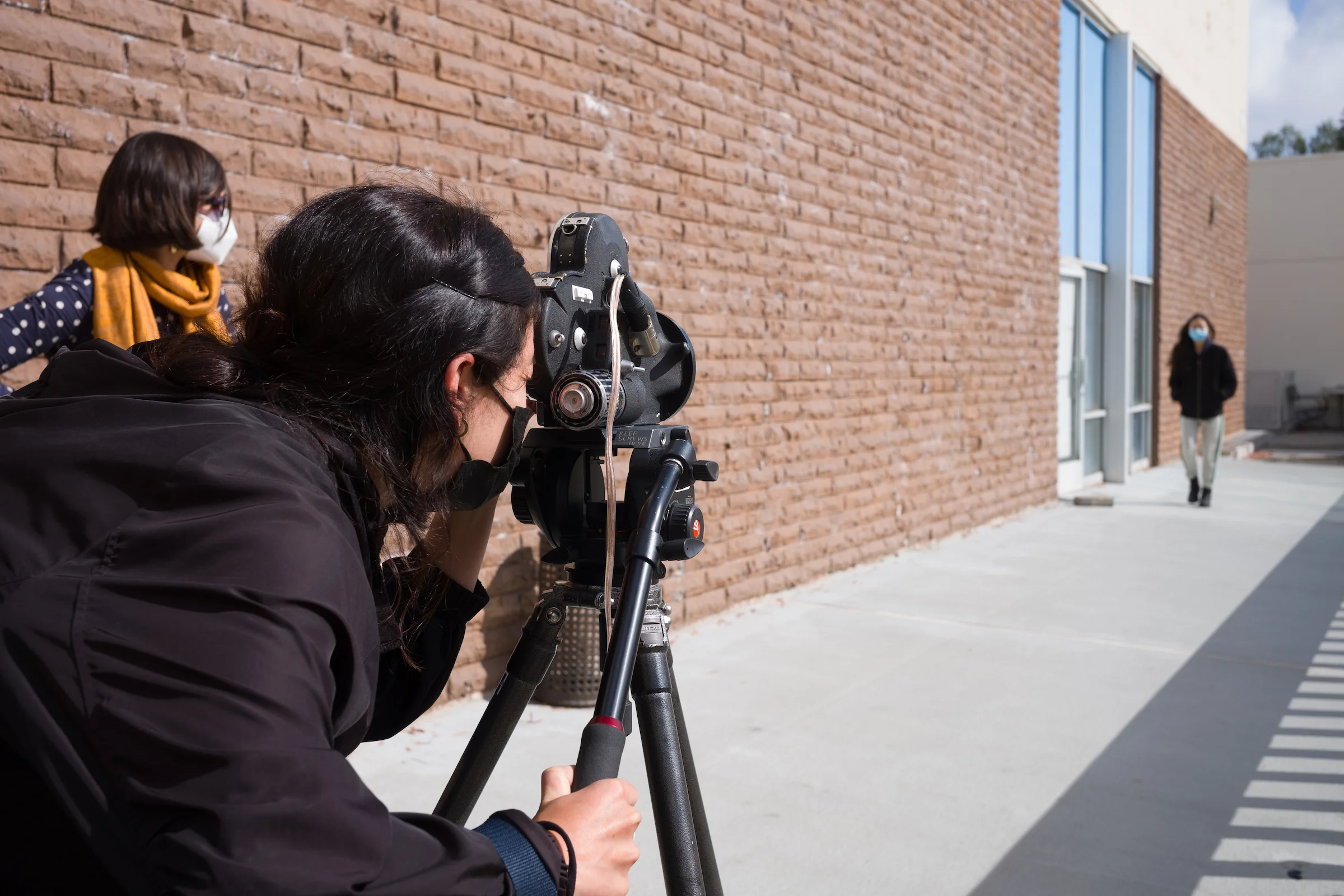
CalArts live-action students shooting on campus. (Courtesy: Ranu Mukherjee)
RM: The Film Directing MFA [...] is a narrative program. Essentially, that is where our narrative filmmakers go, because it approaches narrative from a curious point of view, not a conventional medium where there is one way to make a film. Both of our MFA programs are a minimum of three years, which gives our students a lot of time to create a thesis. They start thinking about the thesis in their second year; some people come in knowing the thesis they want to make, but a lot of people explore that. We encourage people to explore.
The Film and Video MFA has a lot of fundamentals classes similar to undergrad, but they’re doing more advanced projects. MFAs don't take the fundamentals because they’re coming in with a lot more experience, but they do have to take Cinematography and Digital Editing, just to beef up their skills in those areas. Then, they have their own film production workshops where they make their own films. And they have Cinematic Voices, a class on contemporary filmmakers.
MFAs have to take a menu of classes [...] in staging and performance, including ‘Scene Study,’ ‘Visual Design,’ ‘Acting I,’ and ‘Advanced Acting.’ The acting piece goes back to the total filmmaker idea where you're on a lot of different sides of this equation. MFAs have to take at least three courses in structure and form so they learn narrative structure, cinematic storytelling, long-form and short-form screenwriting, and advanced script-writing, depending on what kind of writer they want to be. We also have students working within different narrative structures, such as the essay films melding aspects of documentary and fiction.
MFAs take image and sound classes: Cinema Production, Post-production, and Post-Production Sound. They take ‘Cinematography for Directors.’ They have to take ‘Film History I’ and ‘Film History II,’ plus classes on process, which includes ‘Project Development,’ ‘Thesis Workshop,’ and ‘Narrative Editing.’ They also take special topics courses developed by our faculty. The really interesting one is called ‘The Taste of Cinema,’ taught by Ki Jin Kim. It’s like a cooking class, but students shoot films and think about the dinner table scene, which is a very common trope in cinema. They get to think about that from a lot of different angles while cooking.
RM: We have professional development classes for MFAs, like ‘Film School to the Film World.’ Everybody studies on a mentor model, too. So, no matter what program you’re in, everyone has a mentor who oversees their education, filmmaking, and transition into the professional world.
RM: Each of our programs has its own director. When we have a class coming in, the directors meet to discuss how to assign mentors at the beginning of their program, but students can request to change them.
We also offer independent studies. Students may work with [a mentor] for a semester or a year on their projects and then they choose to study independently. Independent studies are really about the match between the expertise of the faculty and the student needs for their own work. For instance, you may be really skilled at creative writing, but maybe need more help on your cinematography or photography skills. You might ask one of the faculty with expertise in that area to work with you on a cinema project.
Mentors are generally our core faculty who know that school really well. Part of the mentorship is about navigating CalArts as an institution, looking at your degree and how you're moving through it, talking to you when any issues come up. They’re kind of a consistent voice during the program. (Again, students can also change who they're assigned to.) They have weekly faculty meetings for each program. And so, some of this gets discussed because our core faculty are the ones who are doing the admissions work. They get to choose our incoming class. So, they start thinking about assigning mentors during that process.
Part 2 of our CalArts interview dives into what makes an application memorable (and common mistakes to avoid), the undergraduate mid-residency review, guest speakers, how CalArts prepares film students for a rapidly changing industry, and insights from Mukherjee on what it means to express yourself as an artist. To keep reading, upgrade your membership.
To learn more about CalArts, get in touch with Ranu by emailing rmukherjee@calarts.edu. You can also reach out to CalArts’ Live Action admissions advisor, Ani Kazandjian, at akazandjian@calarts.edu, and Animation admissions advisor, Patrick Schmid, at pschmid@calarts.edu.
Applying to CalArts? Connect with other FilmSchool.org members in our Application Year threads. After you apply, help support our community by logging your application.
Help keep FilmSchool.org 100% ad-free. Articles and interviews like this are made possible by our Supporting Members. By joining, you'll unlock access to exclusive bonus articles, our comprehensive application database (Scattergram, GPAs, portfolios, and more), 45 charts that offer a deep dive into Film School Acceptance Statistics, Keyword Alerts to get notified via email, on-site notification, or both when new content is posted using words you're tracking, and other outstanding features.
While CalArts’ live action film program has produced prolific names in the industry, such as Academy Award-winning sound designer Dane A. Davis (“The Matrix” trilogy), director James Mangold (“Walk the Line,” “Logan”) and director Tim Burton (Dir., “Beetlejuice,” “The Nightmare Before Christmas,”), animation is arguably where CalArts has had its greatest success. The school's Character Animation and Experimental Animation programs earned the no. 1 spot in all 15 eligible categories in Animation Career Review's 2026 rankings for the sixth consecutive year. Prestigious animators who graduated from CalArts include Pete Docter (“Inside Out,” “Up”), Andrew Stanton (“Finding Nemo,” “WALL·E”), Chris Buck (“Frozen”), and Daniel Chong (“Hoppers”).
Alexa Pellegrini for FilmSchool.org spoke with Ranu Mukherjee to share deeper insights into getting admitted to CalArts and what the school looks for in applicants.
Ranu Mukherjee is the Dean of the School of Film/Video at CalArts. She has been at CalArts since 2024, and her career has spanned more than thirty years in higher education. Previously, she was a professor and chair at the California College of Arts in San Francisco; prior to that, she was on the faculty at Goldsmiths College in London. Mukherjee is also a practicing artist whose work spans painting and film installation. Her cross-disciplinary practice is central to her approach as an educator and drew her to CalArts' model of integrating the arts. You can view Mukherjee’s work in the permanent collections of the Asian Art Museum, San Francisco; de Young Museum, San Francisco; Escalette Collection at Chapman University, Orange, California; and the Oakland Museum of California, among others. She has served on the boards of directors at the San Jose Museum of Art and Bridge Live Arts, and is currently a board member at Southern Exposure.
Ranu Mukherjee
Editor's note: This interview is approximately 12 pages. Part 2 (7 pages) offers a closer look into the types of films students create, how students collaborate across disciplines, the CalArts alumni network, and more. It is available exclusively to Supporting Members, without whom in-depth articles and interviews like this one would not be possible as FilmSchool.org is 100% advertisement-free. Supporting Members also enjoy access to our database that tracks upwards of 5,000 film school applications and the full Acceptance Data statistics for each film program that helps demystify common questions about how to construct a winning portfolio, ideal GPAs and GRE scores, and much more.
CalArts says that it trains the "total filmmaker." What does that mean?
Ranu Mukherjee: The way we describe [CalArts] is that it’s an art school film program. Training the total filmmaker [...] means that our students will come in and learn the basic skills of their field while developing their vision as an artist. A lot of people find their way into what they want to do through our process, and also what their vision is and what they want to make.
The pipeline taught in a lot of conventional film schools is very much like this: Students are proposing different scripts, and then a few scripts are chosen to be made. They're working in a team and people are assigned roles. So, that model is great if you definitely know you want to be a DP, and you want to go to a film school where you know you're primarily going to do that role. But if you really want to expand your work, and be certain you will be making your own work along with serving others, CalArts is a great fit.
CalArts students collaborate on film lighting. (Courtesy: Ranu Mukherjee)
Since CalArts is first and foremost an art school, what does that collaboration with film and other disciplines entail?
RM: Film students benefit from sometimes being in courses with students from our Music school, Theater school, Art school, and Dance School. We have students who do a range of different kinds of projects. [...] For example, Character Animation students often work with Acting students to do voice-overs on their animations. We have an advanced acting class that includes theater students who want to work in film, too. So, there is a lot of cross-pollination across different areas.
Music students often come and train to work in the realm of cinema, and our film students have access to musicians for sound for their films. We have a pretty advanced sound area, so there's a possibility of creating full sound mixes on students’ films. We try to take the sound part of filmmaking very seriously. We think of it as at least 50% of making a film.
What kind of sound equipment and space do students get to work with?
RM: We have a fully seated mixing theater for sound, where you can mix the sound while watching the projection of the film. We also have a recording booth so people can do ADR, that kind of thing. And then, we have a required sound curriculum for all our film students.
We also have electives like ‘Bad Sound,’ which is sort of an experimental class that thinks about everyday sound in your environment, how to record things, and about the different qualities of microphones that you can use to get different kinds of sounds. Also, right now, we're trying to collaborate more with the Music school so that some film students can get basic music instruction as well.
What is admissions looking for in the creative sample and personal essay?
RM: We are looking for imagination, passion, and interesting ideas. You know, somebody who is motivated by their inner life, or their relationship to the world in some way. I think all of CalArts’ programs are really looking for [...] that artistic authorship. If someone is coming to learn one specific skill or be on only one side of the filmmaking equation, CalArts is not the best film school for them. There are programs where you can just learn to be a sound designer, for example; that's not our school.
We don't expect people who apply to be completely developed, because that's why you go to art school. But we expect to see their imagination in their portfolios. We are a very diverse community, so when we look at [...] the essay, we are looking for the whole person in there — who they are, and how that plays into what they want to make.
Do you require an interview for admissions? If so, how should applicants prepare?
RM: Interviews play an important role as stage two of the MFA admissions process. This is a way that faculty can get to know the candidate and vice versa. We want to have a conversation with the graduate students to understand their ambitions, interests and ideas and emergent visions for work not yet made, in addition to what is in the application.
They do not need to come in with a project in hand — this is what they develop while here. We know that this is a big decision for an emerging filmmaker. CalArts is a small school and one of the benefits is to have a close connection to your faculty- this is what can begin in an interview.
How much weight do the portfolio and personal statement have in admissions?
RM: Faculty admissions panels focus on the portfolio and statement, as well as prior experience and recommendations, to determine an artistic ranking. They review other factors such as GPA and transcripts to make sure candidates meet the minimum requirements.
So, it is a holistic admissions process with the weight being on artistic merit. This includes vision and experience as well as the portfolio; it is not simply about prior technical skills.
What is the acceptance rate for each undergraduate and graduate film program?
RM: Our most recent numbers, from 2025, are:
- Character Animation (BFA) 13%
- Experimental Animation (BFA) 32%
- Experimental Animation (MFA) 19%
- Film/Video (BFA) 23%
- Film/Video (MFA) 33%
- Film Directing (BFA) 27%
Could you share more about CalArts' prestigious Animation programs?
RM: We have an Experimental Animation BFA and MFA. Then we have Character Animation, which is only a BFA.
Experimental Animation [...] looks at the industry, the art world, and film festival world at the same time, and students are very interested in making animation in a way that's very hybrid. So, those students will learn, at the very beginning, different techniques. There’s a lot of [drawing by hand], stop motion, clay animation, puppetry, and building sets. So, there's a lot of handmade, physical work going on. Students also do CG, and some of them are starting to work with AI applications. And so, a lot of work in our Experimental Animation program is hybrid in that way, since it combines technology and techniques. Students move into specializations over time; some students are just doing motion capture, for instance. BFAs and MFAs have a few core courses that they have to take, and they have a lot more room to take electives. These students might take more [electives] in art or dance.
The Character Animation BFA is really focused on traditional character animation. It's kind of unconventional but it's definitely industry-facing. Students make a film every year, with a year-long film workshop that ends with a finished film—the same as our Experimental Animation students. But Character Animation, in comparison, is centered around story development and character development, where they move from a lot of hand drawing to digital animation and visual development. This program is very structured all the way through. They do take a couple of electives, but not as many.
What does the core BFA curriculum look like before students start branching into electives?
RM: The BFA in Film and Video, which is our undergraduate live-action program, begins with core classes Filmmaking Fundamentals I and II in the first semester and second semester. One thing that's really important to note is that all the technical and conceptual are totally melded in these courses. We don't really see the making as different from learning to use these tools. They'll learn about all sorts of different approaches to live-action filmmaking, and look at a lot of work, as well as starting to develop their own projects.
Then they take ‘Cinematography’ and ‘Digital Editing' in the fall. In 'Cinematography,' they learn the basic functions of cinematography and stage setup. They also learn about lighting, thinking about on-set versus outdoor lighting, et cetera. They have a lecture, and then they have a hands-on section.
‘Digital Editing’ is exactly as it sounds: a basic editing class. Then, students take ‘Production Sound’ in the fall and ‘Post-Production Sound’ in the spring. So, that’s sort of self-explanatory. But it's important to point out that, again, we're not thinking of the tools as separate from the conceptual understanding of what sound is in a film. We’re thinking about the dimensions you can open up by working with sound, same as with working with light and image.
Then, students take ‘Film History’ in the spring, which is a deep dive into the history of cinema. It’s a very dense curriculum in the first year, which sets everybody out for the same kind of grounding. We also recommend that they take a class called ‘Aesthetics of Sound and Image,’ which is about the relationship between the visual and the aural elements of film.
When they go into their second year, they do a production workshop in the fall, which follows more of a personal filmmaking model. And then, in the spring, they take ‘Advanced Production,’ which is crew-based filmmaking, or ‘Multi-Channel Installation,’ which is more about multi-channel spatial presentation. So, students start to think about where they're oriented and what kind of moving image work they want to make.
We also have an ‘Optical Printing’ class where students work with 16 millimeter film. Students work in digital filmmaking, but we still offer a lot of hand processing classes where they can also work with celluloid film, if they want. We also have art installation classes where students can think about the world of cinema versus the art world.
After that [...] students can take electives in different areas, depending on what kind of work they want to do. They can also take electives outside of the program. So, the first year is the only one that's super-super-structured. In the second year, it starts to open up and slowly, they get into exploring their own style.
CalArts live-action students shooting on campus. (Courtesy: Ranu Mukherjee)
On the graduate side, what can students expect from the live-action Film and Video program and Film Directing program?
RM: The Film Directing MFA [...] is a narrative program. Essentially, that is where our narrative filmmakers go, because it approaches narrative from a curious point of view, not a conventional medium where there is one way to make a film. Both of our MFA programs are a minimum of three years, which gives our students a lot of time to create a thesis. They start thinking about the thesis in their second year; some people come in knowing the thesis they want to make, but a lot of people explore that. We encourage people to explore.
The Film and Video MFA has a lot of fundamentals classes similar to undergrad, but they’re doing more advanced projects. MFAs don't take the fundamentals because they’re coming in with a lot more experience, but they do have to take Cinematography and Digital Editing, just to beef up their skills in those areas. Then, they have their own film production workshops where they make their own films. And they have Cinematic Voices, a class on contemporary filmmakers.
MFAs have to take a menu of classes [...] in staging and performance, including ‘Scene Study,’ ‘Visual Design,’ ‘Acting I,’ and ‘Advanced Acting.’ The acting piece goes back to the total filmmaker idea where you're on a lot of different sides of this equation. MFAs have to take at least three courses in structure and form so they learn narrative structure, cinematic storytelling, long-form and short-form screenwriting, and advanced script-writing, depending on what kind of writer they want to be. We also have students working within different narrative structures, such as the essay films melding aspects of documentary and fiction.
MFAs take image and sound classes: Cinema Production, Post-production, and Post-Production Sound. They take ‘Cinematography for Directors.’ They have to take ‘Film History I’ and ‘Film History II,’ plus classes on process, which includes ‘Project Development,’ ‘Thesis Workshop,’ and ‘Narrative Editing.’ They also take special topics courses developed by our faculty. The really interesting one is called ‘The Taste of Cinema,’ taught by Ki Jin Kim. It’s like a cooking class, but students shoot films and think about the dinner table scene, which is a very common trope in cinema. They get to think about that from a lot of different angles while cooking.
What is CalArts doing to set film students up for the industry once they graduate?
RM: We have professional development classes for MFAs, like ‘Film School to the Film World.’ Everybody studies on a mentor model, too. So, no matter what program you’re in, everyone has a mentor who oversees their education, filmmaking, and transition into the professional world.
Once a mentor is assigned, can students request a change?
RM: Each of our programs has its own director. When we have a class coming in, the directors meet to discuss how to assign mentors at the beginning of their program, but students can request to change them.
We also offer independent studies. Students may work with [a mentor] for a semester or a year on their projects and then they choose to study independently. Independent studies are really about the match between the expertise of the faculty and the student needs for their own work. For instance, you may be really skilled at creative writing, but maybe need more help on your cinematography or photography skills. You might ask one of the faculty with expertise in that area to work with you on a cinema project.
Mentors are generally our core faculty who know that school really well. Part of the mentorship is about navigating CalArts as an institution, looking at your degree and how you're moving through it, talking to you when any issues come up. They’re kind of a consistent voice during the program. (Again, students can also change who they're assigned to.) They have weekly faculty meetings for each program. And so, some of this gets discussed because our core faculty are the ones who are doing the admissions work. They get to choose our incoming class. So, they start thinking about assigning mentors during that process.
Thank you for reading! The interview continues in part 2…
Part 2 of our CalArts interview dives into what makes an application memorable (and common mistakes to avoid), the undergraduate mid-residency review, guest speakers, how CalArts prepares film students for a rapidly changing industry, and insights from Mukherjee on what it means to express yourself as an artist. To keep reading, upgrade your membership.
To learn more about CalArts, get in touch with Ranu by emailing rmukherjee@calarts.edu. You can also reach out to CalArts’ Live Action admissions advisor, Ani Kazandjian, at akazandjian@calarts.edu, and Animation admissions advisor, Patrick Schmid, at pschmid@calarts.edu.
Applying to CalArts? Connect with other FilmSchool.org members in our Application Year threads. After you apply, help support our community by logging your application.
Help keep FilmSchool.org 100% ad-free. Articles and interviews like this are made possible by our Supporting Members. By joining, you'll unlock access to exclusive bonus articles, our comprehensive application database (Scattergram, GPAs, portfolios, and more), 45 charts that offer a deep dive into Film School Acceptance Statistics, Keyword Alerts to get notified via email, on-site notification, or both when new content is posted using words you're tracking, and other outstanding features.