LMU First Year MFA (Writing & Producing for TV) AMA!

theMorrigan

Active Member
Supporter+
Hi all! Finishing up my first semester at LMU. I know that when I was in the waiting to hear on applications period, reading FilmSchool.org threads helped me with decision anxiety.

Questions about your application? Thinking about applying next year? Hit me up and AMA!
 
Hi all! Finishing up my first semester at LMU. I know that when I was in the waiting to hear on applications period, reading FilmSchool.org threads helped me with decision anxiety.

Questions about your application? Thinking about applying next year? Hit me up and AMA!
How's the first semester? Do you have any specific pros and cons?
 
How's the first semester? Do you have any specific pros and cons?
The first semester was phenomenal. Despite some Covid restrictions on mixers and the like, our class sizes allowed for in-person (masked, with free tests whenever we wanted/needed them) instruction. Two of our classes in the first semester (Elements of TV Writing and Writing the TV Series Spec (where you could choose drama or comedy) were workshop heavy. In the former, we got to dabble in writing sequences for every TV genre and in the latter, we wrote a full spec episode for the series selected by the professor. My class did The Equalizer, Queen Latifah's current series, and it was a blast. The third class was TV History, and it was surprisingly creative along with the academia one would expect from a history class.

Pros
  • LMU has three MFA tracks: Writing & Producing for TV (WPTV), Writing for the Screen, and Film & TV Production. Because our program is three years, we get both a deep dive into our track, plus experience in the other tracks. Next semester, I'll have both Production Fundamentals specific to WPTV and Writing the Feature.
  • LMU's educators, like many programs, have experience in the business and many are still active. That's a really cool touchpoint.
  • LMU wants a robust program that serves the grad students' needs. As such, our end of semester performance review wasn't just about our performance but was an opportunity to provide feedback in what would serve us best in breaking into the industry after graduation.
  • We get as much talk about business as we do about craft. That's key and awesome.
  • LMU curates cohorts that bring a vast variety of experience to the table. Not everyone studied film in undergrad, and that makes for an incredible workshop experience.
  • The School of Film & Television (SFTV) has its own campus in Playa Vista. The editing bays, ADR room, sound stages, makeup/hair studios, theater, and classrooms are top notch.
  • LMU fosters an atmosphere where all three programs are encouraged to consider ourselves as one cohort. Plenty of opportunities to work together and dig into the collaborative nature of the film and television process.
  • Instructor feedback is designed to help us become the best writers we can be, and that's not just in the words on the page. It's about how we interact in the room, how we accept notes and integrate them, how we work with our collaborators.
  • Our Career Development center is handling Covid restrictions incredibly well and the availability doesn't seem impacted too much.
I feel like the only real cons at the moment are Covid specific. I haven't had an opportunity to be on set yet; I'll be doing that next semester. The program prefers that we not do internships or work in the first year (though, I do know there are some who do). I kept a remote development internship from my undergrad program because the studio begged, and they've been really flexible about their expectations. I'm upfront with them about what I can do each week. Grad school is A LOT of work, but it's very rewarding!
 
The first semester was phenomenal. Despite some Covid restrictions on mixers and the like, our class sizes allowed for in-person (masked, with free tests whenever we wanted/needed them) instruction. Two of our classes in the first semester (Elements of TV Writing and Writing the TV Series Spec (where you could choose drama or comedy) were workshop heavy. In the former, we got to dabble in writing sequences for every TV genre and in the latter, we wrote a full spec episode for the series selected by the professor. My class did The Equalizer, Queen Latifah's current series, and it was a blast. The third class was TV History, and it was surprisingly creative along with the academia one would expect from a history class.

Pros
  • LMU has three MFA tracks: Writing & Producing for TV (WPTV), Writing for the Screen, and Film & TV Production. Because our program is three years, we get both a deep dive into our track, plus experience in the other tracks. Next semester, I'll have both Production Fundamentals specific to WPTV and Writing the Feature.
  • LMU's educators, like many programs, have experience in the business and many are still active. That's a really cool touchpoint.
  • LMU wants a robust program that serves the grad students' needs. As such, our end of semester performance review wasn't just about our performance but was an opportunity to provide feedback in what would serve us best in breaking into the industry after graduation.
  • We get as much talk about business as we do about craft. That's key and awesome.
  • LMU curates cohorts that bring a vast variety of experience to the table. Not everyone studied film in undergrad, and that makes for an incredible workshop experience.
  • The School of Film & Television (SFTV) has its own campus in Playa Vista. The editing bays, ADR room, sound stages, makeup/hair studios, theater, and classrooms are top notch.
  • LMU fosters an atmosphere where all three programs are encouraged to consider ourselves as one cohort. Plenty of opportunities to work together and dig into the collaborative nature of the film and television process.
  • Instructor feedback is designed to help us become the best writers we can be, and that's not just in the words on the page. It's about how we interact in the room, how we accept notes and integrate them, how we work with our collaborators.
  • Our Career Development center is handling Covid restrictions incredibly well and the availability doesn't seem impacted too much.
I feel like the only real cons at the moment are Covid specific. I haven't had an opportunity to be on set yet; I'll be doing that next semester. The program prefers that we not do internships or work in the first year (though, I do know there are some who do). I kept a remote development internship from my undergrad program because the studio begged, and they've been really flexible about their expectations. I'm upfront with them about what I can do each week. Grad school is A LOT of work, but it's very rewarding!
Thank you for this, it’s really detailed! I’m glad you’ve enjoyed your first semester there!
 
Log your film school application with our Application Database so that we can improve our admissions statistics.


Users who are viewing this thread


Latest Accepted Applications

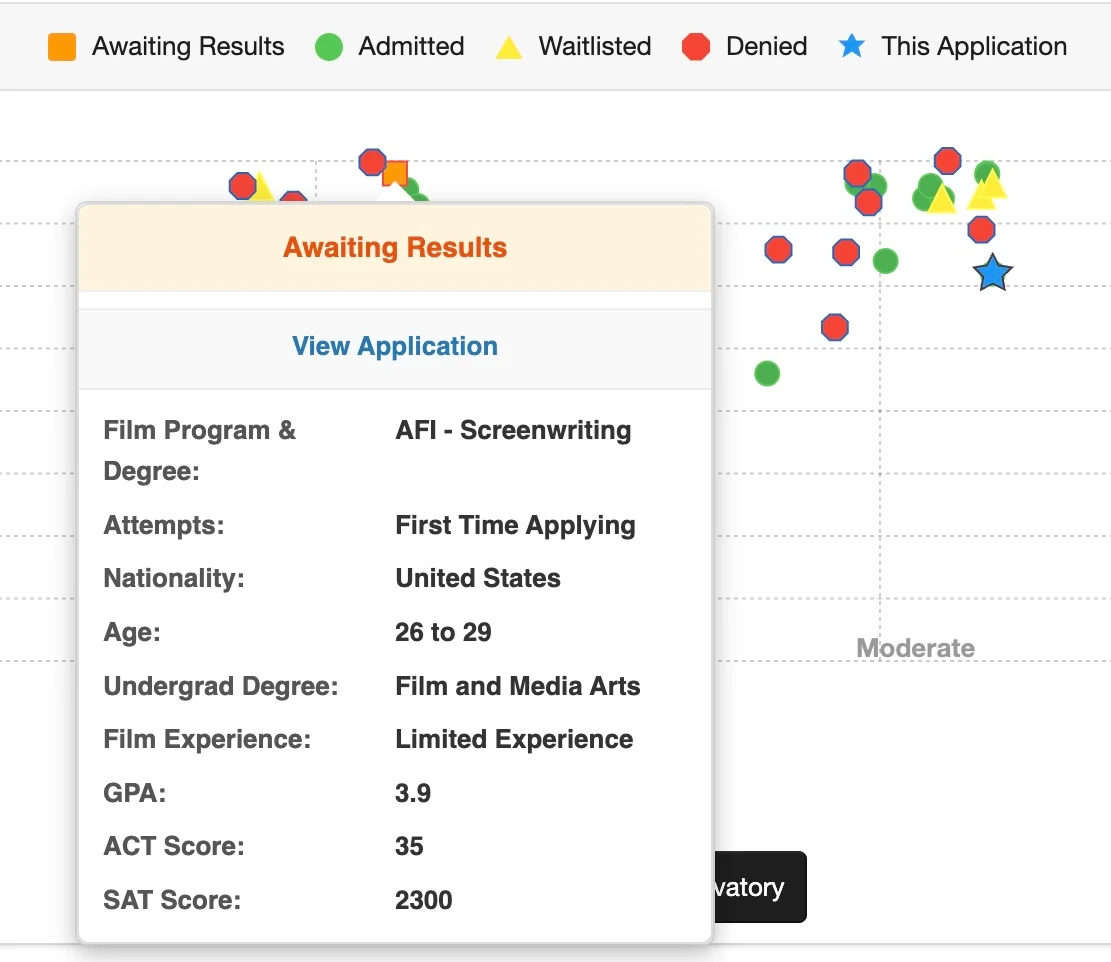
This Application in the Scattergram

Exclusive Supporting Member Benefits

Peak behind the admissions curtain. Supporting Members unlock full access to insightful data, interviews, and more...

Instant Keyword Alerts
Visible Supporter Badge & Highlighted Profile
Share Subscription with one family member or friend

Instant access • Cancel anytime

Latest Film School Reviews

  • USC School of Cinematic Arts
    5.00 star(s)
    Best Film School in the world
    I am eternally grateful to everything USC has done for me, especially as an international student; it has closed learning gaps that would have...
    • Anonymous
  • Sacred Heart University - School of Communication, Media & the Arts
    5.00 star(s)
    FTMA: Professional AND Personal Growth
    FTMA was an integral part of my development process as a filmmaker and a human being. Through this program, I learned discipline, follow-through...
    • Anonymous
  • Antioch University - Low-residency MFA in Creative Writing
    5.00 star(s)
    Great Program
    Obtaining my MFA is something that I have considered for many years. However, it never seemed like the right time. Antioch made it the right time...
    • Anonymous
  • Antioch University - Low-residency MFA in Creative Writing
    5.00 star(s)
    A Deeper layer to writing, art and connection
    Antioch's MFA in Dramatic Writing is unlike any program I've encountered. What sets it apart immediately is the mentorship model — your mentors...
    • Anonymous
  • NYFA - New York Film Academy (Los Angeles Campus)
    1.00 star(s)
    Military Avoid as if your life depends on it
    This school is a freaking NIGHTMARE. I was sexually harassed and bullied by foreigners in my class and the school took their side because they...
    • Anonymous

Latest Applications

Latest questions

Latest Articles

Latest Accepted Applications

Applications
Articles
Forums
Film Schools
Scholarships
Back
Top