• Supporting Membership Pricing Increasing on May 1 for New Subscriptions

    To continue expanding the exclusive tools, producing more in-depth interviews with admissions teams, and keeping FilmSchool.org completely ad-free and unbiased, Supporting Membership prices for new subscriptions will increase starting May 1st.

AFI 2012

Jerry Bruckheimer fan: I wasn't trying to compare myself to you, I guess I was trying to get a feel for what the Institute is looking for in terms of academics and body of film work.
 
Jerry Bruckheimer fan: can you tell me about the current class of production design fellows, as far as their backgrounds? Greatly appreciate any insight.
 
pdhopeful: All the production designers are really talented. Some have backgrounds in theater design. A couple have done costumers. One guy worked as a carpenter for a bit, too. There's another one with a background in mechanical engineering. There's a PDF of biographies for all the 1st year and 2nd year fellows. I'm not sure if I'm allowed to send that out to non-AFI people, though.

alidir08: In terms of academic background, I haven't really noticed too much of a trend. A handful of fellows have degrees in film production, but many do not. Since you're applying for directing, all I can say is that most of the directors have portfolios of work and their films aim to tell stories, first and foremost. Generally speaking, their films are well crafted and look fairly professional.
 
AFI has extended their deadlines again this year:

Cinematography and Screenwriting -
applications due by March 30.
Editing, Producing and Production Design -
applications due by May 1.
Directing is closed.

Not enough applications to have a well-balanced class, I suppose.
 
Last edited by a moderator:
Originally posted by Directnews:
When does AFI issue invitations for interviews?

I interviewed last year on January 31st, and I remember getting the call on a Friday several weeks before that so it was probably the 14th.

However, they scatter the interviews so I would not be alarmed if you don't hear anything for several months.
 
Originally posted by pdhopeful:
AFI has extended their deadlines again this year:

Cinematography and Screenwriting -
applications due by March 30.
Editing, Producing and Production Design -
applications due by May 1.
Directing is closed.

Not enough applications to have a well-balanced class, I suppose.

It's always hard to fill something like production design or editing just because not that many people want to go to graduate school in those disciplines, and so many producing applicants think (mistakenly so) that Stark is the only program just as screenwriters do with UCLA. However, I will say I'm surprised about cinematography since I don't think there's any question that it's the best program there is for that discipline (same goes with directing, which is why it's closed).
 
Last edited by a moderator:
PS: I don't think I qualified the above statements anywhere, but I am also a first year AFI fellow like JB Fan. Will try and stop by occasionally to answer people's questions, but feel free to PM me as well if you have something urgent. And good luck to everyone applying: hope to see you all on campus next fall!
 
Originally posted by Brice88:


It's always hard to fill something like production design or editing just because not that many people want to go to graduate school in those disciplines, and so many producing applicants think (mistakenly so) that Stark is the only program just as screenwriters do with UCLA. However, I will say I'm surprised about cinematography since I don't think there's any question that it's the best program there is for that discipline (same goes with directing, which is why it's closed).

But I'm curious how many applicants is their minimum or goal from which to select the 14 fellows. And if the deadline is May 1 what about the April 15 notification date for people who applied by the original deadline? Cest la vie.
 
Submitted to screenwriting, looking forward to hearing back soon. Any current fellows have particular thoughts about the screenwriting program?
 
Originally posted by BRooney:
Submitted to screenwriting, looking forward to hearing back soon. Any current fellows have particular thoughts about the screenwriting program?

Hey, good luck with your application.

I'm a first year screenwriting fellow and am happy to talk about the program (which I'm really enjoying overall). Do you have specific questions or just want a general overview?
 
Pretty much just general questions. How is the rigor of the program? Do you find yourself growing as a screenwriter? Do they help with job prospects in the second year? Do graduates leave to write for TV (if interested in TV) soon after graduation? Are you aware of fellows that sell specs while enrolled? In short, does the program leave the fellow with enough in their arsenal (knowledge, material, and business savvy) to hit the ground running upon graduation? Also, I understand many of the directing fellows write their own screenplays for their thesis films, is this a problem? Do other fellows seem eager to work with writing fellows in developing projects? I know they have to for the first year short, but how about after? Thanks for your time, much appreciated.
Originally posted by Brice88:
<BLOCKQUOTE class="ip-ubbcode-quote"><div class="ip-ubbcode-quote-title">quote:</div><div class="ip-ubbcode-quote-content">Originally posted by BRooney:
Submitted to screenwriting, looking forward to hearing back soon. Any current fellows have particular thoughts about the screenwriting program?

Hey, good luck with your application.

I'm a first year screenwriting fellow and am happy to talk about the program (which I'm really enjoying overall). Do you have specific questions or just want a general overview? </div></BLOCKQUOTE>
 
A lot of the program is what you put into it. The requirements are admittedly a bit lax relative to what I self-impose upon myself, but it isn't as if there is anything stopping me from writing more except, well, myself! I've been fortunate enough to have two incredible faculty mentors who have helped a ton, and while I can't speak from personal experience with all the screenwriting faculty I have heard very good things from my classmates. Plus these people aren't “gurus” who tell you how to write a script without ever having sold one themselves (like Syd Field or Robert McKee), but rather successful industry professionals who for the most part are currently working today.

As far as job prospects, I can't speak as much to that just because it's something they haven't told us about yet””though I know there's some kind of script showcase or pitchfest the fall after graduation. However, that doesn't mean you have to wait until then to do anything and””in answer to your question””I can give you a notable example of two fellows (one writer and one director) who sold a script while at AFI last year. If you're familiar with this year's Black List, it was the NUMBER TWO screenplay on there and now has some huge names attached to produce and direct it. Also, one of my faculty mentors sold a script she wrote when she was a second year fellow at AFI either during the year or right after graduation (can't remember which), and she parlayed that into a very successful career including having a #1 movie at the box office this past year. Oh, and there are TV classes offered as well. Several big names in current television are AFI alums.

But this is such a hard field that wherever you go there will be a lot more people who don't even try to become screenwriters after graduation than who sell something. You should choose a school based on the program itself and the faculty, because even if a school can get your work out there (which AFI will, and trust me I've already had people in the industry take me more seriously when they've learned I go there), then the work still has to stand on its own. All I can tell you at this point is that I believe my writing has improved while at AFI. Doesn't mean yours will too, or heck you might be a good enough writer that you don't even need film school. In short, YMMV.

Okay, sorry for the tangent. Let me see...I think I answered most of your questions except about thesis films and working with directors. I'll say this: it depends entirely on the director. I had a great cycle one team and, while demanding, it gave me invaluable insight into the development process and working with a director/producer. Not to compare schools, but from what I've heard you really have to seek out collaborations with other disciplines at other film schools whereas at AFI they require it. Now, I know some people who had tyrannical directors and were basically shut out entirely for their cycle films, so again YMMV. But at least by cycle two everyone has a much better idea of people's personalities, thus you know going in what kind of people you'll be working with.

All in all, I would say writers are lower on the totem pole at AFI than any other discipline except perhaps editors, but it's a pretty accurate reflection of how the industry functions and I'd rather learn to bite my tongue now than get a reputation as “difficult” around Hollywood. Basically, I like to think of film school as a "simulation" of the real world in that you can write a terrible script or make a terrible pitch and your faculty/peers can critique you in the way an exec might. You get the benefit of learning where you need to improve, but not at the cost of having people think negatively of you seeing as everyone is here to get better so we're prepared when we enter the madness that is Hollywood (and if you read about the severed head found by the Hollywood sign, you can understand why I say "madness"!).

Whew! Did that answer everything? If not, let me know. I'll try to keep responses shorter in the future so as not to hog up all the space on this board!
 
Last edited by a moderator:
Hi.

I have applied for the MFA Screenwriting program. Any idea when they start sending out invites to the interviews? They have also extended deadlines, so does this mean interviews will also happen later? The lack of sound is making me nervous.
 
Take this with a grain of salt, but my invitation came last year on what would be the equivalent of tomorrow, and I interviewed January 31st. But (a) that was the first day they interviewed people, (b) they held multiple “rounds” so as to scatter the interviews all the way until close to the March 15th notification date, and (c) the deadline was not extended past December 1st. So I'm not sure. I assume they aren't going to wait until the final deadline to start conducting interviews or even to notify applicants about their status, but at the same time do not panic even if some people start getting calls and you don't. A great thing about AFI is they are incredibly organized, and they know what they're doing when it comes to the admissions process.
 
Last edited by a moderator:
I see. I know this is awfully pessimistic of me. But could it be possible that they have extended deadlines because they haven't received any really great applications as such?
 
Brice, Thank you very much for being so thorough. I'm actually here an LA, I'd love to have an in-person chat with you if you have time in the near future. If so, you can shoot me an e-mail @ brendanrooney365@gmail.com. Thanks again.
Originally posted by Brice88:
A lot of the program is what you put into it. The requirements are admittedly a bit lax relative to what I self-impose upon myself, but it isn't as if there is anything stopping me from writing more except, well, myself! I've been fortunate enough to have two incredible faculty mentors who have helped a ton, and while I can't speak from personal experience with all the screenwriting faculty I have heard very good things from my classmates. Plus these people aren't “gurus” who tell you how to write a script without ever having sold one themselves (like Syd Field or Robert McKee), but rather successful industry professionals who for the most part are currently working today.

As far as job prospects, I can't speak as much to that just because it's something they haven't told us about yet””though I know there's some kind of script showcase or pitchfest the fall after graduation. However, that doesn't mean you have to wait until then to do anything and””in answer to your question””I can give you a notable example of two fellows (one writer and one director) who sold a script while at AFI last year. If you're familiar with this year's Black List, it was the NUMBER TWO screenplay on there and now has some huge names attached to produce and direct it. Also, one of my faculty mentors sold a script she wrote when she was a second year fellow at AFI either during the year or right after graduation (can't remember which), and she parlayed that into a very successful career including having a #1 movie at the box office this past year. Oh, and there are TV classes offered as well. Several big names in current television are AFI alums.

But this is such a hard field that wherever you go there will be a lot more people who don't even try to become screenwriters after graduation than who sell something. You should choose a school based on the program itself and the faculty, because even if a school can get your work out there (which AFI will, and trust me I've already had people in the industry take me more seriously when they've learned I go there), then the work still has to stand on its own. All I can tell you at this point is that I believe my writing has improved while at AFI. Doesn't mean yours will too, or heck you might be a good enough writer that you don't even need film school. In short, YMMV.

Okay, sorry for the tangent. Let me see...I think I answered most of your questions except about thesis films and working with directors. I'll say this: it depends entirely on the director. I had a great cycle one team and, while demanding, it gave me invaluable insight into the development process and working with a director/producer. Not to compare schools, but from what I've heard you really have to seek out collaborations with other disciplines at other film schools whereas at AFI they require it. Now, I know some people who had tyrannical directors and were basically shut out entirely for their cycle films, so again YMMV. But at least by cycle two everyone has a much better idea of people's personalities, thus you know going in what kind of people you'll be working with.

All in all, I would say writers are lower on the totem pole at AFI than any other discipline except perhaps editors, but it's a pretty accurate reflection of how the industry functions and I'd rather learn to bite my tongue now than get a reputation as “difficult” around Hollywood. Basically, I like to think of film school as a "simulation" of the real world in that you can write a terrible script or make a terrible pitch and your faculty/peers can critique you in the way an exec might. You get the benefit of learning where you need to improve, but not at the cost of having people think negatively of you seeing as everyone is here to get better so we're prepared when we enter the madness that is Hollywood (and if you read about the severed head found by the Hollywood sign, you can understand why I say "madness"!).

Whew! Did that answer everything? If not, let me know. I'll try to keep responses shorter in the future so as not to hog up all the space on this board!
 
Last edited by a moderator:
Log your film school application with our Application Database so that we can improve our admissions statistics.


Users who are viewing this thread


Latest Accepted Applications

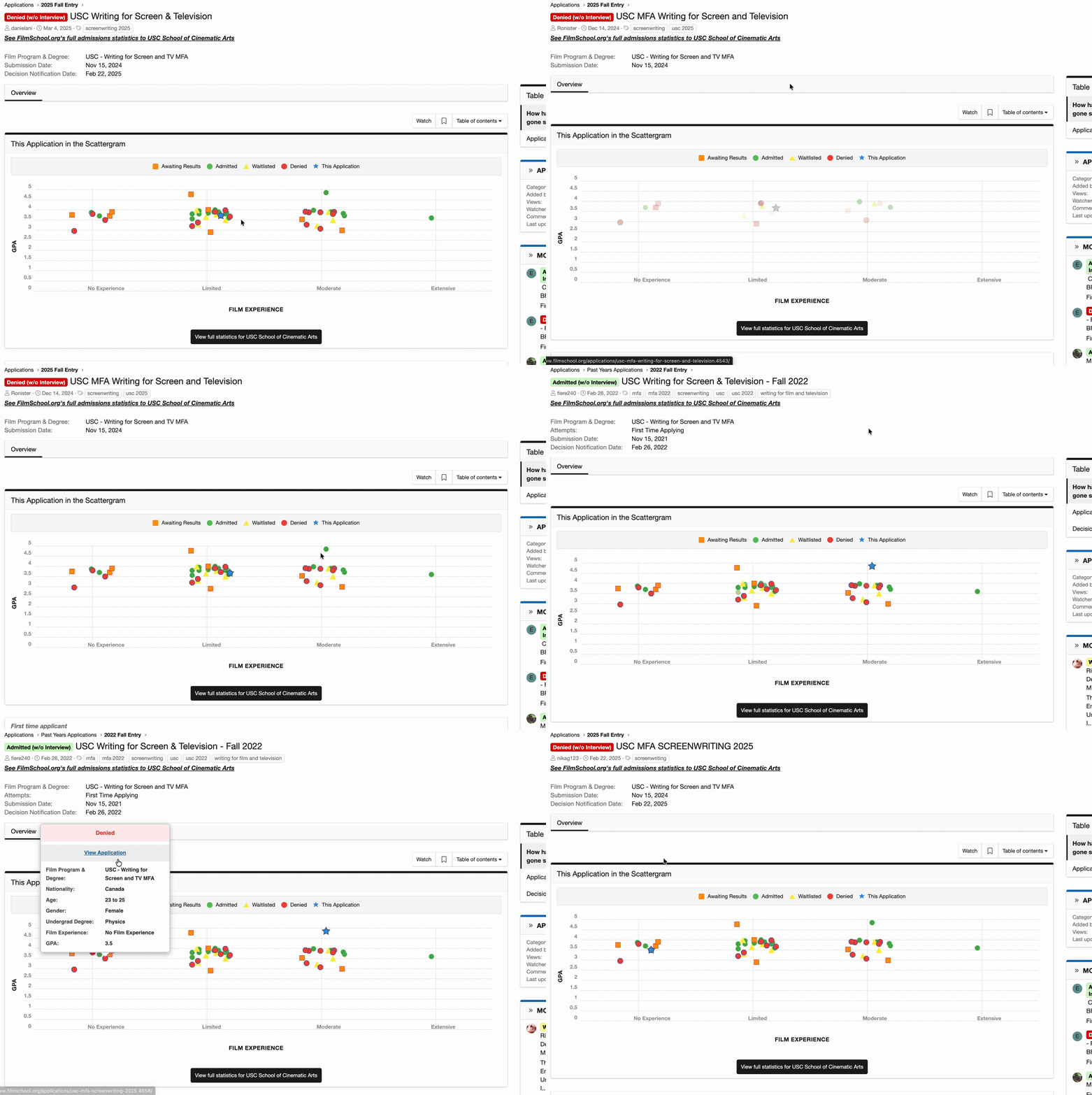
This Application in the Scattergram

Unlock Film School Admissions Insights

Stop guessing about your chances. See exactly where you stand with real data from 5,000+ applications by becoming a Supporting Member.

This Application in the Scattergram

  • See applications plotted by GPA + Film Experience
  • View real outcomes: Admitted, Waitlisted, Denied, Awaiting Results
  • Hover for full application details

+ 45 Exclusive Admissions Charts

Acceptance rates, reapplication success, interview impact, portfolio breakdowns, and more.

Instant access • Cancel anytime

Latest Film School Reviews

  • DePaul University - School of Cinematic Arts
    4.00 star(s)
    Overall good
    While I was there, parts of the directing track felt like they were still evolving, so the quality of classes was a bit uneven. Some were...
    • Anonymous
  • Stony Brook University (SUNY)
    5.00 star(s)
    Stony Brook TV Writing MFA
    I love this program so much. If you are interested in TV Writing this is the best program for it. We have incredibly talented writers and the...
    • glafmay1
  • San Diego State University - School of Theatre, Television, and Film
    3.00 star(s)
    Nothing special
    You really kind of get what you pay for with this program. It might be one of the cheapest programs out there but it’s also one of the most...
    • Anonymous
  • USC School of Cinematic Arts
    5.00 star(s)
    USC is a Lighthouse
    The School of Cinematic Arts has essentially been created in the image of a corporate film studio. Artistically successful films you make at this...
    • Anonymous
  • Full Sail University
    4.00 star(s)
    Self Motivated? You'll Do Fine
    I did the 27 month, online, Digital Cinematography Bachelor’s degree at Full Sail. It is basically a film degree with the added focus of trying to...
    • Pryde Pierce

Latest Applications

Latest questions

Latest Articles

Latest Accepted Applications

Applications
Articles
Forums
Film Schools
Scholarships
Back
Top