Working During Graduate School

TheArsenal1886

Well-Known Member
Just curious how reasonable it is to think I might be able to work while in a MFA program. I'm going to have to take out loans regardless, but I'm trying to figure out ways that I might be able to keep my borrowing as low as possible.

Does anybody have experience with this? I'd like to be able to work part-time, at least, but I also might have the opportunity to retain my current job and transfer full-time to one of our offices in LA. I tend to think it'd be a bit too much to work full-time and keep up with everything in school, but if others have succeeded in doing so, that would be ideal for me.

Additionally, what type of jobs are people working while in graduate film school?
 
I'm not sure how you'd be able to do a full time job. Unless you can telecommute and do the work late at night but I'm not sure what type of work you do or if that is even possible. When are your classes going to be? That would be the main concern as to how you can figure this out.

It's certainly doable in some form... but you'll risk burning the candle at both ends.

I totally appreciate the goal of keeping borrowing to as little as possible. That is an awesome goal. Does your current employer have any programs to help their employees go to school?
 
No, unfortunatly my current employer doesn't provide any programs for education outside our field. With the intention to schedule as many evening classes as possible and the paperless way most offices are operating now, I could forsee a situation in which it'd be possible to work remotely, but I'd also have to be afforded quite a bit of flexibility by whomever is running the office I would be transferring to in Los Angeles. That's something that's mostly out of my control, though.

I think your point about burning the candle at both ends is certainly fair, and in my mind, I expected that to be the case. I just needed to make sure it wasn't a misjudgement on my part to think it might be too much.

I suppose with the savings I've got now, and a part-time job I'll pick up (hopefully... anywhere...) I'll probably be able to subsidize my living expenses for a two year program and only have to borrow for tuition.

Other than your normal part-time jobs I'd find anywhere, are there any industry-related jobs that I could/should pursue? I'm not as naive as I am just wholly ignorant to the part-time job market in LA. Just thinking about ways I could keep moving forward, in an adjacent way, with the real goal rather than going back to waiting tables like I did in undergrad.
 
Other than your normal part-time jobs I'd find anywhere, are there any industry-related jobs that I could/should pursue? I'm not as naive as I am just wholly ignorant to the part-time job market in LA. Just thinking about ways I could keep moving forward, in an adjacent way, with the real goal rather than going back to waiting tables like I did in undergrad.

There are a ton on industry jobs in LA - part time - not so much that I know of at least. Most entry level jobs in the industry require pretty heavy hours. What are you interested in doing?
 
There are a ton on industry jobs in LA - part time - not so much that I know of at least. Most entry level jobs in the industry require pretty heavy hours. What are you interested in doing?

Hmm... That's what I figured. I'm primarily interested in writing but would be open to any part-time work even semi-related to the industry.

Do you think it'd be a better decision to find whatever I can get (waiting tables, etc.) for my first year and then try to parlay a summer internship into something during my second year?

All of this is contingent on my even being accepted, of course, but I feel like this is a pretty important thing to consider regardless.
 
Last edited by a moderator:
I would suggest that you take as many internships as you can while you're in school. Especially at places where you can show your skills off. I know a few people who have gotten a career started by aggressively going for internships that help build networks for them. This is also considering he went the producing track at Chapman. One of the few producers that actually got a job as an associate producer as soon as he graduated.
Actually, he's on this forum a few times as well, look up DJ Dodd.
in regards to actually working a paid job, if you do it, do jobs that are related to your skill set or in the part of the industry that will further your career. Don't go waiting tables or play barista at starbucks.
Also consider that if you actually go to school, work paid jobs and also internships, do not expect a social life outside your film peers. (and yes, part of this is that you also help them out in some way shape or form like being on set or other stuff because these people will be your network in the future)
 
I would suggest that you take as many internships as you can while you're in school. Especially at places where you can show your skills off. I know a few people who have gotten a career started by aggressively going for internships that help build networks for them.

Internships were a huge part for me getting my first gig. The important thing is to have drive and a good work ethic. And show up when you're supposed to and do what you're asked to do. If you have drive and a good work ethic things will usually fall into place.
 
As important and real as money is, I suppose it's more important, at this point at least, to jump in with both feet if I'm going to do this at all. I'll treat any income I can muster up as gravy and hit the internship path hard. I've been known to stretch a dollar pretty thin anyway.

Appreciate you both for your considered replies -- mighty generous of you.
 
Thanks for mentioning me, V. I can go back and forth on this topic actually. I had one internship while in grad school, but it was really more than an internship since I had a lot of opportunities to network with agents, managers, other producers, and production companies. It also lasted almost the entire two years I was in grad school.

My big thing is networking. If you have the time to work a side job and network, then definitely go for it. However, if you're not really willing to put everything into your potential career in show business, then it might be wise to reassess spending all that money on grad school. The little money to make working at Starbucks and not focusing on your career isn't really going to help you if you graduate and can't secure a job in the industry.

I know I've said this before in other posts and don't want to sound like a broken record, but if your hope is to become a producer, then find material and develop it while in grad school and then network at your internships or on your own to try and setup your developed projects. In my personal opinion, that is paramount in trying to build a new career in the entertainment industry as a producer.

Since it seems like you're more interested in writing, I would suggest writing as many marketable features as you can during your time in grad school. This is what will potentially land you a manager and/or agent and get your foot in the door. If you graduate and only have a limited number of polished scripts, you might end up working 14 hours a day as a set PA or assistant after grad school with no time to write at all. Grad school will give you a lot of free time to write. Just something to consider.

If you want to ask me any other questions, feel free. I'm happy to help.
 
Hey-- thanks, DJ. I'm indeed more interested in writing and certainly support your point about writing as much as I can in school.

You also bring up an interesting point in the last paragraph when referring to working jobs that don't afford any time to write. Are there any other jobs that anybody can think of, off the top of your heads, that might seem like they're a step in the right direction but might actually be more of a hindrance to a potential career in terms of time commitment and lack of legitimate learning opportunities available?

That's really a difficult question to answer without knowing anything specific about a student or the job in question, but I'm hoping you might have a general insight as to which types of jobs/internships are often beneficial to seek out and which ones are best to generally avoid.

Determination and ability are also variables in this discussion, but let's assume, for the sake of the argument, that one holds the requisite levels of both.
 
When I mentioned jobs in previous posts, I was referring to jobs outside the industry. If you're able to get your foot in the door while in grad school, jump on the opportunity. If you're thinking about working 40 hours a week at Starbucks while going to school, I'd advise against that. That was more of my point in the previous post.

Otherwise, an internship is less work than a job, so that won't take up all your time. You'll be working maybe three days a week. If you're talking about entry level paid work however, it will be very time consuming. As a PA, you'll usually need to show up on set first and be the last to leave, so that can easily turn into a 14 or 15 hour day after a commute. As an executive assistant, free time will also be pretty sparse.

You might be better served trying to do freelance PA and script coverage work. That way, you'll be reading a lot of scripts, which is really important for writers to do, but you'll also be able to set your own hours. If you're able to get steady freelance PA gigs a couple days a week and do coverage, you can probably make just enough money to get by, but also have the time to write. The only issue is that you'll need experience doing both those things in order to get paying gigs, so you'll need to start out as an intern first.

Regarding internships, I'd recommend getting one that requires daily coverage, so that you can get used to it and get good at it, so you can eventually get paid for it. This industry can be incredibly hard to break into because of how time consuming it can be. You can work an entry level job and have no time to write new scripts or develop projects as a producer, so you end up just working your way up from the bottom, which is one way to make it in this business. Another way is to write a lot of stuff, network, and get your work into the right hands. With some talent, a little luck, and a lot of perseverance, you could end up optioning and/or selling something and moving up really quickly.

Any entry level job though is going to be very time consuming because, in one way or another, you're supporting someone else. You're either a PA supporting development or production in one way or another or an assistant supporting an executive. There's really no way to just jump up the ranks, and an MFA won't really help with that. It can make you stand out amongst the other PAs or assistants, but no producer is going to hire you for a writing assignment or to show run a drama series because you have an MFA.

Now, I say that, but there are exceptions. If you spend your time writing, and you have the right script that gets to the right agent, manager, or producer at the right time, you could end up in a meeting and get a job as a staff writer on a series or possibly even get a writing assignment. Though, I still think it all boils down to networking, which was my initial point of the post.
 
Mount St. Mary's College has an MFA program for working professionals. It's a two year weekend program based at Hollywood Center Studios. You'll be busy as heck while juggling between school and work, but it's a good program for disciplined filmmakers. Here's a link: http://www.msmc.la.edu/graduate-programs/film-and-television.asp

As others have said, you don't need an MFA unless you see teaching in your future. Maybe best route for you is UCLA Extension classes and hit the internships HARD.
 
Hello,
I'm planing to attend Film school for MFA. I'm pretty sure it'll be dream come true but don't know if it'll worth it financially.
DJ I saw your reply and very curious on what are most directing major graduates do after grad school? A PA opportunity? Anything better?
 
Hello,
I'm planing to attend Film school for MFA. I'm pretty sure it'll be dream come true but don't know if it'll worth it financially.
DJ I saw your reply and very curious on what are most directing major graduates do after grad school? A PA opportunity? Anything better?

I know most undergraduate film majors start out as a PA or some other entry level position. I'm not sure about graduate. I assume the goal of graduate school for screenwriters would be to create a portfolio of scripts that one would then try to sell and get optioned.

I'm sure one goal of graduate directors is to have some shorts that are noticed by people.

The goal of producing graduates is to gather a portfolio of projects and talent that they can pitch with.

However, the path for editors and probably most other people in production such as cinematographers and is to start at the bottom and work up.

Hopefully during graduate school you can find yourself a team of your peers that you can partner with and ride the waves of Hollywood together.

For example, if you are interested in directing, find some producers and screenwriters that you want to collaborate with in your program and work on relationships.

Getting a job in this industry is as much about relationships as it is talent and hard work.
 
When I mentioned jobs in previous posts, I was referring to jobs outside the industry. If you're able to get your foot in the door while in grad school, jump on the opportunity. If you're thinking about working 40 hours a week at Starbucks while going to school, I'd advise against that. That was more of my point in the previous post.

Otherwise, an internship is less work than a job, so that won't take up all your time. You'll be working maybe three days a week. If you're talking about entry level paid work however, it will be very time consuming. As a PA, you'll usually need to show up on set first and be the last to leave, so that can easily turn into a 14 or 15 hour day after a commute. As an executive assistant, free time will also be pretty sparse.

You might be better served trying to do freelance PA and script coverage work. That way, you'll be reading a lot of scripts, which is really important for writers to do, but you'll also be able to set your own hours. If you're able to get steady freelance PA gigs a couple days a week and do coverage, you can probably make just enough money to get by, but also have the time to write. The only issue is that you'll need experience doing both those things in order to get paying gigs, so you'll need to start out as an intern first.

Regarding internships, I'd recommend getting one that requires daily coverage, so that you can get used to it and get good at it, so you can eventually get paid for it. This industry can be incredibly hard to break into because of how time consuming it can be. You can work an entry level job and have no time to write new scripts or develop projects as a producer, so you end up just working your way up from the bottom, which is one way to make it in this business. Another way is to write a lot of stuff, network, and get your work into the right hands. With some talent, a little luck, and a lot of perseverance, you could end up optioning and/or selling something and moving up really quickly.

Any entry level job though is going to be very time consuming because, in one way or another, you're supporting someone else. You're either a PA supporting development or production in one way or another or an assistant supporting an executive. There's really no way to just jump up the ranks, and an MFA won't really help with that. It can make you stand out amongst the other PAs or assistants, but no producer is going to hire you for a writing assignment or to show run a drama series because you have an MFA.

Now, I say that, but there are exceptions. If you spend your time writing, and you have the right script that gets to the right agent, manager, or producer at the right time, you could end up in a meeting and get a job as a staff writer on a series or possibly even get a writing assignment. Though, I still think it all boils down to networking, which was my initial point of the post.

What he said. :)

My experience getting into the industry is very much from the point of view of an editor.

For the other areas in Hollywood - DJ is spot on.

But even for an editor it really comes down to networking, hard work, and talent.

Networking to help get you jobs, hard work and talent so that you can get recommended for the next one. And so on and so on. That's really what it boils down to. Those three things.
 
The school can perhaps help facilitate this with PT work, either within the school such as in the case of work study, or via internships and external jobs they help students with via external business partnerships. You will not be able to work FT while also doing a FT MFA.

I see some people on threads here mentioning that writing students should get into doing coverage. I would be careful about that. Depending on what type of writer you are, and what your goals are, writing coverage can really kill your personal writing time. You end up spending time on other writer's work and not your own: it's not the same as pleasure or organized academic reading. Sometimes it's better to take gigs like that which are within the industry but not writing/editing specific. Background work, casting assistant… gigs that are film/TV related and allow for meeting people and learning, and that are very flexible. Paying for grad school is paying for full time hours to develop craft and your own work, and you should not split that time with anything else if possible. Otherwise, you might be better off in a full time job and a part time professional conservatory or private program/workshop. Frankly, and unfairly, anyone who isn't rich shouldn't be attending an MFA program without significant grants and other support from the university.
 
The school can perhaps help facilitate this with PT work, either within the school such as in the case of work study, or via internships and external jobs they help students with via external business partnerships. You will not be able to work FT while also doing a FT MFA.

I see some people on threads here mentioning that writing students should get into doing coverage. I would be careful about that. Depending on what type of writer you are, and what your goals are, writing coverage can really kill your personal writing time. You end up spending time on other writer's work and not your own: it's not the same as pleasure or organized academic reading. Sometimes it's better to take gigs like that which are within the industry but not writing/editing specific. Background work, casting assistant… gigs that are film/TV related and allow for meeting people and learning, and that are very flexible. Paying for grad school is paying for full time hours to develop craft and your own work, and you should not split that time with anything else if possible. Otherwise, you might be better off in a full time job and a part time professional conservatory or private program/workshop. Frankly, and unfairly, anyone who isn't rich shouldn't be attending an MFA program without significant grants and other support from the university.

Since this thread was about working during graduate school, that's why I was addressing that. Personally, I don't think anyone should work during grad school. Someone who wants to become a pro screenwriter should be writing in all their free time. Someone attempting to become a producer should be reading scripts, gathering projects, and networking. And so on.

Since this person is a potential screenwriting grad student, I was recommending jobs that I feel would be the most advantageous to strengthening his craft, while also getting paid. Screenwriters should without a doubt read as many scripts as possible and do as much coverage as possible. Knowing the marketplace by reading specs that have sold is incredibly important. Hollywood is a business. If you're a writer, but writing things that have no chance of selling or getting optioned because there's no appetite for it, you're just wasting your time. (That is, unless you're just writing for the hell of it with no intention of ever getting paid for it.)

By doing coverage, you'll learn how to analyze a script from a buyer's perspective. What makes it marketable? Are the characters likable? Is it a high concept? Is it character driven? Etc. Reading enough good material and doing enough coverage will make you a better writer without a doubt (assuming you're actually learning from doing the work).

I stand by my opinion that if you absolutely HAVE TO WORK while going to school and are trying to become a screenwriter, getting paid as a reader and for coverage is the definite way to go. But again, I'm only saying that to people who absolutely have to work while in school.
 
Log your film school application with our Application Database so that we can improve our admissions statistics.


Users who are viewing this thread


Latest Accepted Applications

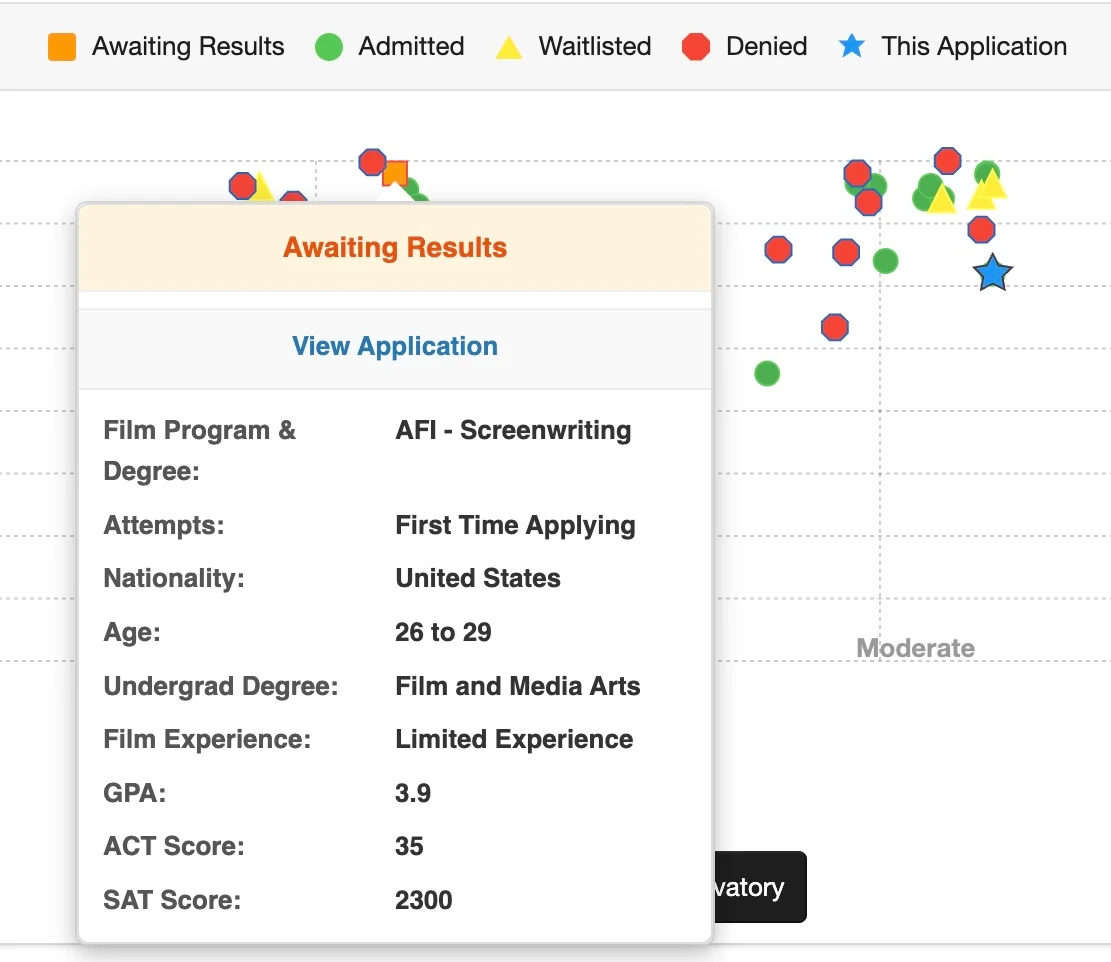
This Application in the Scattergram

Exclusive Supporting Member Benefits

Peak behind the admissions curtain. Supporting Members unlock full access to insightful data, interviews, and more...

Instant Keyword Alerts
Visible Supporter Badge & Highlighted Profile
Share Subscription with one family member or friend

Instant access • Cancel anytime

Latest Film School Reviews

Latest Applications

Latest questions

Latest Articles

Latest Accepted Applications

Applications
Articles
Forums
Film Schools
Scholarships
Back
Top