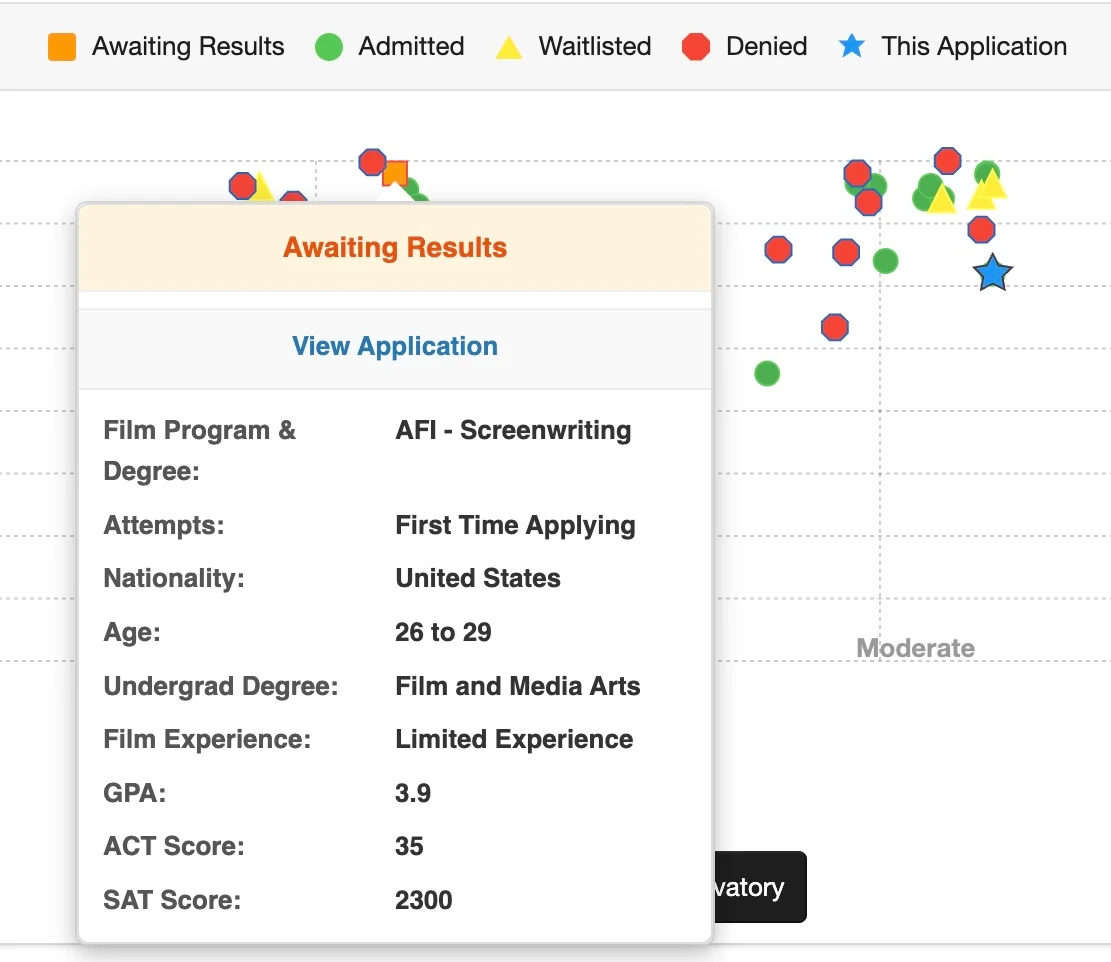
Think they all come out in one day?
Not sure.... You can check the
AFI applications in our database from previous years to see what the interview notification dates are.
BE SURE TO ADD/UPDATE YOUR APPLICATION ON FILMSCHOOL.ORG with the interview notification dates so this data is as accurate as possible.

It's a big help for future years.
More data on accepted demographics and important dates here.
Here are some of the relevant parts re interview from
our interview with AFI:
Can you give prospective AFI students an overview of the applications process?
J.M.
The first step is to apply. Then we review your application, as long as we receive all the required materials. That includes your portfolio as well as your two letters of recommendation and academic transcripts. If you're an international candidate and you received a qualifying English proficiency score, we’ll review your application, too. Like Anna said, every application is reviewed twice – sometimes three times, if there's a differing opinion between the reviewers.
The second step is the interview portion. Not everyone is invited for an interview. And then from those who have interviews, we decide who gets into AFI. The third step is the admissions selection process. We decide for applicants who have had interviews if they get into AFI, if they're on the waitlist, or if they're not selected for admissions.
What do you consider to be the most important part of the AFI application?
J.M.
We have a holistic approach to our applications review process, meaning that we look at each part of the application but not each part is weighted equally. But I would say the two most important parts are the portfolio and the narrative statement.
People tend to focus more on the portfolio but skimp on everything else, including the narrative statement. It's probably even more important than the portfolio because in the narrative statement, we're asking you to tell us your story. Who are you as a human being? What makes you laugh? Why are you passionate about filmmaking [...] and the discipline that you're applying to, specifically?
A.P.
We certainly look at experimental films [...] and documentaries, because all of that is storytelling. But you have to remember AFI is a narrative, visual storytelling school. I can't tell you how many people come into the interview portion and they're not able to share the movies and television shows they like and the kinds of stories they want to tell!
Applicants need to like come in a room and be ready to share that and be excited about storytelling. Sometimes, that's lost in the application and we wonder if they'll be happy at AFI. It's sort of like not understanding what AFI is about.
G.M.C.
I think that you should also keep in mind that there has to be a bit of a through line with what your narrative statement is telling us about who you are and what is in your portfolio. There has to be a sense of identity. You could think when you're applying to AFI that you want to be a horror filmmaker or a comedy person. Then while you're at AFI, you discover this whole other side to you – that happens all the time.
The number one thing that we don't want is for you to think that you have to put yourself in a box. People look at our alumni and they think of David Lynch. I keep mentioning him because he's probably a huge reason why people apply to AFI. He's inspired a lot of filmmakers, but some people are like, 'I have to be David Lynch in order to get into AFI.' It’s like, we had David Lynch. We don't we don't need another one!
AFI is not limited to that kind of filmmaking. If you are a dark comedy person, lean in hard into who you are […] and the kind of stories you want to tell. More than anything, have fun with it. The more you are true to yourself in that application, the more you'll stand out.
Let's say an applicant doesn't do great in the interview portion, but they're checking all the boxes for everything else. How much weight does the interview actually have?
J.M.
The interview is meant to be conversational. It's not meant to be like a job interview or like an HR interview, and I think a lot of people approach it like that. They're ready for HR-type questions, and that's not what we're going to ask. We'll talk to you about the films and scripts that you submitted, what you want to see in your future, and why you need to come to specifically AFI. I don't think that the interview is weighted more, per se. But obviously it gives us a better sense of who the applicant is and how they will be able to communicate once they're at AFI.
As Anna said, people get thrown by this question all the time, and it's interesting because they're all filmmakers. We ask them, 'What are you watching and reading right now?' and it's like everything goes out of their brains! They're like, 'Oh, I'm not sure...' So the most important thing is to just be ready to talk about yourself as a storyteller and as a person, your hopes and dreams for the future, as well as anything inspiring you at the moment.
We take everything into consideration — it's like, 'You know, I didn't love their interview, but I'm blown away by their application.' That's also a conversation as well, right? The interview is important, but it's not the be all, end all if the rest of the application is amazing and vice versa. We'll invite people for interviews when we see something in them. Maybe their narrative statement was wonderful, but their films weren't the best, so we interview them to see what they're really about.
Read more here:
Ask anyone about where to go to film school, and you’re bound to hear the American Film Institute Conservatory. First established in 1967, AFI is world renowned for producing pioneers and trailblazers in the film industry. In 2024, The Hollywood Reporter ranked AFI the no. 2 film program in the...