US film school bfa transfer VS US film graduate after finishing bfa in korea

jeongeonho

New Member
Hi guys, I'm film major (bfa)student from south korea, and now serving in korea military. (Discharge at 2025 Dec)
I've been dreamed about studying film at US, which has hollywood and such a great film industry.
So now i'm thinking about transferring to USC, Nyu, ucla film school.
But 1. high tuition and total fee cost 2. applying as an international transfer student makes me think about it seriously.

1) There's almost none scholarship for international student, so i have to pay full cost.
My parents told me not to think about money, but i still cant just let it go. (Even they can afford it, i feel it's too expensive)

2) I haven't saw student from korea uni transferring to US film school. and i heard that USC, UClA accept huge amount of student from cc, so there's not gonna have enough seats for international.
Some consultant advise me to go 1st school like CC or lower school for 1year and retransfer to usc, nyu, ucla. They say it will be more safe way. But i think it's kinda time and money waste if i cant reach there as once.

So, the planB i thought was MFA program of US film school. Thinking AFI, USC, Columbia. (Nyu, ucla is planB in this case, cause their programs are 3-year scheduled. i wanna finish in 2 years)

As this plan, I might finish my bfa in korea university, and apply to mfa right after.
This might cost way less than going bfa transfer. I'll apply for national scholarship program. (If anybody knows how many applicants get how much of scholarship when accepted, please let me know!)
But actually i haven't thought about MFA... So i dont know this choice will take worth.

Please give me some advice!
Thank you :)
 
If I speak honestly, pursuing an MFA in the United States after finishing your BFA in Korea makes more sense in your situation. Transferring into an undergraduate program at places like USC, NYU, or UCLA, Film and Television is extremely competitive, especially as an international transfer student. Many of their transfer spots are taken by students from California community colleges which naturally reduces the number of seats available for international applicants. On top of that, undergraduate tuition is very expensive and Film is not a guaranteed career path, so thinking carefully about cost is responsible, not ungrateful.

An MFA is different in tone and structure. Programs such as AFI the MFA program at USC or Columbia are designed for filmmakers who already know they are serious about their craft. Students tend to be older, more focused and more professionally driven. The conversations are different. The expectations are higher. You would not be starting from the beginning. You would arrive with a completed BFA, military experience that builds discipline and perspective, and ideally a few strong short films that reflect your voice.

There is also the matter of artistic growth. If you complete your BFA in Korea first you have time to develop your storytelling, experiment and create a portfolio that truly represents you. MFA admissions committees care far more about your creative voice and the quality of your work than about where you completed your undergraduate degree. Applying as a graduate student with a clear identity is often stronger than applying as a transfer student who is still developing.

Financially, the MFA path can also be more efficient. While still costly, it is usually shorter than undergraduate and more importantly, you would be investing in a program that functions as a professional bridge into the industry rather than repeating foundational coursework.

Timing matters as well. After finishing military service in late 2025, completing your BFA and then applying to MFA programs could place you in the United States around 2027 or 2028. That is a very normal age for graduate film students. Many filmmakers refine their voice over time. Entering an MFA with more life experience can actually strengthen your storytelling because you have more perspective to draw from.

Ultimately, this is not a choice between safety and ambition. It is a choice between immediacy and strategy. The dream of working in the American film industry does not disappear if you approach it through graduate school. In many ways, it becomes more focused and realistic. Taking the time to build your skills and clarify your artistic direction may position you much more strongly in the long run.

The fact that you are weighing these decisions carefully suggests that you are thinking like a director already. You are considering structure, resources, and long-term consequences. That kind of thinking will serve you well, no matter which path you choose.
 
Log your film school application with our Application Database so that we can improve our admissions statistics.


Users who are viewing this thread


Latest Accepted Applications

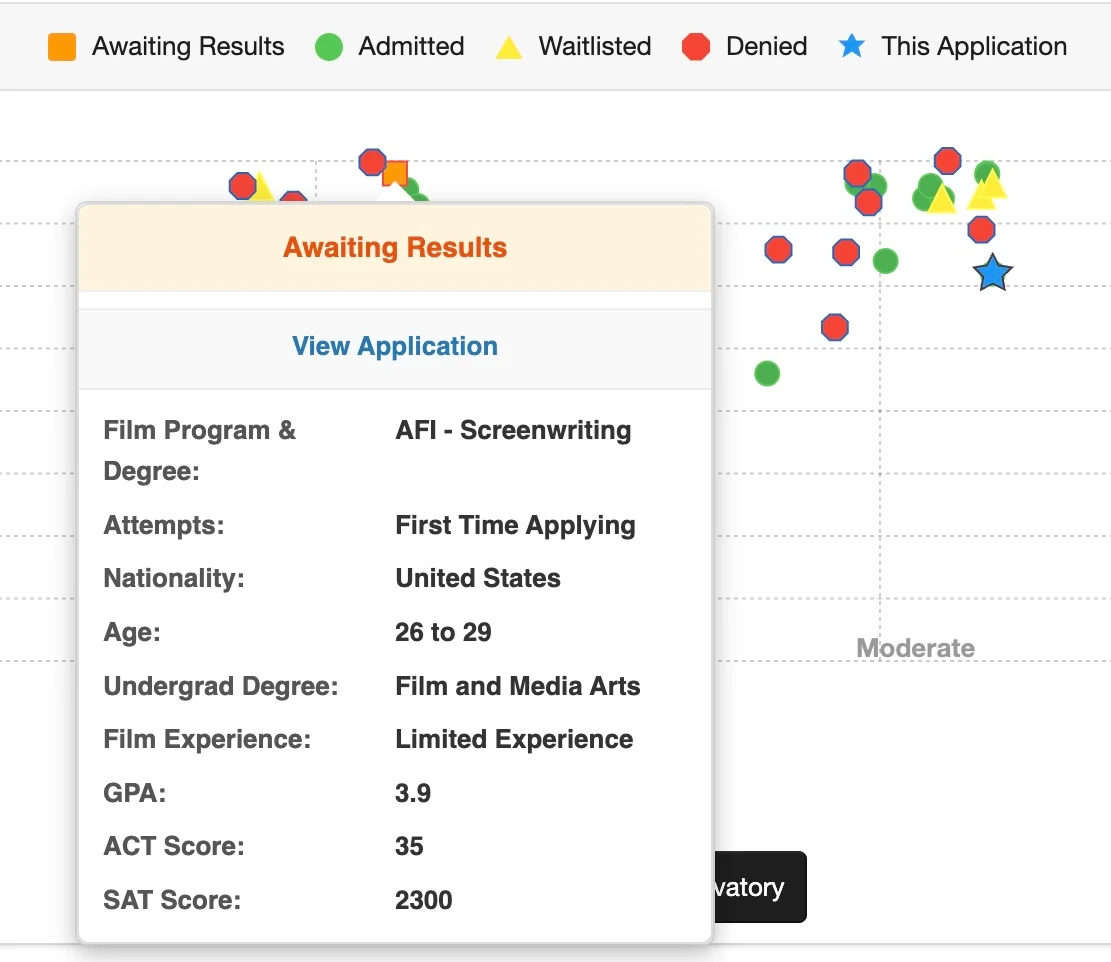
This Application in the Scattergram

Unlock Film School Admissions Insights

Stop guessing about your chances. See exactly where you stand with real data from 5,000+ applications by becoming a Supporting Member.

This Application in the Scattergram

  • See applications plotted by GPA + Film Experience
  • View real outcomes: Admitted, Waitlisted, Denied, Awaiting Results
  • Hover for full application details

+ 45 Exclusive Admissions Charts

Acceptance rates, reapplication success, interview impact, portfolio breakdowns, and more.

Instant access • Cancel anytime

Latest Film School Reviews

  • Stony Brook University (SUNY)
    5.00 star(s)
    Stony Brook TV Writing MFA
    I love this program so much. If you are interested in TV Writing this is the best program for it. We have incredibly talented writers and the...
    • glafmay1
  • San Diego State University - School of Theatre, Television, and Film
    3.00 star(s)
    Nothing special
    You really kind of get what you pay for with this program. It might be one of the cheapest programs out there but it’s also one of the most...
    • Anonymous
  • USC School of Cinematic Arts
    5.00 star(s)
    USC is a Lighthouse
    The School of Cinematic Arts has essentially been created in the image of a corporate film studio. Artistically successful films you make at this...
    • Anonymous
  • Full Sail University
    4.00 star(s)
    Self Motivated? You'll Do Fine
    I did the 27 month, online, Digital Cinematography Bachelor’s degree at Full Sail. It is basically a film degree with the added focus of trying to...
    • Pryde Pierce
  • Antioch University - Low-residency MFA in Creative Writing
    5.00 star(s)
    Invaluable Excitement
    I came into the MFA program as a novelist, with a focus on Fiction. I took the screenwriting elective that first semester, and was immediately...
    • Caledfwlch

Latest Applications

Latest questions

  • Columbia University's School of the Arts
    I am checking to see if others have received notification that Columbia’s deadline for their MFA film application has been extended until December...
    • zk-writer-01
  • Stockholm University of Arts
    Hello. I am seriously thinking about applying to SKH, but I have no idea how the application process happens. Does anyone here know that? Thanks...
    • IgorCL
  • Syracuse University
    How about now after a whole year? How are the connections plus the production side of the sets?
    • anynonmous78
  • California Institute of the Arts (CalArts)
    Does anyone know the acceptance rate for the MFA in PFV and/or the Film Directing programs? Im thinking of applying for 2026
    • reproducibility_
  • NYU Tisch Kanbar Institute of Film & Television
    Hey there! I'm considering applying for 2026 class, and was wondering about the 120pg guideline, is it expected we hit 120pages for the full...
    • PATTY E

Latest Articles

Latest Accepted Applications

Applications
Articles
Forums
Film Schools
Scholarships
Back
Top